Climate, Pandemics and Artificial Intelligence: The Global Dangers Facing Humanity
Can Humanity Avoid Catastrophe? Scientists Map 17 Threats to the Year 2100
Artificial intelligence, nuclear conflict and climate change are among 17 major threats identified in a new Lancet assessment, warning that decisions made today could shape humanity’s health, and, in the worst-case scenarios, its survival, for generations to come.
BEIRUT, October 13, 2026
Humanity’s future may not hinge on a single crisis, but on a series of interconnected threats that could amplify one another with devastating consequences. From the rapid development of artificial intelligence to the specter of nuclear conflict and the accelerating climate crisis, the risks facing the world extend far beyond national borders and could shape global health for the rest of the century.
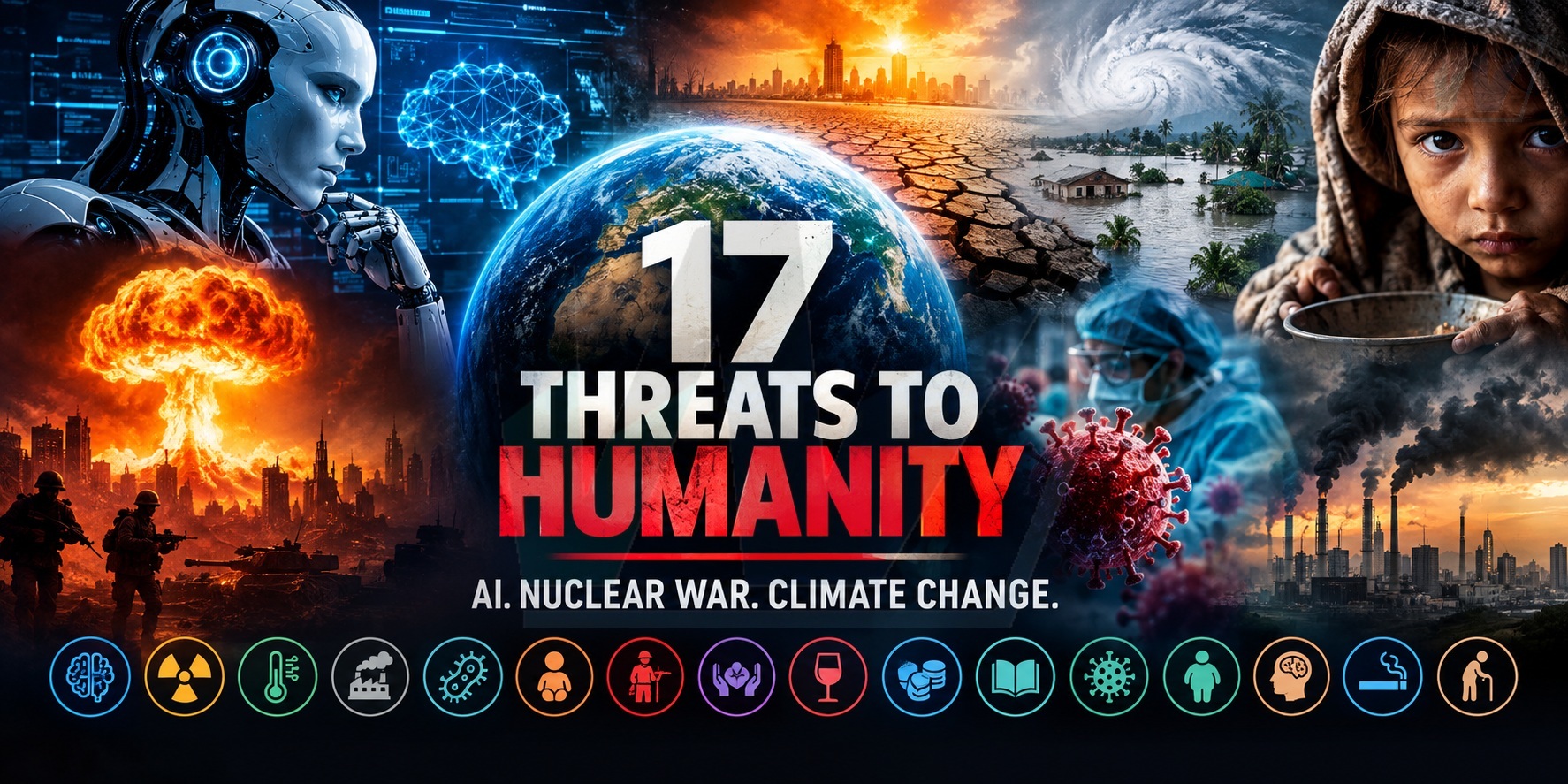
A new assessment by The Lancet Commission on 21st-Century Global Health Threats identifies 17 major threats that could undermine human health through 2100, placing the malicious use of artificial intelligence and nuclear war among the dangers with the potential to threaten humanity’s very survival.
But the report’s central message is not that catastrophe is inevitable. It is that early action could change the outcome.
AI and Nuclear War: Risks That Could Escalate Beyond Control
Among the most alarming scenarios is the possibility that artificial intelligence could be weaponized for destructive purposes, including assistance in developing biological weapons capable of causing widespread harm.
The concern is not technology itself, but the possibility that increasingly powerful tools could be exploited for hostile purposes, creating threats that are difficult to contain once unleashed.
Nuclear war presents a different but equally devastating danger. Beyond the immediate destruction and mass casualties, a large-scale nuclear conflict could send enormous quantities of particles and smoke into the upper atmosphere, blocking sunlight, disrupting temperatures and undermining agricultural production.
The resulting collapse in food supplies could trigger widespread famine, potentially affecting populations far removed from the battlefield.
The assessment acknowledges that such catastrophic scenarios are considered unlikely. Yet their potential consequences are so severe that even a low probability demands serious preparation.
The year 2100 is not a predicted deadline for humanity’s extinction. It is the time horizon researchers use to examine how global threats could evolve and what can be done to reduce their impact.
The 17 Threats Identified by Researchers
The assessment extends well beyond warfare and emerging technologies. Its list brings together interconnected health, environmental, social and economic challenges that could undermine human well-being over the coming decades.
The 17 threats are:
- Malicious use of artificial intelligence.
- Nuclear conflict.
- Climate change.
- Air pollution.
- Antimicrobial resistance.
- Child malnutrition.
- Conventional armed conflict.
- Declining international development and health assistance.
- Excessive alcohol consumption.
- High blood pressure.
- Income inequality.
- Low educational attainment.
- Naturally emerging epidemics.
- Obesity.
- Mental health disorders.
- Smoking.
- Unhealthy ageing.
These threats do not operate in isolation. Climate change can intensify food insecurity, armed conflicts can overwhelm already fragile health systems, and cuts to international assistance can weaken countries’ ability to prevent and contain epidemics.
The danger lies not only in the individual threats, but also in the way they can reinforce one another.
Climate Change and Health Aid: Billions of Healthy Years at Stake
The assessment’s modelling highlights the enormous human cost of delaying action and the potential benefits of choosing a different course.
According to the reported findings, limiting global warming to approximately 1.8°C, rather than allowing temperatures to rise to 4.4°C, could avert the loss of around 1.89 billion healthy life-years by 2100.
The implications of a sharp decline or potential collapse in international health assistance are equally troubling. Such a scenario could result in the loss of up to 1.5 billion healthy life-years over the same period, with approximately 70% of those losses occurring in sub-Saharan Africa.
The figures underscore the unequal distribution of global health risks.
In higher-income economies, obesity and mental health disorders account for significant health burdens. In lower-income regions, limited educational opportunities, child malnutrition and weaker access to essential health services can contribute more heavily to preventable illness and premature death.
The message is clear: the consequences of global crises will not be shared equally, and the countries least equipped to respond may face some of the greatest losses.
How Did Researchers Measure the Risks?
To compare threats with very different causes and consequences, the researchers used disability-adjusted life years, or DALYs a standard public-health measure that estimates healthy years lost through illness, disability and premature death.
The assessment drew on data and modelling covering 204 countries and territories, examining potential trajectories between 2025 and 2100.
Rather than simply listing dangers, the approach seeks to estimate the scale of health losses associated with different scenarios and identify how much suffering could be avoided through effective interventions.
According to The Guardian’s report, 35 experts contributed to the assessment. Its findings are intended to be updated annually as new evidence emerges and the global risk landscape changes.
This continuing reassessment is important because threats evolve. Technological breakthroughs can create new vulnerabilities, climate impacts can intensify, and geopolitical developments can rapidly change the likelihood or severity of a crisis.
From Warning to Prevention: Will Governments Act in Time?
The researchers are calling on governments to treat these threats as interconnected challenges spanning public health, technology, economics, the environment and international security, not as isolated problems for separate institutions to address.
Their recommendations include investing in responsible technological innovation, strengthening health systems, improving epidemic preparedness, monitoring emerging risks and committing the financial and human resources needed to prevent crises before they escalate.
Christopher Murray, co-chair of the commission and director of the Institute for Health Metrics and Evaluation at the University of Washington, has emphasized the lasting consequences of decisions made by today’s leaders for the health and well-being of future generations.
The challenge is particularly urgent as technological advances accelerate while environmental pressures and geopolitical tensions continue to test international cooperation.
No single government can eliminate every threat. But coordinated action can reduce vulnerabilities, strengthen resilience and prevent manageable risks from developing into disasters.
The Defining Question: Can the World Prevent What It Can Already See Coming?
The assessment presents a stark choice. Humanity cannot predict every crisis, and not every catastrophic scenario can be eliminated. Yet many of the conditions that magnify global risks can be addressed before the consequences become irreversible.
The response will require more than warnings. It will demand sustained investment, international cooperation, scientific monitoring and political decisions that prioritize long-term resilience over short-term gains.
The greatest danger may not be the existence of 17 threats to humanity. It may be failure to act while there is still time to prevent them from becoming catastrophes.
The future is not predetermined. The decisions made today could determine how much of that future remains within humanity’s control.