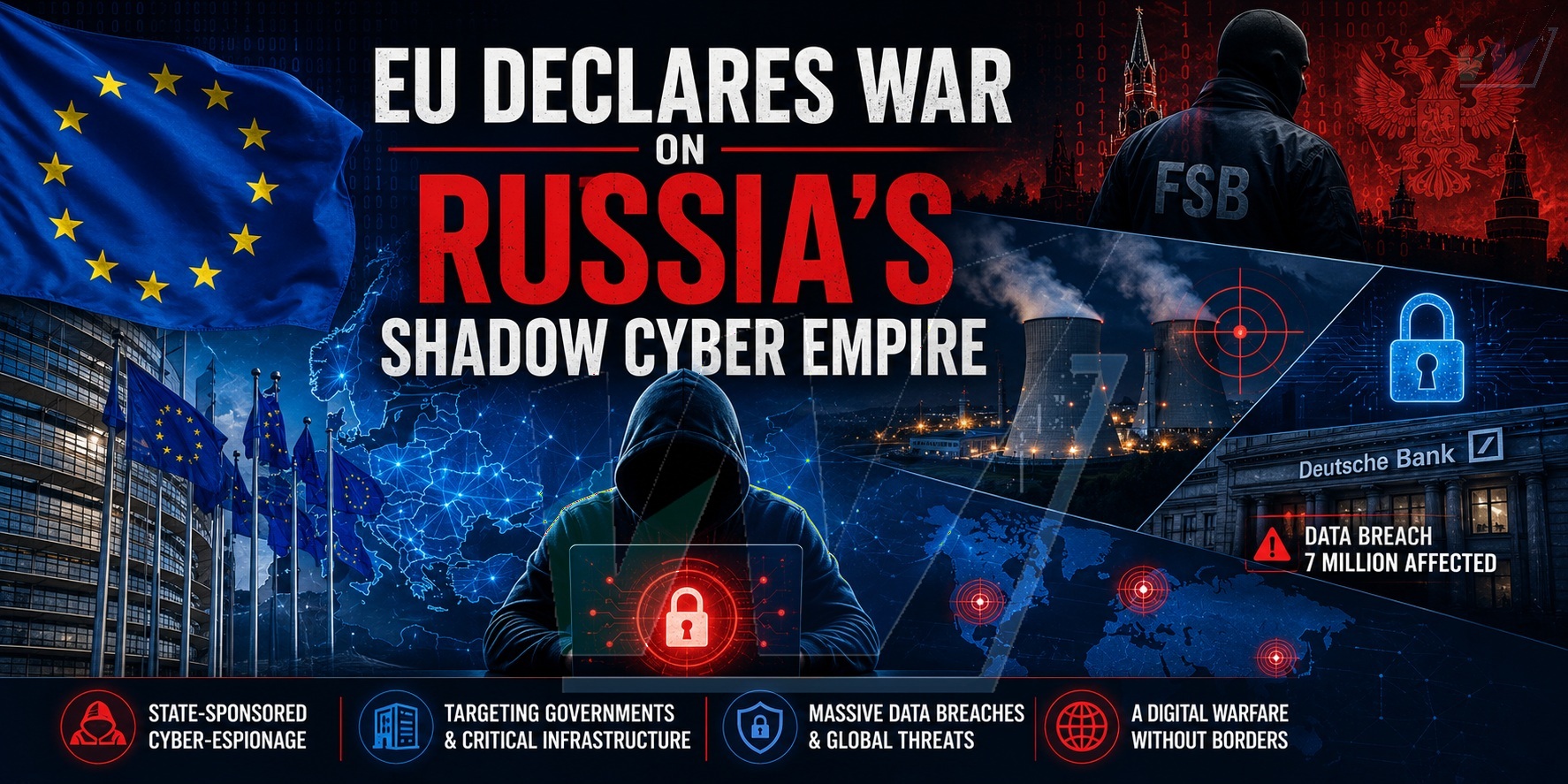
Brussels Exposes Vast Kremlin-Linked Espionage Network as Critical Infrastructure, Governments and Global Corporations Face Escalating Digital Attacks
BRUSSELS —
Europe has pulled back the curtain on what officials describe as one of the most sophisticated cyber-espionage ecosystems ever uncovered on the continent.
After years of classified investigations, intelligence sharing and forensic analysis, the European Union and multiple member states have publicly accused Russia’s Federal Security Service (FSB) of directing an extensive cyber campaign targeting governments, military institutions, critical infrastructure and strategic industries across Europe.
The coordinated disclosure marks one of the strongest public condemnations yet of Russian state-sponsored cyber operations and reflects growing concern that cyberspace has become a permanent battlefield alongside conventional military conflict.
Security officials warn that the campaign extends far beyond espionage. It includes long-term infiltration of government networks, cyber reconnaissance against energy systems, attempts to compromise industrial infrastructure and persistent efforts to steal sensitive political, military and technological intelligence.
The Shadow Network Behind the Attacks
According to European cybersecurity agencies and intelligence officials, much of the activity has been linked to elite Russian hacking groups widely associated with the FSB, including the notorious Turla cyber-espionage operation, also known in cybersecurity circles as Snake, Uroburos, or Venomous Bear.
For more than two decades, Turla has been regarded by Western intelligence agencies as one of Russia’s most advanced cyber units.
Unlike financially motivated ransomware gangs, their primary mission is intelligence collection.
Investigators say the group’s operations typically unfold over months, or even years, allowing attackers to quietly penetrate networks, establish persistence, steal classified information and move laterally through compromised systems while avoiding detection.
European officials argue that recent investigations demonstrate that these operations remain active despite years of sanctions, indictments and international law-enforcement actions.
Governments and Critical Infrastructure in Crosshairs
Officials say the campaign targeted a broad range of high-value institutions across Europe.
Among the countries reporting significant malicious activity are:
- France
- Germany
- Poland
- Slovakia
- Finland
According to investigators, the attacks focused on:
- Government ministries
- Defense contractors
- Foreign affairs departments
- Military suppliers
- Research institutions
- Combined heating and power plants
- Critical infrastructure operators
- Strategic technology companies
Cybersecurity experts note that attacks against energy facilities are especially concerning because they may provide valuable intelligence for future disruption during geopolitical crises.
Although European officials have not publicly disclosed evidence that widespread physical sabotage occurred, they warn that reconnaissance inside industrial systems can lay the groundwork for future cyberattacks capable of interrupting essential services.
A New Era of Hybrid Warfare
European security analysts increasingly describe Russia’s cyber strategy as part of a broader doctrine of hybrid warfare.
Rather than relying solely on conventional military force, Moscow is accused of combining cyber operations with espionage, disinformation campaigns, political influence efforts, economic pressure and strategic intelligence gathering.
Since Russia’s full-scale invasion of Ukraine, Western governments have repeatedly warned that cyber activity targeting NATO and European institutions has intensified.
Officials believe many cyber campaigns are designed not only to gather intelligence but also to test vulnerabilities that could be exploited during future geopolitical confrontations.
Australia Warns of Parallel Global Cyber Campaign
The European disclosures coincided with a separate warning from the Australian Cyber Security Centre (ACSC).
Australian authorities reported that cybercriminals and state-linked actors are actively exploiting vulnerabilities in widely used Content Management Systems (CMS) to gain unauthorized access to websites and organizational networks.
Officials urged organizations worldwide to:
- Immediately install available security patches.
- Enable multi-factor authentication.
- Review administrator accounts.
- Monitor for suspicious network activity.
- Strengthen incident response procedures.
The warning underscores a growing concern among cybersecurity agencies that attackers are increasingly exploiting unpatched internet-facing systems before organizations have time to respond.
Corporate America and Europe’s Financial Sector Under Pressure
The surge in state-sponsored cyber activity comes as major corporations continue facing significant cybersecurity incidents.
Among the most notable disclosures this week:
AssuranceAmerica Data Breach
U.S.-based insurance provider AssuranceAmerica disclosed a cyber incident affecting approximately seven million individuals.
The company said the breach involved sensitive personal information, prompting investigations, customer notifications and regulatory reporting requirements.
Security specialists continue working to determine the full scope of the compromise and whether any stolen information has appeared on criminal marketplaces.
Hackers Claim Deutsche Bank Breach
Meanwhile, cybercriminals claimed responsibility for a breach involving Deutsche Bank, one of Europe’s largest financial institutions.
The bank has been investigating the claims while cybersecurity teams assess whether any internal systems or customer information were compromised.
As of now, public reporting indicates that the full extent and authenticity of the hackers’ claims remain under investigation.
Financial institutions across Europe remain on heightened alert amid increasing attacks targeting banks, payment systems and financial technology providers.
The Expanding Cyber Battlefield
The latest developments illustrate how today’s cyber conflicts increasingly blur the line between national security and economic security.
Governments now face simultaneous threats from:
- State-sponsored espionage.
- Financially motivated cybercriminals.
- Ransomware organizations.
- Supply-chain compromises.
- Artificial intelligence-assisted cyberattacks.
- Disinformation operations.
- Infrastructure sabotage.
Security experts warn that many sophisticated campaigns involve cooperation between intelligence agencies, proxy hacker groups and criminal organizations, making attribution significantly more complex than in previous decades.
Why Critical Infrastructure Has Become the Prime Target
Power grids, transportation systems, telecommunications networks, healthcare providers and industrial control systems have become attractive targets because they represent the backbone of modern economies.
Unlike traditional cybercrime focused on financial theft, attacks against infrastructure may provide strategic leverage during diplomatic crises or military confrontations.
European intelligence officials increasingly view cyber resilience as an essential component of national defense.
That shift has accelerated investments in:
- Zero-trust cybersecurity architecture.
- Threat intelligence sharing.
- Industrial control system protection.
- Artificial intelligence-based threat detection.
- Joint NATO-EU cyber exercices.
- Public-private cybersecurity partnerships.
Europe’s Message to Moscow
The coordinated attribution by the European Union represents more than a technical cybersecurity announcement.
It is also a geopolitical signal.
By publicly naming Russian intelligence services and exposing their alleged cyber ecosystem, Brussels is attempting to increase diplomatic pressure, strengthen collective defense and demonstrate unity among member states.
Whether such public attribution deters future cyber operations remains uncertain.
Historically, Russian-linked hacking groups have continued operating despite sanctions, criminal indictments and repeated international exposure.
The Digital Cold War Is Accelerating
Cybersecurity experts increasingly describe today’s global environment as a digital Cold War, where espionage, infrastructure attacks, artificial intelligence, satellite communications and cyber operations have become central instruments of geopolitical competition.
From government ministries in Europe to multinational corporations in North America and financial institutions across the globe, virtually every connected network has become part of an expanding battlefield.
The latest disclosures from Brussels serve as another reminder that modern conflicts are no longer fought solely with soldiers, missiles or tanks.
Increasingly, they unfold silently, through malicious code, hidden malware, stolen credentials and invisible networks operating deep inside the world’s digital infrastructure.
As geopolitical tensions continue to intensify, governments and businesses alike face a stark reality: the next major international crisis may begin not with an explosion, but with a cyber intrusion that no one sees until it is already too late.