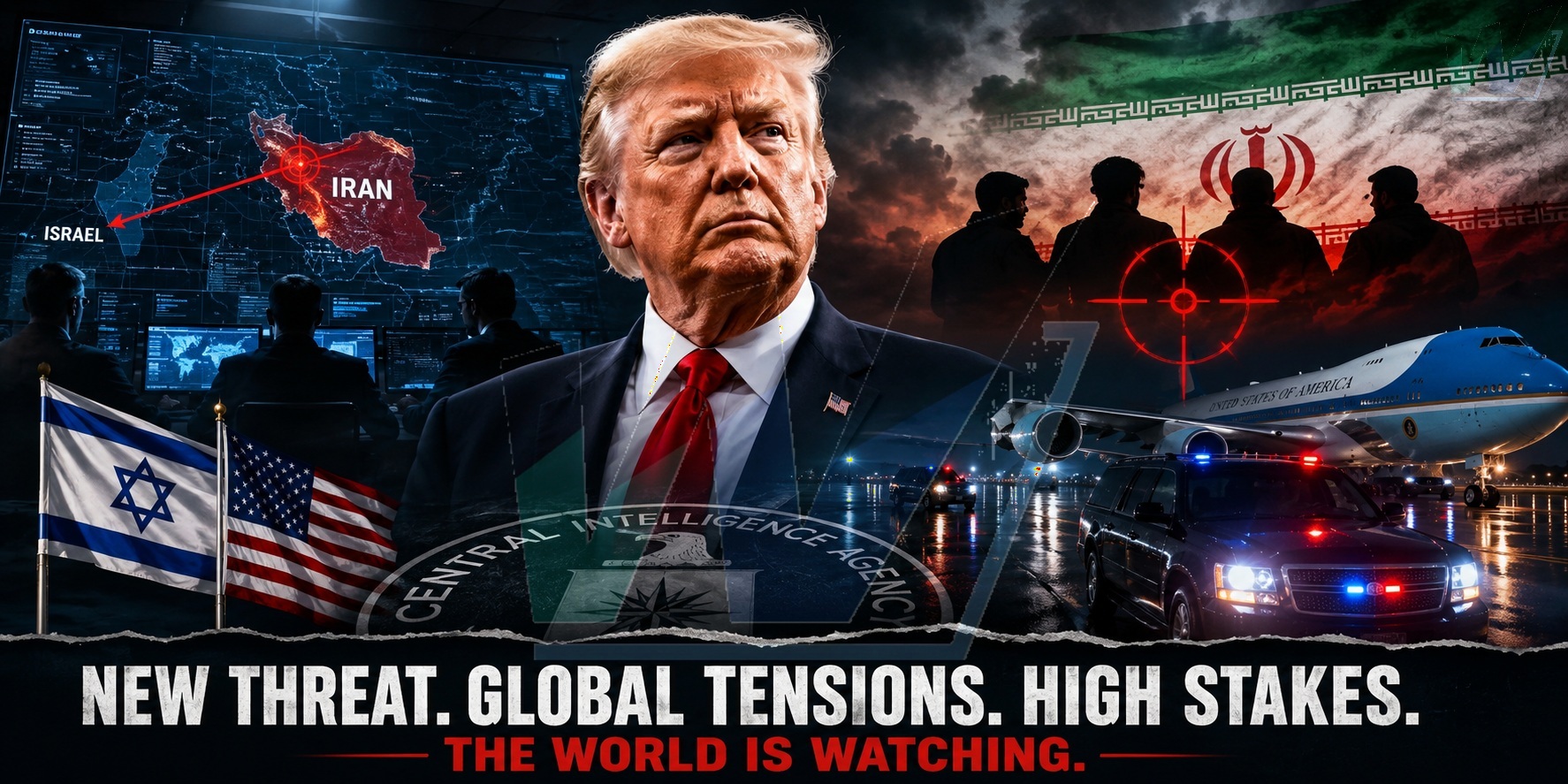
Intelligence Warning Sparks Global Alarm as Reports Emerge of a New Iranian Plot Against Trump
Washington, Jerusalem, Tehran —
The message arrived quietly.
No public announcement.
No emergency press conference.
Just a classified intelligence warning passed between allies at a moment when the Middle East was already standing on the edge of a wider confrontation.
Then the leaks began.
Within hours, reports from Washington, Jerusalem, and New York revealed a stunning claim: Israeli intelligence had allegedly informed the United States that Iran had developed a fresh plan targeting President Donald Trump.
Suddenly, a threat that many believed belonged to the past was back at the center of global attention.
And this time, the stakes may be even higher.
A Warning from the Shadows
According to reports first published by The Wall Street Journal and later echoed by Fox News, The New York Post, The Jerusalem Post, and other outlets, Israeli intelligence recently shared information with U.S. officials indicating that Tehran may have revived efforts to target Trump. The intelligence reportedly emerged amid escalating tensions between Iran, Israel, and the United States across multiple fronts in the region.
While American officials have not publicly released evidence supporting the allegation, sources familiar with the intelligence reportedly described the warning as serious enough to trigger immediate review by U.S. security agencies.
The reports have not been independently confirmed by U.S. intelligence agencies, and Iran has not acknowledged any such operation.
Yet the warning has reignited one of the longest-running vendettas in modern geopolitics.
The Ghost of Soleimani
To understand why the allegation matters, one must return to a cold January night in 2020.
That was when a U.S. drone strike near Baghdad International Airport killed General Qassem Soleimani, commander of Iran’s elite Quds Force and one of the most influential military figures in the Islamic Republic’s history.
The operation was authorized by President Trump.
For Tehran, Soleimani’s death was not merely a military loss.
It was national humiliation.
Since then, Iranian officials and state-linked figures have repeatedly vowed that those responsible would eventually face justice.
Over the years, American intelligence agencies have warned of potential Iranian efforts to target current and former U.S. officials linked to the operation. Several criminal cases and investigations in the United States have alleged connections between Iranian operatives and murder-for-hire schemes directed at Trump and other senior officials, allegations consistently denied by Tehran.
The President Who Knows He’s a Target
Trump himself has spoken openly about the threat.
During recent appearances following international meetings, he acknowledged that Iran has long viewed him as a primary target, while insisting that American security services remain vigilant. Reports indicate that some travel and security arrangements were adjusted after the latest intelligence warning surfaced, although officials have not publicly confirmed operational details.
Behind the scenes, current and former security officials describe the challenge as unique.
Protecting a president is difficult.
Protecting a president against a state-backed adversary seeking revenge years after the original event is something else entirely.
A Region on Fire
The alleged assassination threat emerges against the backdrop of a rapidly escalating confrontation between Iran, Israel, and the United States.
Recent military exchanges in the Gulf, clashes around the Strait of Hormuz, attacks on military infrastructure, and retaliatory threats from both sides have dramatically increased tensions. Analysts warn that even an unverified intelligence report can have enormous geopolitical consequences when the region is already operating under crisis conditions.
Israeli officials have remained largely silent regarding the specific intelligence disclosures.
Iranian authorities have likewise refrained from commenting directly on the latest allegations.
That silence has only fueled speculation.
Fact, Intelligence, and Uncertainty
What is known?
Israeli intelligence reportedly provided the United States with information describing a new threat against Trump. Multiple major outlets have confirmed that such intelligence sharing took place.
What is not known?
No government has publicly released evidence proving the existence of an operational assassination plan.
No arrests connected to the alleged new plot have been announced.
No intelligence agency has publicly verified the details contained in the reported warning.
For now, the story remains an intelligence assessment rather than a proven operation.
But intelligence assessments have often been the first signs of far larger events to come.
The Most Dangerous Possibility
Security experts note that modern state-sponsored operations rarely resemble Hollywood scenarios.
The greatest danger is not necessarily a dramatic attack.
It is uncertainty.
The uncertainty that forces governments to shift resources.
The uncertainty that changes diplomatic calculations.
The uncertainty that can alter the decisions of military commanders and political leaders.
Whether the reported Iranian plan is active, preliminary, exaggerated, or entirely unworkable, it has already achieved one objective:
It has captured the attention of Washington.
And when the world’s most powerful nation begins treating a threat seriously, the consequences extend far beyond the individual being protected.
The Next Move
Tonight, intelligence analysts in Washington are examining reports.
Security teams are reassessing risks.
Diplomats are watching Tehran.
And across the Middle East, a question hangs in the air:
Was this merely another warning in a decades-long shadow war?
Or is the world witnessing the opening chapter of a new confrontation between Iran and the man who ordered the strike that changed the region forever?
The answer may remain hidden in classified files.
For now.
But history suggests that in the Middle East, the most consequential battles often begin long before the first shot is fired.