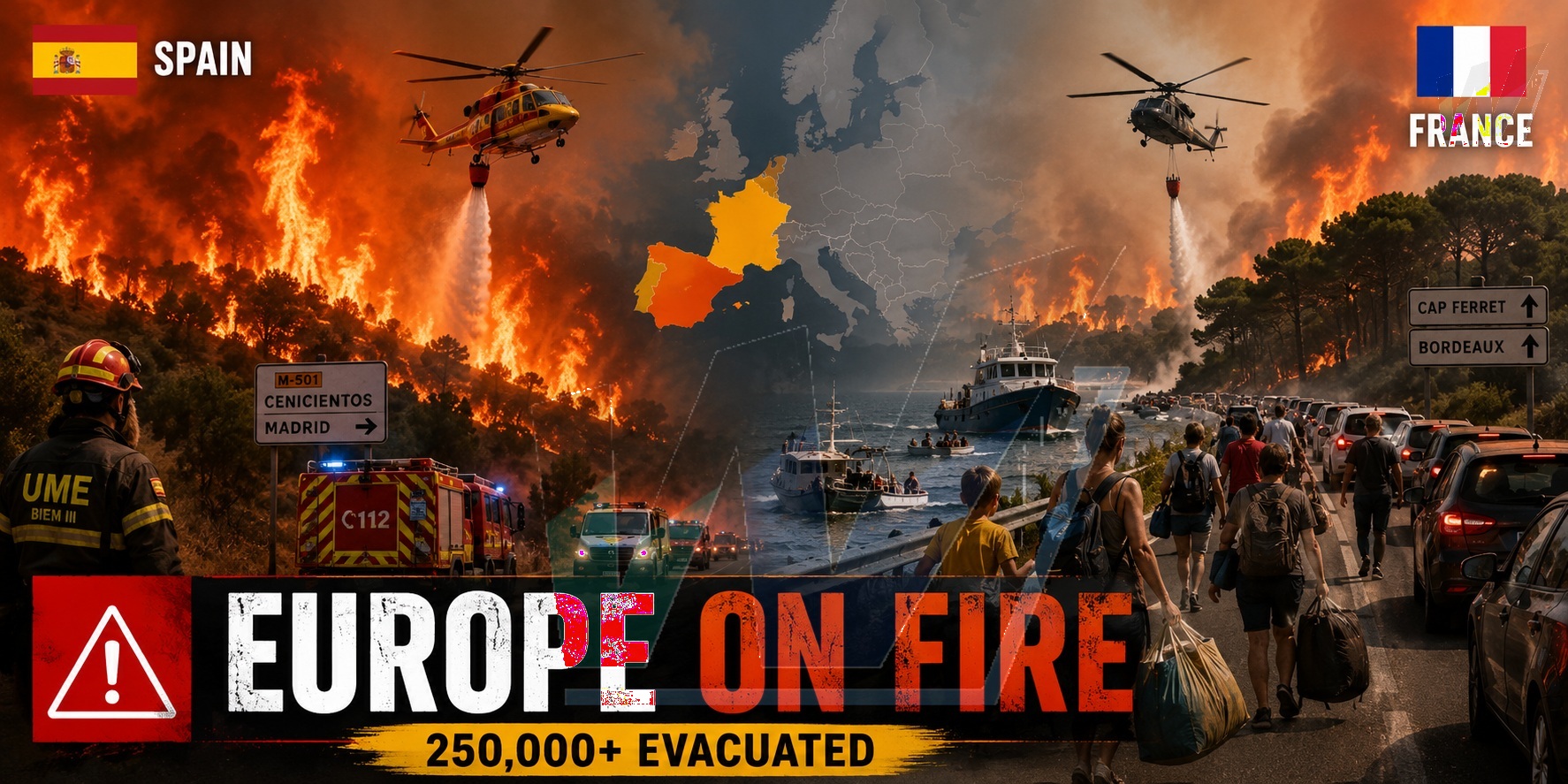
Europe on Fire: More Than 250,000 Evacuated as Uncontrollable Wildfires Tear Through Spain and France
The fire lines are spreading faster than authorities can contain them.
From the forests west of Madrid to the Atlantic coast near Bordeaux, Spain and France are battling a wildfire emergency of historic proportions, with more than 250,000 people evacuated or forced to flee their homes and holiday destinations as extreme heat, drought and erratic winds turn vast areas of southern Europe into a tinderbox.
Spain has declared a national emergency over fires threatening communities in the Madrid region and neighboring Ávila province. France, facing its own unprecedented wildfire crisis, has mobilized military forces and appealed for international assistance.
The crisis has rapidly evolved from a series of local fires into a cross-border European emergency, stretching the resources of firefighters, emergency services and national governments to their limits.
Spain: Fires Merge Near Madrid as Winds Threaten a New Explosion
Near the Spanish capital, firefighters are battling a massive and highly unpredictable blaze formed after separate fires merged west of Madrid.
Carlos Novillo, the Madrid region’s emergency management chief, warned that the fire had reached a point “beyond the capacity” of firefighters to contain, with shifting winds threatening to push the flames into new communities.
Spanish authorities said tens of thousands of people had been evacuated from the Madrid and Ávila areas. Fires have consumed enormous stretches of land, while the danger remains highly volatile despite a decline in temperatures.
The Spanish government declared a national emergency after several fires erupted simultaneously under adverse weather conditions, forcing the mobilization of resources from national, regional and local authorities. The operational command was handed to Spain’s Military Emergency Unit, the UME.
Prime Minister Pedro Sánchez warned that the battle ahead would be difficult.
The immediate priority, he said, was not simply to save forests, but to save lives and protect inhabited areas.
That concern has become increasingly urgent as the fires move through dry vegetation and mountainous terrain, where wind direction can change with little warning.
France: The Atlantic Coast Becomes an Evacuation Zone
Across the border, the crisis has taken an equally dramatic turn.
In southwestern France, fires have devastated areas around Gironde and Landes, forcing the evacuation of tens of thousands of residents and tourists.
The famous Cap Ferret peninsula, a major Atlantic holiday destination known for its beaches, luxury homes and tourist resorts, was evacuated as flames approached the region’s main access route.
Some residents escaped by road. Others were taken away by boat.
The evacuation unfolded village by village as authorities attempted to move people out of the path of a rapidly advancing fire. Thousands were also evacuated from suburbs around Bordeaux, including Le Haillan, Eysines and Mérignac.
French officials described the scale of the fires as unprecedented. The country has deployed military personnel, specialized aircraft and additional firefighters, while the government has sought broader European assistance.
The crisis has also carried a heavy human cost for emergency crews. France’s National Gendarmerie reported that two firefighters died while battling a violent blaze near Bordeaux-Mérignac earlier in the week.
Europe Mobilizes as National Resources Come Under Pressure
The scale of the crisis has triggered a wider European response.
The European Union has prepared its largest wildfire response operation to date for the 2026 summer season, with 777 firefighters from 14 countries pre-positioned in high-risk areas and a fleet of 22 firefighting aircraft and five helicopters available for emergency support.
The EU’s rescEU system is designed to help when national firefighting capacity is overwhelmed.
European countries including Italy, Greece, the Netherlands, Portugal, Croatia and Slovakia have contributed personnel or aircraft to support the response to the continent’s worsening wildfire crisis.
The scale of the emergency is revealing a new reality: wildfires are no longer isolated national disasters. They are increasingly becoming a continental crisis requiring cross-border coordination.
The Numbers Behind the Inferno
The fire crisis is unfolding against an already extraordinary wildfire season across Europe.
According to the EU’s Copernicus and EFFIS monitoring systems, more than 254,000 hectares had been affected by fires across the European Union by July 22, 2026, still above the long-term average for the period.
The fire danger forecast for late July showed very extreme conditions across southwestern France and northern Spain, with extreme danger extending across much of the Iberian Peninsula and western and central France.
World Weather Attribution reported that by late July, approximately 116,000 hectares had burned in Spain and 42,000 hectares in France, amid exceptional heat and widespread dryness across Europe.
The figures are not merely statistics. Each burned hectare represents forests, wildlife habitat, agricultural land, homes, infrastructure and communities placed directly in the path of advancing flames.
Heat, Drought and Wind: The Perfect Storm
The fires are being driven by a dangerous combination of conditions.
Large parts of Europe experienced below-average rainfall between April and June. Successive heatwaves then dried vegetation and soils, leaving forests and grasslands highly flammable.
When strong or unpredictable winds arrive, fires can rapidly change direction, leap containment lines and create their own dangerous weather conditions.
Scientists and climate researchers have repeatedly warned that a warming climate is intensifying the conditions that allow wildfires to spread rapidly and burn with greater intensity.
World Weather Attribution has linked Europe’s increasingly severe heat and drought conditions to the broader effects of climate change, while European authorities have warned that wildfire seasons are becoming longer, earlier and more destructive.
The danger is not simply that temperatures are rising.
It is that heat, drought, dry vegetation and wind are arriving together, creating conditions for fires that can overwhelm even highly developed emergency systems.
The Smoke Emergency Is Spreading Beyond the Fire Lines
The threat is not confined to the flames.
Smoke has spread across wide areas, raising concerns over air quality and forcing authorities to issue warnings to residents in affected regions.
In Spain, smoke and poor air quality have added another layer of danger to a crisis already involving mass evacuations.
In France, smoke from fires has travelled beyond the immediate fire zones, forcing authorities to warn residents to limit exposure and keep windows closed in affected areas.
For emergency planners, the crisis has therefore become a three-front battle:
stop the flames, move the population and protect people from toxic smoke.
A Warning for the Rest of Europe
Spain and France are not alone.
Portugal, Greece, Italy, Croatia and other European countries have also faced severe wildfire threats during the summer.
The EU has responded by strengthening its collective firefighting capacity, but the scale of the fires raises a deeper question: can emergency response keep pace with a rapidly worsening climate risk?
Europe has invested heavily in aircraft, firefighters, early warning systems and cross-border cooperation. Yet the events of 2026 demonstrate how quickly multiple crises can emerge simultaneously.
When several countries are fighting major fires at the same time, assistance becomes more difficult to move from one emergency to another.
The fire season is no longer simply a period of isolated disasters.
It is becoming a test of the continent’s resilience.
The Fire Is Still Burning
For the hundreds of thousands of people forced to leave their homes, hotels and holiday resorts, the crisis is not measured in hectares or emergency declarations.
It is measured in the moment the evacuation order arrives.
It is measured in the smoke darkening the sky.
It is measured in the frantic search for a safe road out.
And it is measured in the uncertainty of whether there will still be a home to return to.
As firefighters battle flames across Spain and France, governments are mobilizing military forces and seeking international help.
But behind the emergency response lies a far larger warning.
The fires are spreading across Europe that is becoming hotter, drier and increasingly vulnerable to extreme weather.
For now, the battle is being fought with water bombers, helicopters, military units and exhausted firefighters.
But the question confronting Europe is becoming impossible to ignore:
If this is the new wildfire reality, how much longer can the continent outrun the flames?