Lula Wins Brazil Election 2026 as Flávio Bolsonaro Challenges Result
BRAZIL ELECTION 2026
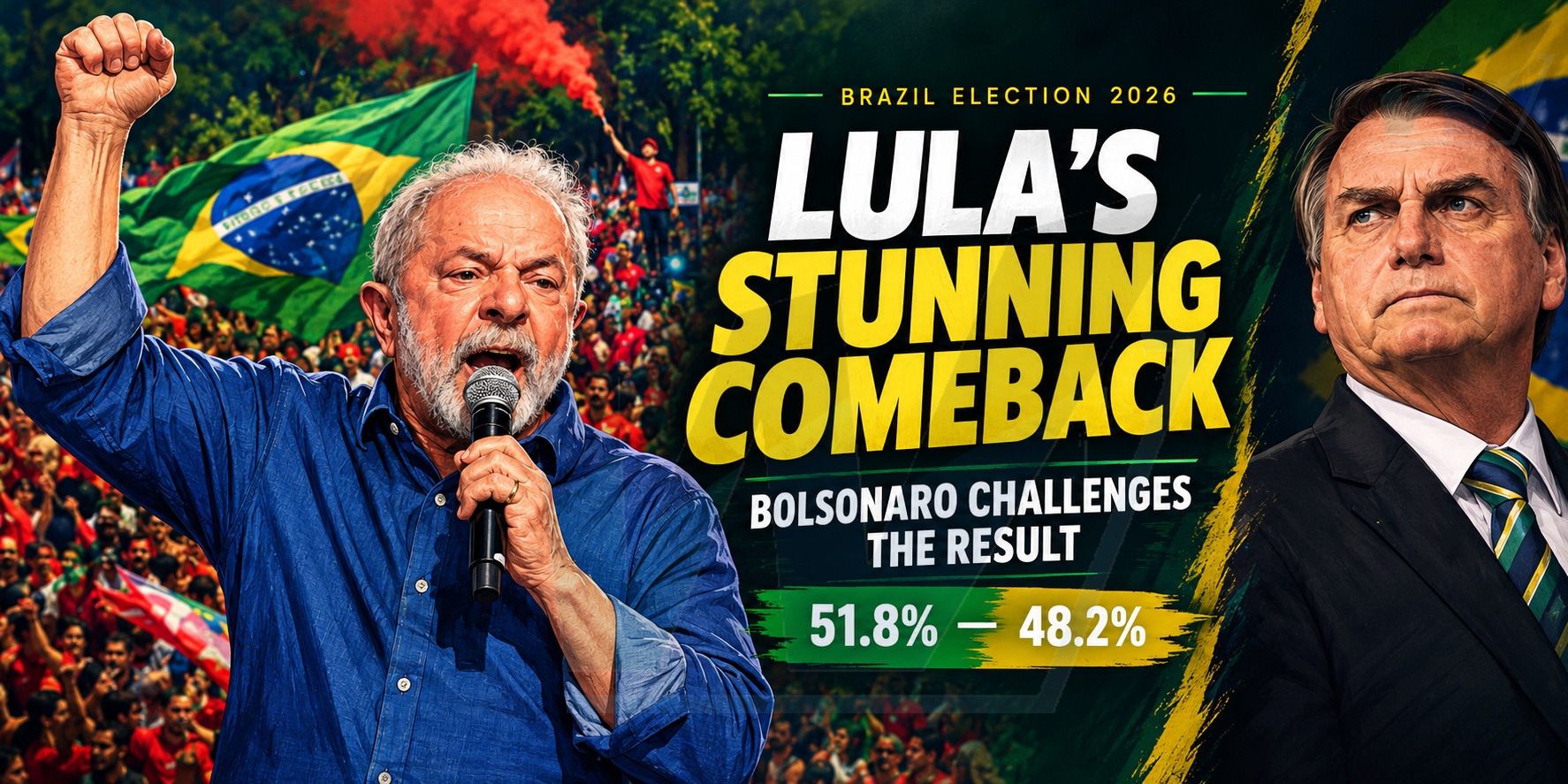
Brazil’s president wins a fourth, nonconsecutive term with 51.8% of the vote, defeating Flávio Bolsonaro by about 4.4 million votes. But a dispute over extended voting hours, and criticism from Donald Trump’s political camp, opens a tense new chapter for Latin America’s largest democracy.
Brazil’s presidential election has delivered a dramatic political reversal. President Luiz Inácio Lula da Silva has defeated right-wing Senator Flávio Bolsonaro, son of former president Jair Bolsonaro, securing another four-year mandate and dealing a major setback to the right-wing movement that appeared poised to take power.
The result, announced after Sunday’s October 25 runoff, gives Lula approximately 51.8% of the valid vote against Bolsonaro’s 48.2%. The margin, roughly 4.4 million vote, turned a fiercely contested campaign into a consequential victory for Brazil’s left.
Yet the celebrations have been accompanied by an immediate political confrontation. Bolsonaro has refused to accept the result and says he will seek to have the election annulled, challenging a last-minute decision to extend voting hours.
The dispute that threatens to overshadow the victory
The controversy centers on a two-hour extension ordered by Supreme Court Justice Cristiano Zanin after reports of transport difficulties and delays affecting voters, including in parts of Bahia and São Paulo.
Bolsonaro has argued that the decision altered the rules on election day and undermined fairness. But Brazil’s Agência Brasil reports that both presidential campaigns had requested additional voting time. The electoral authorities also clarified that the extension applied to polling stations that remained open, rather than reopening stations that had already closed.
The distinction is central to the dispute. Bolsonaro’s allegations are not, by themselves, evidence that the result was fraudulent. Reporting by the Associated Press says he would need to provide evidence of fraud affecting Lula’s margin, while electoral authorities and regional leaders have recognized Lula’s victory.
The legal challenge now threatens to prolong a campaign already shaped by deep polarization. Lula’s victory is clear in the reported count, but the political battle over its legitimacy is only beginning.
Washington’s reaction adds another layer of tension
The result also carries implications beyond Brazil. Flávio Bolsonaro was aligned with US President Donald Trump’s political camp, making Lula’s win a setback for a broader right-wing network across the Americas.
Donald Trump Jr. criticized the voting extension, questioning why US media would react differently if a conservative government had made the same decision. Separately, German broadcaster Deutschlandfunk reported that President Trump himself described the Brazilian election as manipulated, without providing evidence in the report.
In the United States, progressive Senator Bernie Sanders congratulated Lula, praising his record on workers’ rights and democracy. Democratic Congressman Ro Khanna said the result reflected resistance to extremism and urged Trump not to undermine Brazil’s election. New York City Mayor Zohran Mamdani also celebrated the outcome.
The contrasting reactions underline how Brazil’s vote has become part of a wider international argument over political polarization, democratic institutions and the influence of populist movements.
Europe welcomes a partner on trade and climate
Across Europe, leaders quickly congratulated Lula, emphasizing the importance of continued cooperation with Brazil.
European Commission President Ursula von der Leyen said democracy and multilateralism had prevailed, while European Council President António Costa expressed a desire to deepen ties. French President Emmanuel Macron called for stronger strategic relations, and Spanish Prime Minister Pedro Sánchez described the result as a progressive comeback. German Chancellor Friedrich Merz also congratulated Lula and signaled interest in strengthening the strategic partnership between Berlin and Brasília.
The diplomatic response has a practical dimension. Brazil is a major agricultural exporter, a key player in the global climate debate and an important partner for Europe’s trade ambitions. Lula’s return is particularly relevant to EU-Brazil relations and the wider Mercosur trade framework.
For European governments, the immediate priority is to maintain cooperation on trade, climate policy and international diplomacy while monitoring the dispute over the election result.
Latin America responds across political lines
In Latin America, the reactions reflected both ideological solidarity and pragmatic regional interests.
Mexican President Claudia Sheinbaum celebrated Lula’s win as a victory for democracy. Cuban President Miguel Díaz-Canel called it historic, while the presidents of Paraguay, Uruguay, Bolivia and Panama emphasized shared interests, regional integration and future cooperation.
Chile’s President José Antonio Kast also congratulated Lula, highlighting economic integration and the fight against organized crime. Ecuador’s President Daniel Noboa pointed to common regional challenges, despite political differences.
The breadth of the response matters: Lula’s victory has received congratulations not only from left-wing allies but also from leaders who do not share his political outlook. For governments across the region, Brazil’s economic weight makes stable relations essential.
China and Russia welcome Lula’s return
Beijing congratulated Lula and expressed its readiness to advance a closer strategic relationship with Brazil. The Chinese Foreign Ministry pointed to cooperation between the two countries and their shared interest in developing a “community with a shared future.”
The Kremlin also welcomed the result. Russian presidential spokesman Dmitry Peskov praised Lula’s contribution to bilateral relations and cooperation through BRICS, the grouping that includes Brazil, Russia, India, China and South Africa, alongside newer members.
Ukraine’s President Volodymyr Zelenskyy also congratulated Lula, emphasizing Brazil’s role in defending sovereignty and territorial integrity and expressing interest in expanding cooperation. That response highlights the diplomatic balancing act facing Brasília: maintaining its BRICS relationships while navigating pressure over Russia’s war against Ukraine.
A victory does not erase Brazil’s divisions
Lula’s return to office is politically significant, but it does not resolve Brazil’s underlying tensions. The close result shows a country still sharply divided between the left and the right, with the Bolsonaro movement retaining substantial electoral support.
The new mandate will also bring familiar policy tests: the cost of living, public security, corruption concerns, workers’ rights, economic growth and protection of the Amazon. Lula must now turn a narrow electoral advantage into a governing programme capable of reaching beyond his own political base.
The opposition’s legal challenge adds uncertainty, but it does not change the reported result. The next test will be whether Brazil’s institutions can handle the dispute through established legal processes while preserving public confidence in the electoral system.
What Lula’s victory means for the world
Brazil’s election has become more than a domestic contest. It is a signal in the struggle between competing political visions across the Americas—and a consequential development for global trade, climate diplomacy and the balance of influence among the United States, Europe, China and Russia.
For Lula, the challenge is now to convert a dramatic comeback into effective government. For Flávio Bolsonaro, the fight has shifted from the campaign trail to the courts and Congress. And for Brazil, the decisive question is whether the country can move beyond a bitterly divided election without allowing the dispute to deepen its democratic crisis.
The ballots have delivered Lula to another mandate. The battle over what that mandate means has only just begun.