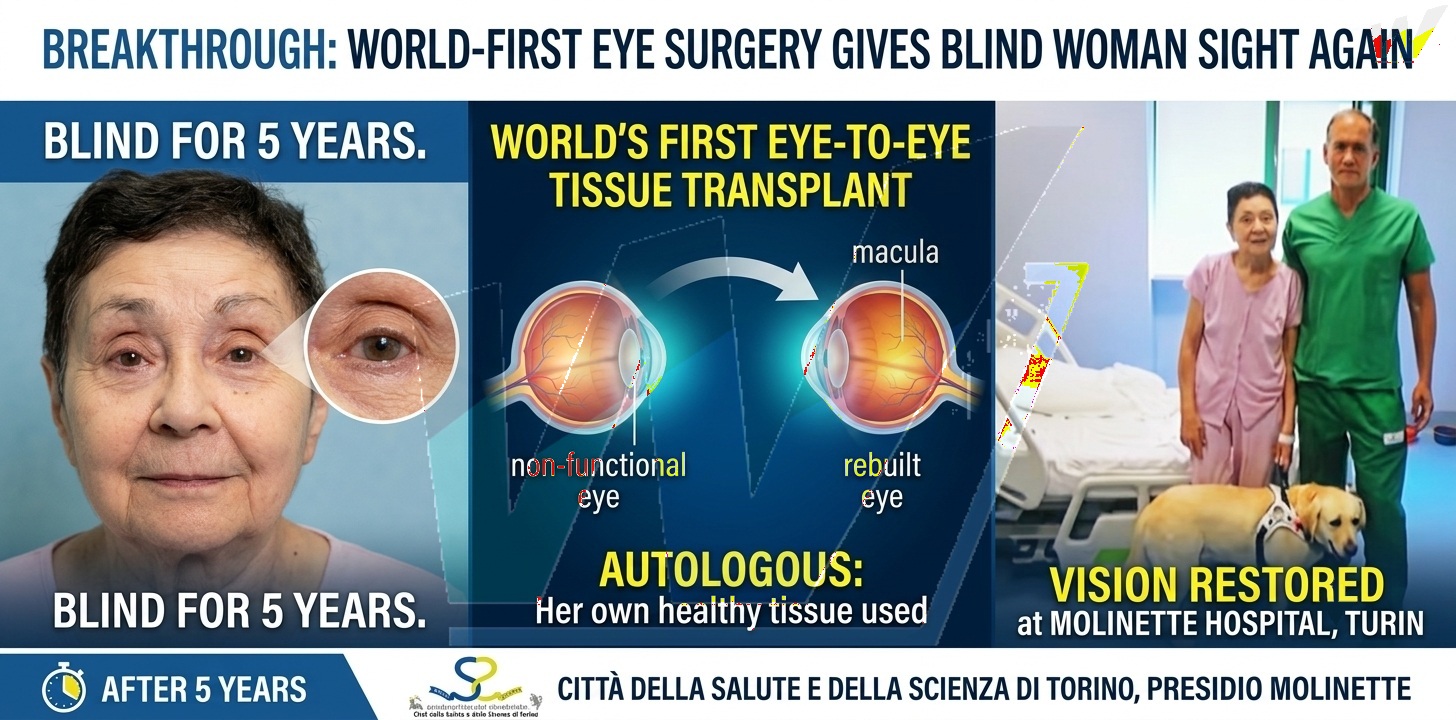
Medical Breakthrough: World’s First Eye-to-Eye Tissue Transplant Restores Vision After Years of Blindness
In a landmark achievement that could reshape the future of ophthalmology, Italian surgeons have restored vision to a 67-year-old woman who had lived in darkness for more than five years, using an unprecedented surgical procedure that transferred healthy tissues from one of her own eyes to the other.
The operation, performed at Molinette Hospital in Turin, Italy, is being hailed by specialists as a world-first because it combined transplantation of the entire anterior segment of the eye with the central portion of the retina (the macula), a feat never accomplished in human eye surgery.
For ophthalmologists worldwide, success represents far more than a single patient’s recovery. It offers fresh hope that carefully selected patients suffering from previously untreatable forms of blindness may one day regain functional vision through advanced reconstructive eye surgery.
From Total Blindness to Seeing Light Once More
The patient, identified only as Elena, lost her eyesight following a devastating road traffic accident years ago.
Doctors explained that the accident caused irreversible damage to the optic nerve in one eye, making it permanently incapable of transmitting visual information to the brain. Remarkably, however, many of the eye’s physical structures remained healthy.
Her other eye retained a functioning optic nerve but suffered catastrophic damage to the cornea, retina and other critical tissues, leaving conventional transplantation impossible.
Instead of relying on donor tissue, surgeons developed an innovative solution: using healthy structures from the non-functioning eye to rebuild the damaged but neurologically connected eye.
A World-First Surgical Technique
Led by Professor Michele Reibaldi at the University Eye Clinic of Turin’s Molinette Hospital, the surgical team carried out what experts describe as the first successful autologous eye-to-eye transplant involving:
- Complete anterior eye segment transplantation
- Corneal tissue transfer
- Ocular surface reconstruction
- Transplantation of the macula, the central region of the retina, responsible for detailed vision
While anterior eye tissue transplantation had previously been attempted in only one highly specialized case, surgeons say no team had ever successfully transplanted the macula from one eye to the other in the same patient.
Why This Surgery Is Different
Unlike conventional corneal transplants, which depend on donor organs, this procedure used the patient’s own healthy tissue.
That approach dramatically reduced the risks of:
- Tissue rejection
- Immune complications
- Long-term transplant failure
Doctors describe the procedure as an auto transplant, meaning tissue is transferred within the same person’s body.
The operation required combining microsurgery with advanced retinal reconstruction, making it one of the most technically demanding ophthalmic procedures ever attempted.
Vision Returns After Five Years
Following surgery, Elena gradually began recovering visual function.
According to the medical team, she first perceived light, then shapes in black and white, before beginning to distinguish colors again during recovery.
In interviews with Italian media, the patient described the experience as being “like a newborn learning to see,” calling the outcome nothing short of miraculous.
Opening a New Frontier in Blindness Treatment
Although physicians caution that the operation will not restore vision for every blind patient, they believe it establishes an entirely new treatment pathway for highly selected individuals.
Potential future beneficiaries could include patients whose:
- Optic nerve remains functional
- One eye contains healthy tissues but cannot transmit vision
- Other eye retains neurological connections but has irreversible structural damage
Researchers believe similar techniques may eventually complement regenerative medicine, stem-cell therapies and bioengineered eye tissues currently under development.
Part of a Global Revolution in Vision Restoration
The breakthrough arrives during an extraordinary period for eye medicine.
Across the world, scientists are simultaneously advancing:
- Stem-cell corneal regeneration
- Gene therapies for inherited blindness
- Artificial retinal implants
- Brain-computer visual prostheses
- Bioengineered corneal transplants
Each innovation targets different causes of blindness, but together they reflect rapid progress toward restoring sight once considered permanently lost.
Experts Urge Careful Optimism
Medical specialists emphasize that this operation remains an exceptional case rather than standard treatment.
The technique required a unique combination of injuries that made the patient’s own healthy ocular tissues suitable for transplantation.
Extensive clinical evaluation and additional successful cases will be needed before similar procedures become widely available.
Nevertheless, ophthalmologists say the operation demonstrates that boundaries once thought impossible in eye surgery can be overcome through innovation and precision microsurgery.
A Glimpse into the Future
For millions living with severe visual impairment, the Turin operation represents more than a remarkable medical success, it signals a shift in what modern medicine may soon be capable of achieving.
As researchers continue refining regenerative eye surgery and transplant techniques, procedures once regarded as science fiction are steadily entering clinical reality.
For one Italian woman, that future has already begun, with the return of light after years of darkness.