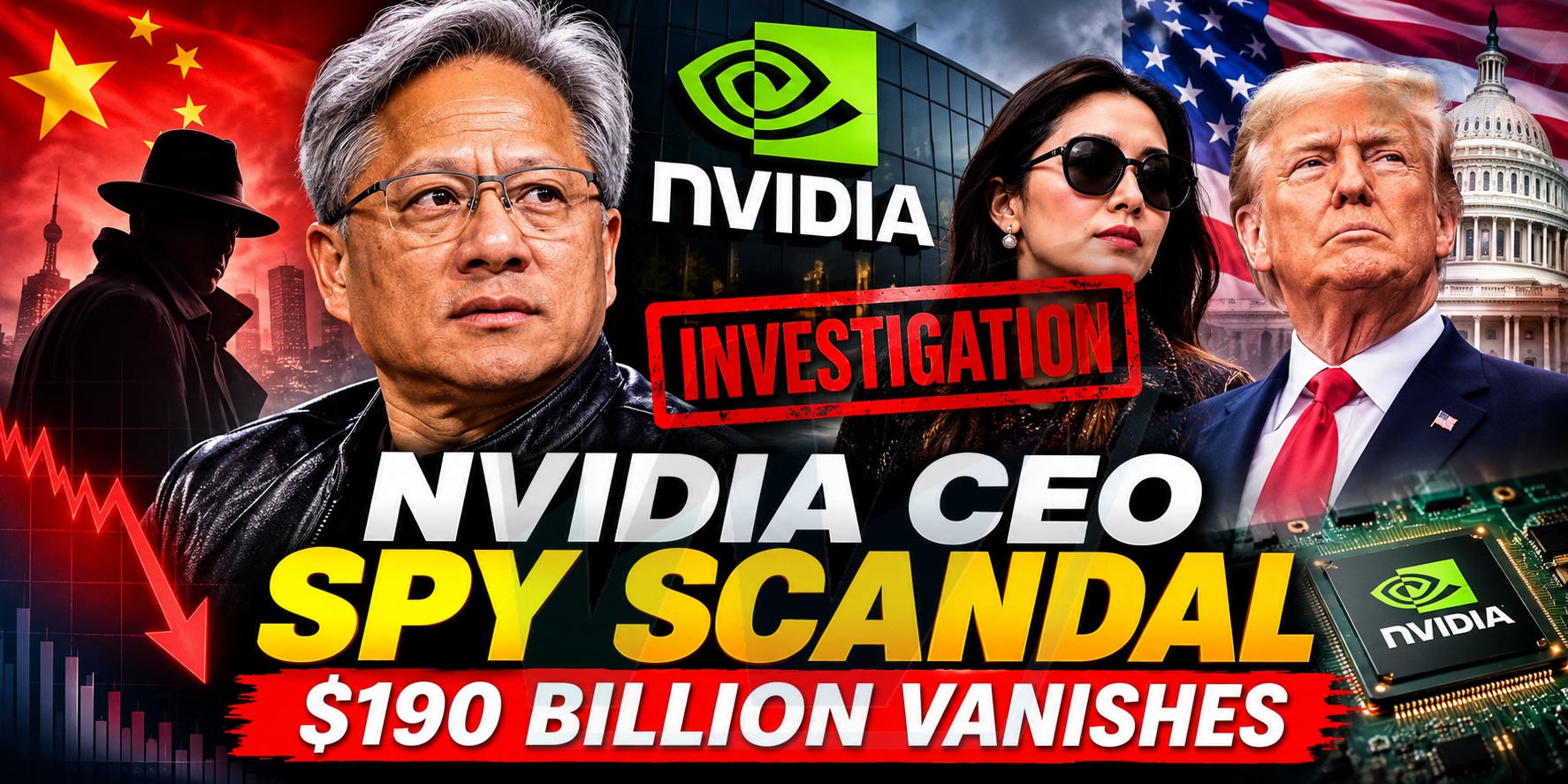
 $4.8 Billion in Chips, a Suspected Spy and a CEO Under Pressure: Nvidia’s Explosive Investigation
The AI Power Struggle Turns Personal: Nvidia Investigates Alleged Chinese Intelligence Operation Targeting Its CEO
The world’s leading AI-chip maker launches an independent investigation after its billionaire CEO admits an affair with a business executive identified in U.S. intelligence reporting as a suspected Chinese intelligence asset. Trump offers his support, Beijing rejects the allegations, and shareholders launch a legal challenge.
A corporate crisis with potentially global consequences is unfolding inside Nvidia, the company powering much of the world’s artificial intelligence revolution.
Its founder and chief executive, Jensen Huang, is facing unprecedented scrutiny after reports linked an intimate relationship with Chinese business executive Alice Huang to an alleged intelligence operation involving Beijing’s Ministry of State Security.
The controversy has now reached Nvidia’s boardroom, Washington’s political establishment and Wall Street.
On November 8, Nvidia announced an independent investigation into reports that its 63-year-old chief executive had been targeted by a foreign intelligence operation. The announcement followed Huang’s admission that he had been unfaithful to his wife, accompanied by a public apology to his family, colleagues and shareholders.
The company insists it has no reason to believe that U.S. national security or Nvidia’s trade secrets were compromised. Nevertheless, the investigation will examine all available information.
The woman at the center of the allegations
The controversy centers on Alice Huang, also identified as Huang Le, a Chinese citizen and former senior executive at Singapore-based data-center company Megaspeed.
According to reporting by The New York Times and the Financial Times, U.S. intelligence officials believe she was recruited by China’s Ministry of State Security to gather information about Jensen Huang and potentially influence his position on American restrictions governing advanced AI-chip exports to China.
The two individuals share a surname but are not related.
U.S. intelligence agencies reportedly monitored Alice Huang for more than a year. Their investigation allegedly uncovered communications and a relationship that raised concerns among American security officials.
The allegations remain subject to investigation, and no publicly released evidence has established that Nvidia’s confidential technology or national-security information was transferred to Beijing.
The $4.8 billion Megaspeed connection
Behind the personal controversy lies a potentially far more consequential commercial question.
Megaspeed reportedly purchased more than $4.8 billion worth of Nvidia chips since June 2024, making it a major customer in Southeast Asia.
The company had previously attracted scrutiny from U.S. authorities over suspicions that advanced Nvidia processors could be redirected to Chinese customers despite American export restrictions.
Megaspeed’s commercial network, its executive connections and the ultimate destinations of its hardware purchases are therefore central to the emerging investigation.
The concern extends beyond whether restricted chips changed hands. Investigators must establish whether commercial relationships could have been exploited to obtain strategic information about Nvidia’s technology, business decisions or lobbying efforts in Washington.
Trump’s defense puts Washington in the spotlight
The political implications intensified after President Donald Trump publicly defended Huang.
On November 9, Trump confirmed that he had spoken directly with the Nvidia chief executive. According to the president, Huang told him he had no idea the woman was allegedly a spy.
Trump said he believed him and indicated that the FBI was examining the matter.
The president’s support is significant. Huang has become one of Silicon Valley’s most influential figures in Washington, particularly as Nvidia has pushed for greater access to the Chinese market.
His relationship with the administration has placed him at the center of America’s technological competition with Beijing.
The controversy also raises questions about what U.S. officials knew, when they knew it and whether intelligence warnings were adequately addressed.
China, meanwhile, has rejected the espionage allegations. Foreign Ministry spokesperson Guo Jiakun described the claims as unsubstantiated and an attempt to smear the country.
Congress prepares to demand answers
The pressure is growing on Capitol Hill.
Republican lawmakers have sought a briefing from Huang, while Democratic Senator Chris Coons has promised congressional scrutiny.
The central questions concern potential intelligence exposure, Nvidia’s customer-screening procedures and the effectiveness of U.S. export controls.
If investigators uncover evidence of restricted technology being diverted to prohibited destinations, the consequences could extend well beyond Nvidia, potentially prompting tighter regulations and additional scrutiny of international AI-chip supply chains.
A $190 billion market shock
Financial markets have already reacted.
Reuters reported that Nvidia shares closed 4.3% on November 9, wiping approximately $190 billion from the company’s market capitalization.
The financial pressure increased when shareholders filed a proposed class-action lawsuit in federal court in San Jose, accusing Nvidia and Huang of misleading investors by concealing information concerning the alleged relationship and its potential corporate consequences.
Those accusations have not been established in court.
Nvidia’s board has appointed independent directors to oversee an investigation assisted by outside legal counsel. Huang will remain chief executive while the review proceeds and has pledged full cooperation.
The biggest question: Can Nvidia protect its leadership and America’s AI advantage?
For years, Jensen Huang has been the public face of Nvidia’s extraordinary rise, transforming the company into a central supplier of processors powering artificial intelligence, advanced computing and global data-center expansion.
Now, the company’s leadership, international relationships and security safeguards are facing an extraordinary test.
The board must determine whether Nvidia’s commercial operations were exposed, whether the alleged intelligence operation produced any strategic advantage for Beijing and whether existing safeguards were sufficient.
For Washington, the stakes are equally serious. Advanced AI chips have become instruments of economic power, technological supremacy and national security.
And for investors, the question is no longer simply how quickly Nvidia can grow, but whether the company can protect the trust underpinning its extraordinary global influence.