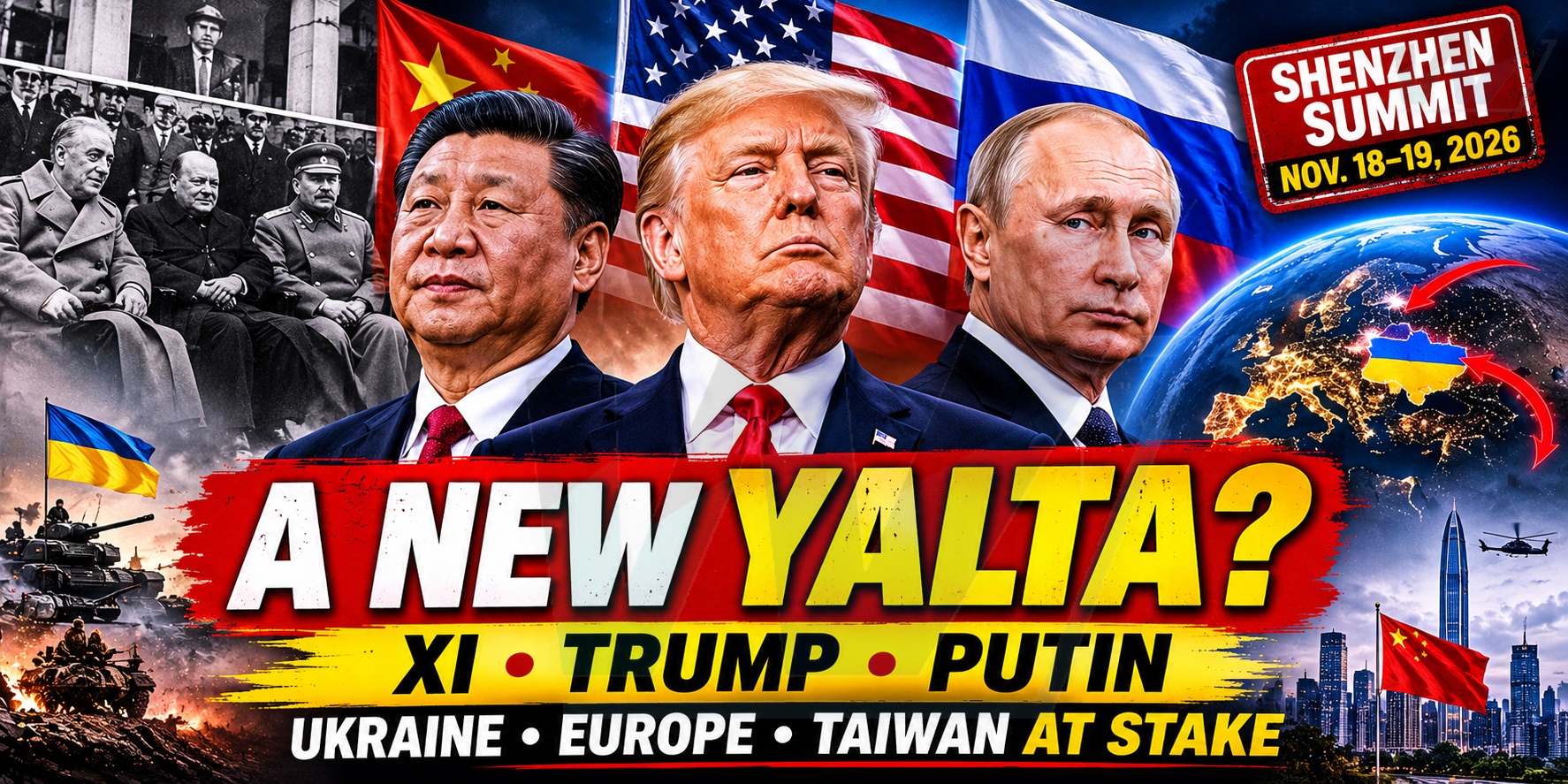
 Xi Trump Putin Summit 2026: Is Yalta 2.0 Coming?
From Yalta 1945 to Shenzhen 2026: Could Three Superpowers Redraw the Global Balance?
Ukraine, Taiwan and Europe on Alert: The Dangerous Stakes of a Possible Xi–Trump–Putin Summit
Geopolitics • International Relations • Ukraine War • US–China–Russia
A possible meeting between Xi Jinping, Donald Trump and Vladimir Putin on the sidelines of the November 18–19 APEC summit in Shenzhen is raising fears of a new global order negotiated by three powerful leaders. With Ukraine’s future, Europe’s security and Taiwan’s sovereignty potentially caught in the balance, the world is watching for signs of a modern-day Yalta.
Three presidents. Three nuclear powers. One negotiating table. And a question that could reshape the international order: can the world’s most powerful leaders decide the future of other nations without those nations having a seat at the table?
The historical comparison is unavoidable.
In February 1945, Franklin D. Roosevelt, Winston Churchill and Joseph Stalin met in Yalta to discuss the post-war settlement of Europe. Their decisions helped shape the division of the continent and the geopolitical confrontation that became the Cold War.
Now, 81 years later, the possibility of a Xi–Trump–Putin encounter in China is reviving the specter of another great-power bargain.
But there is an important distinction: the Shenzhen trilateral meeting has been discussed, and preparations have reportedly been explored, but it has not been confirmed as a formal summit. The prospect is politically significant; the outcome remains uncertain.
And the latest developments in Abu Dhabi have made the stakes even higher.
The Abu Dhabi warning: Ukraine’s future is already on the negotiating table
The geopolitical drama surrounding Shenzhen is unfolding against the backdrop of renewed diplomatic activity over Russia’s war in Ukraine.
On November 10–11, Russian, Ukrainian and American delegations met in Abu Dhabi for the first trilateral negotiations since February.
The outcome was limited but significant: Moscow and Kyiv agreed in principle to a large-scale prisoner exchange, while failing to achieve a breakthrough on a ceasefire, territorial disputes or the fundamental conditions for ending the war.
The most consequential development concerned something much bigger than Ukraine’s battlefield.
Russia pushed for a comprehensive restructuring of Europe’s security architecture, arguing that any settlement must address the continent’s entire security system rather than simply resolve the conflict in Ukraine.
Russian chief negotiator Vladimir Medinsky questioned the role of European governments in the negotiations, arguing that Moscow had received no concrete proposals from them.
For Kyiv and its European supporters, this raised an alarming possibility: that Russia could use negotiations over Ukraine to secure a broader geopolitical settlement granting Moscow greater influence over Europe’s security arrangements.
The United States, meanwhile, has explored a framework for discussing European security that could give Russia a role in continental consultations. Jared Kushner indicated that Moscow would need to present proposals acceptable to European governments rather than expect its demands to be accepted automatically.
The Shenzhen question: A meeting that could change the diplomatic equation
The possibility of a three-way meeting gained momentum after Kremlin officials confirmed that discussions were underway.
On November 9, Trump publicly said he expected to meet Xi and Putin at the APEC summit in Shenzhen on November 18–19.
China has acknowledged communication with the relevant parties, while Kremlin spokesman Dmitry Peskov has said preparations were being discussed.
But the three governments have not published a final joint agenda or confirmed a definitive trilateral agreement.
The distinction matters: a meeting between the three leaders could be politically historic without becoming a negotiation over Ukraine’s borders or the future of Europe.
Xi’s message to Europe: Ukraine cannot be decided without Europeans
One of the most revealing developments came from German President Frank-Walter Steinmeier.
Following his meeting with Xi in Beijing, Steinmeier told Germany’s ARD broadcaster that the Chinese president appeared irritated when the possibility of a trilateral summit discussing Ukraine was raised.
According to Steinmeier, Xi made clear that the war was a European conflict and that European countries must participate in negotiations concerning their own security.
Xi reportedly distinguished between a possible meeting of the three presidents and an actual negotiation over Ukraine.
This position is strategically important for Beijing.
China wants to maintain its relationship with Moscow while preserving its economic and diplomatic ties with Europe. Being perceived as a partner in a great-power arrangement that sidelines European governments could seriously damage those relationships.
For Beijing, the diplomatic challenge is to demonstrate that it can work with Washington and Moscow without endorsing a division of the world into exclusive spheres of influence.
Three leaders, three different agendas
The greatest obstacle to a historic agreement may be the leaders’ fundamentally different priorities.
Leader |
Main strategic priorities |
| Donald Trump | Nuclear arms control, ending the Ukraine war, Iran and US–China trade relations |
| Vladimir Putin | Ukraine, territorial demands, sanctions and a new European security architecture |
| Xi Jinping | Strategic stability, trade, artificial intelligence, Taiwan and China’s international position |
Trump has expressed interest in nuclear disarmament discussions involving China and Russia, while also suggesting that Ukraine could feature in conversations.
Putin has a different priority: securing an outcome to the Ukraine war that recognizes Russian demands and gives Moscow a stronger voice in European security.
Xi faces perhaps the most delicate balancing act. Beijing wants to maintain its strategic partnership with Moscow, avoid unnecessary confrontation with Washington and protect its extensive economic relationship with Europe.
China has also resisted joining nuclear disarmament negotiations on the same terms as Washington and Moscow, arguing that its nuclear arsenal is considerably smaller.
These competing interests make a comprehensive three-power agreement difficult.
As political scientist Wen-Ti Sung of the Australian National University has argued, the absence of a common adversary comparable to Nazi Germany in 1945 makes a grand bargain much less likely.
The more realistic possibility is a series of limited understandings rather than a comprehensive redistribution of global power.
Taiwan: The other front watching Shenzhen
While Ukraine and Europe dominate the immediate diplomatic concerns, Taiwan will be watching the summit with particular attention.
Beijing considers Taiwan part of its territory and has not renounced the use of force to achieve unification. Taipei rejects Beijing’s sovereignty claims and maintains its own democratic political system.
For Taiwan, the concern is not necessarily that a formal agreement will be signed in Shenzhen. It is that the symbolism of a meeting between three powerful leaders could reinforce the idea that Washington is willing to negotiate strategic interests over the heads of its partners.
If Ukraine’s security becomes a bargaining issue between Washington and Moscow, Taiwan may question whether American security commitments could also become subject to negotiations with Beijing.
However, the situations are not identical. Taiwan’s security relationship with the United States differs fundamentally from Ukraine’s, and no evidence establishes that Washington intends to trade away its commitments to Taipei.
Nevertheless, the perception of uncertainty alone could have strategic consequences across the Indo-Pacific.
Yalta 1945 versus Shenzhen 2026: History’s dangerous parallel
The original Yalta Conference took place from February 4 to 11, 1945, in Crimea.
Franklin D. Roosevelt, Winston Churchill and Joseph Stalin discussed the final stages of the Second World War and the post-war international settlement.
Their negotiations covered Germany, Poland, Eastern Europe, the future United Nations and Soviet participation in the war against Japan.
The agreements helped shape the post-war order, but the subsequent confrontation between the Soviet Union and Western powers exposed the limits of wartime cooperation.
Eastern Europe ultimately fell under extensive Soviet domination, contributing to the division of the continent and the emergence of the Cold War.
The modern comparison is therefore powerful, but it should not be taken literally.
In 1945, the three leaders were negotiating the settlement of a world war. In 2026, the proposed Shenzhen encounter would take place within a vastly different international system, with sovereign states, established international institutions, nuclear deterrence and regional powers capable of resisting decisions made by larger countries.
Ukraine is not simply a piece of territory that can be transferred through a diplomatic photograph. Its government, armed forces and population have their own political agency.
Likewise, European governments, NATO members and Taiwan cannot automatically be treated as passive participants in decisions made elsewhere.
The US State Department’s historical account of Yalta also makes clear that the conference’s agreements were more complex than a simple division of the world into three spheres of influence.
Can Europe prevent a new division of the continent?
European leaders face a difficult diplomatic challenge.
They want an end to the war in Ukraine, but not at the cost of Ukrainian sovereignty or Europe’s long-term security.
On November 10, representatives of the European Union, France, Germany, Italy, the United Kingdom, Ukraine, the United States and NATO met in Abu Dhabi to coordinate their positions.
Their joint statement emphasized three principles:
- Respect for Ukraine’s sovereignty and territorial integrity.
- Credible security guarantees as part of any peace settlement.
- Continued centrality of NATO in European collective defense.
The Europeans also made clear that future negotiations should expand to include European partners rather than leave them outside decisions affecting their own continent.
Meanwhile, American envoys Steve Witkoff and Jared Kushner were expected to travel to Moscow following the Abu Dhabi discussions and subsequently continue diplomatic contacts in Dublin.
The sequence of meetings illustrates the growing tension between two approaches: Washington’s attempt to accelerate negotiations through direct engagement with Moscow, and Europe’s insistence that any lasting settlement must involve the countries whose security is at stake.
What could actually emerge from Shenzhen?
Despite the dramatic historical comparisons, analysts caution against expecting a sweeping agreement.
Several limited outcomes are more realistic:
- A diplomatic breakthrough: An agreement to maintain direct communication between Washington, Beijing and Moscow.
- Nuclear dialogue: Initial discussions about arms control, strategic stability and reducing the risks of military escalation.
- Ukraine diplomacy: A possible understanding about continuing negotiations, although no territorial settlement is guaranteed.
- Economic cooperation: Limited progress on trade, critical minerals, technology or other bilateral disputes.
- International security: Potential cooperation on counterterrorism, public health or climate issues.
Yet even these limited achievements would require overcoming major disagreements.
The three governments have different expectations, different strategic interests and different definitions of international security.
The summit could therefore produce an extraordinary photograph without delivering an extraordinary agreement.
The world is watching: A new Yalta or another diplomatic illusion?
Shenzhen may become one of the most closely watched diplomatic encounters of 2026.
For Putin, the opportunity to sit alongside the American and Chinese presidents would represent an important symbolic victory after years of Western isolation.
For Trump, the meeting could demonstrate his ability to bring the world’s most powerful rivals into direct negotiations.
For Xi, it offers an opportunity to reinforce China’s position as a central diplomatic power while avoiding the appearance of endorsing an agreement that sacrifices European interests.
But for Ukraine, Europe and Taiwan, the stakes are considerably more personal.
Their sovereignty, security and political independence could become part of conversations from which they are excluded.
The central lesson of 1945 is that agreements among great powers do not necessarily produce lasting peace. Sometimes, they merely postpone the next confrontation.
The world does not need another Yalta. It needs a diplomatic settlement in which no country is treated as a bargaining chip, no continent is divided behind closed doors, and no nation’s future is decided without its consent.
On November 18–19, Shenzhen could offer the world a historic diplomatic moment. Whether it becomes the beginning of a new international order or simply another carefully staged display of great-power politics remains the question.