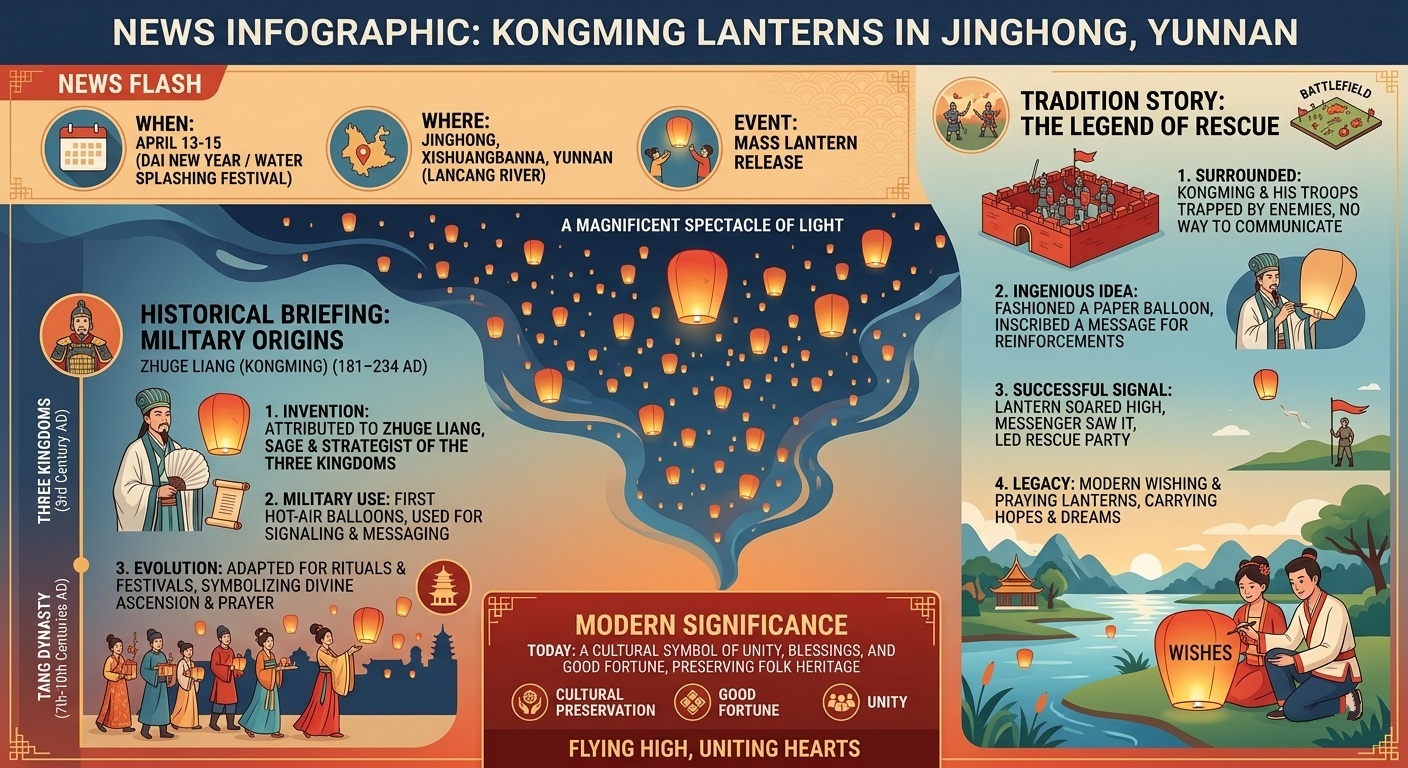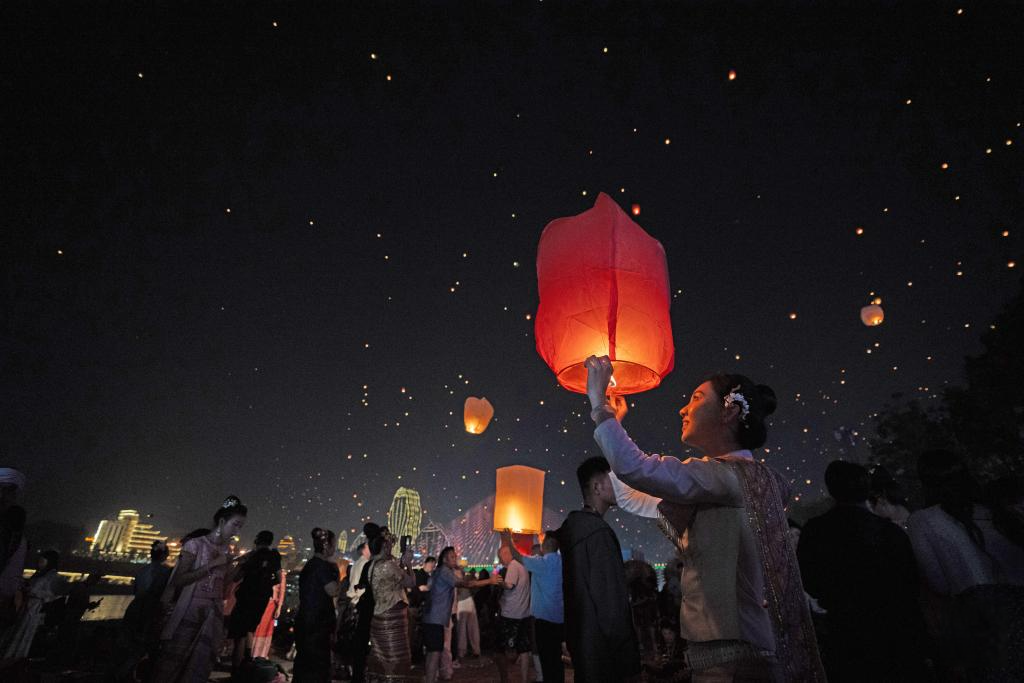
JINGHONG, April 13, 2026 — As the sun dipped below the horizon of the Lancang River, the sky over Jinghong was not reclaimed by darkness. Instead, it was set ablaze by thousands of Kongming lanterns, marking a breathtaking start to the traditional festivities in Xishuangbanna.
Thousands of residents and travelers gathered along the riverbanks to participate in the mass release. These delicate paper balloons, powered by the heat of small candles, drifted upward in a golden stream, mirroring the lights of the city below. For the local Dai people, this isn’t just a visual spectacle; it is a profound ritual of letting go of the past year’s misfortunes and sending prayers for health and prosperity into the heavens.
The Strategist’s Signal “Historical Briefing”:
The Kongming lantern is widely regarded as the world’s first hot-air balloon. Its history dates back nearly 1,800 years to the Three Kingdoms period (220–280 AD).
- The Inventor: The lantern is named after Zhuge Liang (literary name Kongming), a legendary chancellor and master strategist of the Shu Han state.
- Military Origins: Originally, these were not festive items. They were tactical tools used for military signaling. In an era before radio or long-range optics, the height and visibility of a floating light allowed commanders to communicate across vast distances or coordinate pincer movements at night.
- Scientific Design: The basic physics—using a flame to heat air inside a light paper shell to create buoyancy—has remained virtually unchanged since its inception, showcasing early Chinese mastery of fluid dynamics.
The Legend of the Besieged City “The Tradition”:
While history focuses on the military utility, folk tradition tells a more dramatic story of survival and ingenuity.
According to legend, Zhuge Liang found himself and his army surrounded by enemy forces in a city with no way to send for help. Every mountain pass was blocked, and every messenger was intercepted. Observing the way heat rose from a campfire, Kongming fashioned a large “hat” out of oiled rice paper and a bamboo frame.
He wrote a plea for reinforcements on the paper, lit a lamp beneath it, and watched as it soared over the enemy lines. His allies saw the drifting light, recognized the signal, and arrived in time to break the siege.
“Today, the message written on the paper has changed from a cry for help to a wish for peace, but the spirit of hope remains the same.”