Vatican Excommunicates Rebel Traditionalist Clergy in Dramatic Crackdown, Reopening a 50-Year Catholic Rift
VATICAN CITY —
The warning had been issued.
The letters had been sent.
Rome had pleaded for restraint.
But on a hillside in the Swiss Alps, beneath ceremonial vestments, Latin chants, and clouds of incense, a line was crossed.
And the Vatican decided it had seen enough.
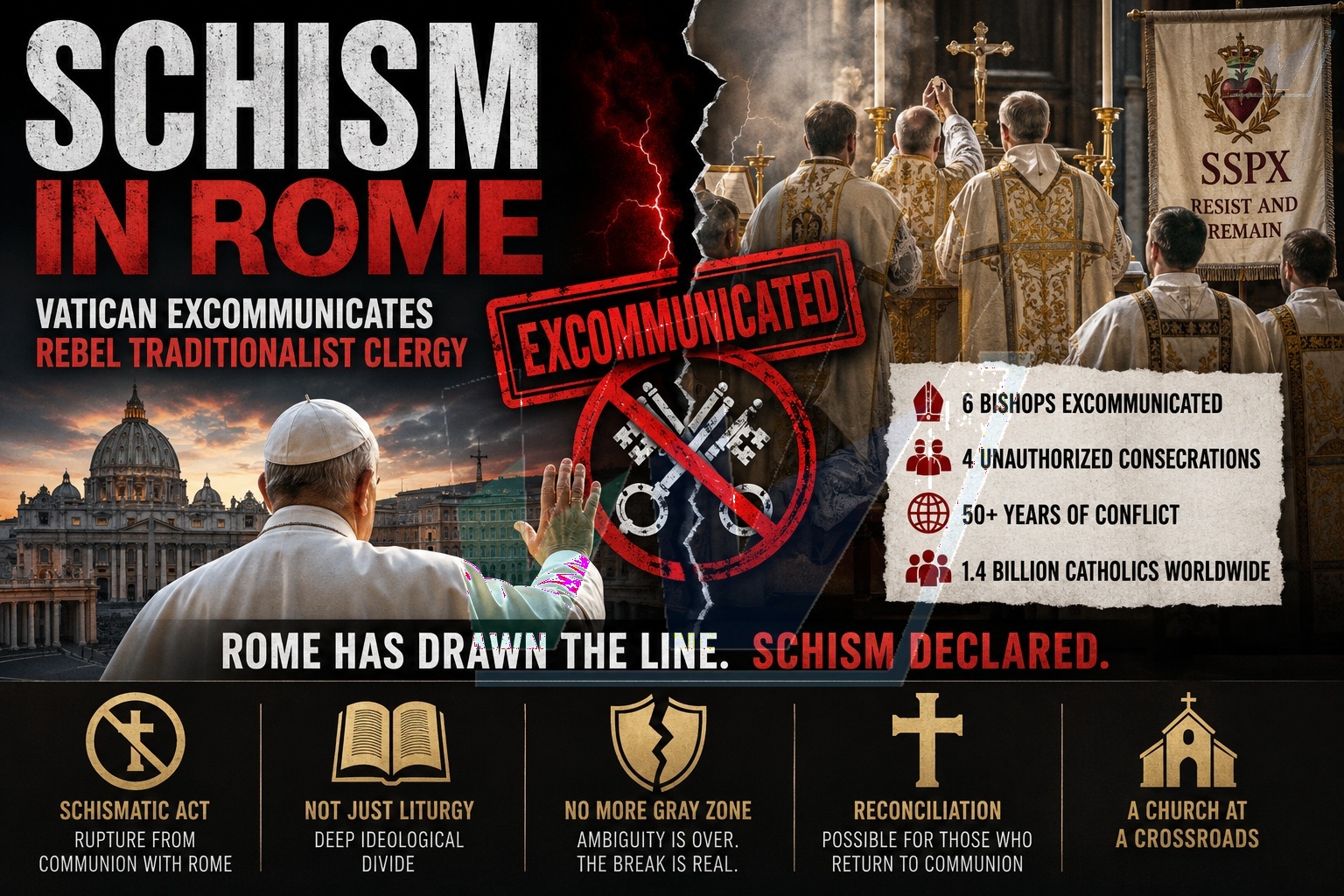
In one of the most consequential disciplinary actions of the modern Catholic era, the Holy See has formally excommunicated bishops and clergy linked to the Society of Saint Pius X (SSPX) after the rebel traditionalist movement defied papal authority and consecrated new bishops without approval from Pope Leo XIV.
The decree sent shockwaves through the global Catholic Church.
What had simmered for decades as theological rebellion has now exploded into open rupture.
Rome has spoken with its harshest weapon.
Schism.
The Ceremony That Triggered the Break
It happened in Écône, Switzerland, long the symbolic heart of the SSPX.
Thousands gathered.
Priests in lace-trimmed vestments processed toward the altar.
Ancient liturgical chants filled the mountain air.
Then came the act Rome had explicitly forbidden.
Four priests were elevated to bishop.
No papal mandate.
No authorization from the Vatican.
No communion with Rome.
Under Catholic canon law, the unauthorized consecration of bishops constitutes one of the gravest ecclesiastical offenses possible.
The result was immediate.
Automatic excommunication.
But the Vatican did not stop there.
It escalated.
Far beyond what many expected.
Rome Drops the Hammer
In an extraordinary decree from the Vatican’s Dicastery for the Doctrine of the Faith, Church authorities declared that the SSPX had committed a “schismatic act”, a formal rupture from communion with the Catholic Church.
Six bishops were directly excommunicated:
- Two senior bishops who performed the consecrations
- Four newly consecrated bishops
The Vatican also declared SSPX clergy to be operating outside ecclesial communion and warned that faithful who formally adhere to the movement risk excommunication themselves.
The message was unmistakable:
This was no symbolic reprimand.
This was institutional separation.
More Than a Liturgical Dispute
To outsiders, the conflict may appear to revolve around Latin Mass preferences.
It goes much deeper.
The Society of Saint Pius X was founded in 1970 by Archbishop Marcel Lefebvre, who rejected reforms introduced after the Second Vatican Council.
Those reforms transformed modern Catholic life:
- Mass celebrated in local languages instead of Latin
- Expanded interfaith dialogue
- Greater engagement with the modern world
- New theological approaches to religious freedom
To SSPX hardliners, those reforms represented not renewal, but betrayal.
For decades, the movement occupied a gray zone:
Not fully inside the Church.
Not fully outside it.
Now, that ambiguity has ended.
Pope Leo’s Defining Test
For Pope Leo XIV, this crisis may become one of the defining tests of his papacy.
Leo entered office promising unity.
He inherited a Church increasingly fractured between reformists, moderates, and militant traditionalists.
In recent months, Vatican officials attempted dialogue with SSPX leadership.
Negotiations continued.
Warnings intensified.
Appeals were made privately.
Even personal intervention reportedly failed.
Then came the consecrations.
And with them, defiance.
The Vatican’s response suggests something profound:
Rome concluded that the rebellion was no longer rhetorical.
It had become structural.
Why This Matters Far Beyond the Vatican
The SSPX is numerically small compared with the Catholic Church’s 1.4 billion faithful, but its influence exceeds its size.
The movement spans dozens of countries, with hundreds of priests, seminaries, schools, and dedicated followers.
Its appeal has grown among Catholics seeking certainty, ritual, and doctrinal rigidity in an age of social upheaval.
That makes this confrontation larger than a canonical dispute.
It is also ideological.
Traditionalism versus reform.
Authority versus resistance.
Obedience versus self-preserved orthodoxy.
And beneath all of it lies the question haunting Catholicism in the 21st century:
Who defines authentic tradition?
Rome?
Or those claiming Rome has abandoned it?
A Church at a Crossroads
Inside the Vatican, officials insist the door is not fully closed.
The Church says reconciliation remains possible for clergy and faithful willing to return to communion.
But after this decree, the road back has narrowed dramatically.
Some traditionalists are already rallying behind SSPX leadership.
Others fear permanent fracture.
Catholics around the world now watch nervously.
Because history offers a warning.
Major schisms rarely begin with armies.
They begin with conviction.
With liturgy.
With authority challenged.
With one side refusing to yield.
And once the break becomes spiritual, repairing it can take generations.
The Silence After the Decree
In St. Peter’s Basilica, bells still ring.
Pilgrims still pray.
Mass continues.
Outwardly, little has changed.
Yet beneath the marble and ritual, something seismic has shifted.
A fracture that Rome spent decades trying to heal has reopened.
And this time, the language is no longer diplomatic.
It is canonical.
Final.
Severe.
Ancient.
Excommunication.
The word carries centuries of weight.
And tonight, it echoes once more through the walls of the Vatican.
By the Numbers
- 6 bishops excommunicated
- 4 unauthorized episcopal consecrations
- 750+ SSPX priests worldwide
- 50+ years of conflict with Rome
- 1.4 billion Catholics globally
Status: The Vatican has declared SSPX clergy schismatic; reconciliation remains possible for members who return to full communion with Rome.