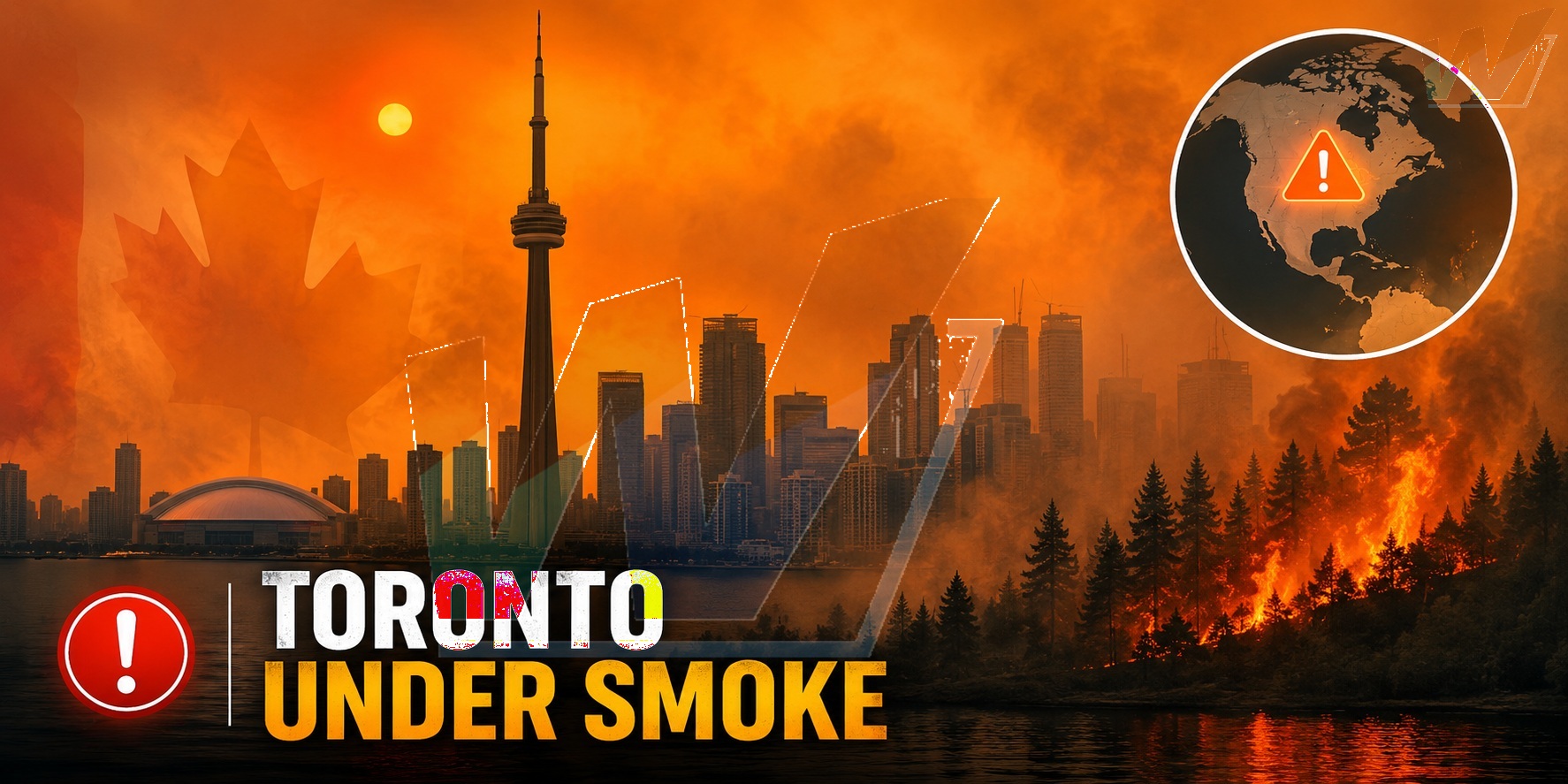
Canada’s Wildfire Crisis Turns North America’s Largest City into a Smoke-Shrouded Landscape as Air Quality Plunges to the World’s Worst
TORONTO —
The skyline disappeared.
The familiar blue summer sky faded into an eerie orange glow.
The sun looked more like a dim red ember than the bright centerpiece of a July afternoon.
Across Toronto, millions of residents woke Wednesday to a city transformed by one of Canada’s most severe wildfire smoke events in recent years, a thick blanket of haze that reduced visibility, triggered widespread health warnings, disrupted major public events, and briefly gave Canada’s largest city the worst air quality of any major city on Earth.
A City Trapped Beneath a Blanket of Smoke
What appeared at first to be heavy fog quickly revealed itself as something far more dangerous.
Smoke drifting hundreds of kilometers from massive wildfires burning across northwestern Ontario settled over southern Ontario, turning the skyline an unsettling orange and filling the air with microscopic particles capable of penetrating deep into the lungs.
Environment Canada issued high-risk air quality warnings, while the city’s Air Quality Health Index surged to 10+, the government’s highest warning category.
Residents reported:
- Burning eyes
- Persistent coughing
- Difficulty breathing
- A strong smell of smoke throughout the city
- Significantly reduced visibility across Lake Ontario
The famous Toronto skyline nearly vanished behind a curtain of smoke.
World’s Worst Air Quality
For several hours, real-time monitoring platform IQAir ranked Toronto as the most polluted major city in the world, placing it ahead of cities that frequently battle severe smog, including Delhi and Kinshasa.
Health officials urged residents to:
- Stay indoors whenever possible
- Keep windows closed
- Run air filtration systems
- Avoid strenuous outdoor exercise
- Wear well-fitted N95 masks if spending extended time outside
Authorities warned that even healthy adults could experience respiratory irritation, while children, seniors, pregnant women and people suffering from asthma or heart disease faced elevated health risks.
Hundreds of Fires Still Burning
The smoke is only the visible symptom of a much larger disaster unfolding across Canada.
According to Canadian wildfire authorities:
- More than 830 active wildfires are burning nationwide.
- Over 110 remain out of control.
- Nearly 1.9 million hectares have already burned during the 2026 fire season.
Many of the most dangerous fires are concentrated in northwestern Ontario, where remote communities have faced evacuation orders as flames continue advancing through forests.
Several First Nations communities have been forced to flee, while emergency crews continue battling fast-moving fires under difficult weather conditions.
Smoke Crosses an International Border
The crisis is no longer Canada’s alone.
Powerful upper-level winds pushed the smoke southward into the United States, blanketing large parts of the Midwest and Northeast.
Air quality alerts spread across:
- New York
- Michigan
- Minnesota
- Wisconsin
- Massachusetts
- Vermont
- New Hampshire
New York City also issued air quality advisories as smoke combined with extreme summer heat, while officials across several states warned residents to reduce outdoor activity.
Meteorologists say shifting winds could continue transporting smoke across the eastern United States over the coming days.
Orange Sun, Red Skies
Scientists explain the dramatic orange skies through a phenomenon known as light scattering.
Wildfire smoke contains enormous concentrations of fine particulate matter, especially PM2.5, particles less than 2.5 microns in diameter.
These particles scatter shorter wavelengths of sunlight while allowing longer red and orange wavelengths to dominate what reaches the human eye.
The result:
- Orange skies
- Crimson sunsets
- Red midday sun
- Reduced visibility
- Thick atmospheric haze
The visual spectacle may appear dramatic, but experts emphasize that it signals dangerous concentrations of airborne pollution rather than merely unusual weather.
Major Events Disrupted
The smoke has begun affecting daily life across Ontario.
Organizers canceled or modified outdoor activities, including events associated with Toronto’s FIFA Fan Festival, while schools, sports organizations, and employers closely monitored changing air quality conditions.
Public health agencies warned that prolonged exposure, even among healthy individuals, could increase respiratory stress and aggravate existing medical conditions.
Climate Change Intensifies Fire Seasons
Wildfires are a natural part of Canada’s boreal forest ecosystem.
But scientists increasingly warn that hotter temperatures, prolonged droughts, and changing precipitation patterns are creating conditions that allow fires to ignite more easily, spread faster, and burn more intensely.
Climate researchers say the combination of extreme heat and persistent dryness has lengthened wildfire seasons and increased the frequency of smoke events reaching major urban centers, episodes that were once relatively uncommon in southern Ontario.
What Comes Next?
Forecasters expect hazardous air quality to persist until weather systems shift enough to disperse the smoke.
Much will depend on two factors:
- Whether firefighters can contain the largest blazes in northwestern Ontario.
- Whether changing wind patterns push smoke away from heavily populated regions.
Until then, millions across Canada and the United States remain under health advisories, watching the sky for signs of relief.