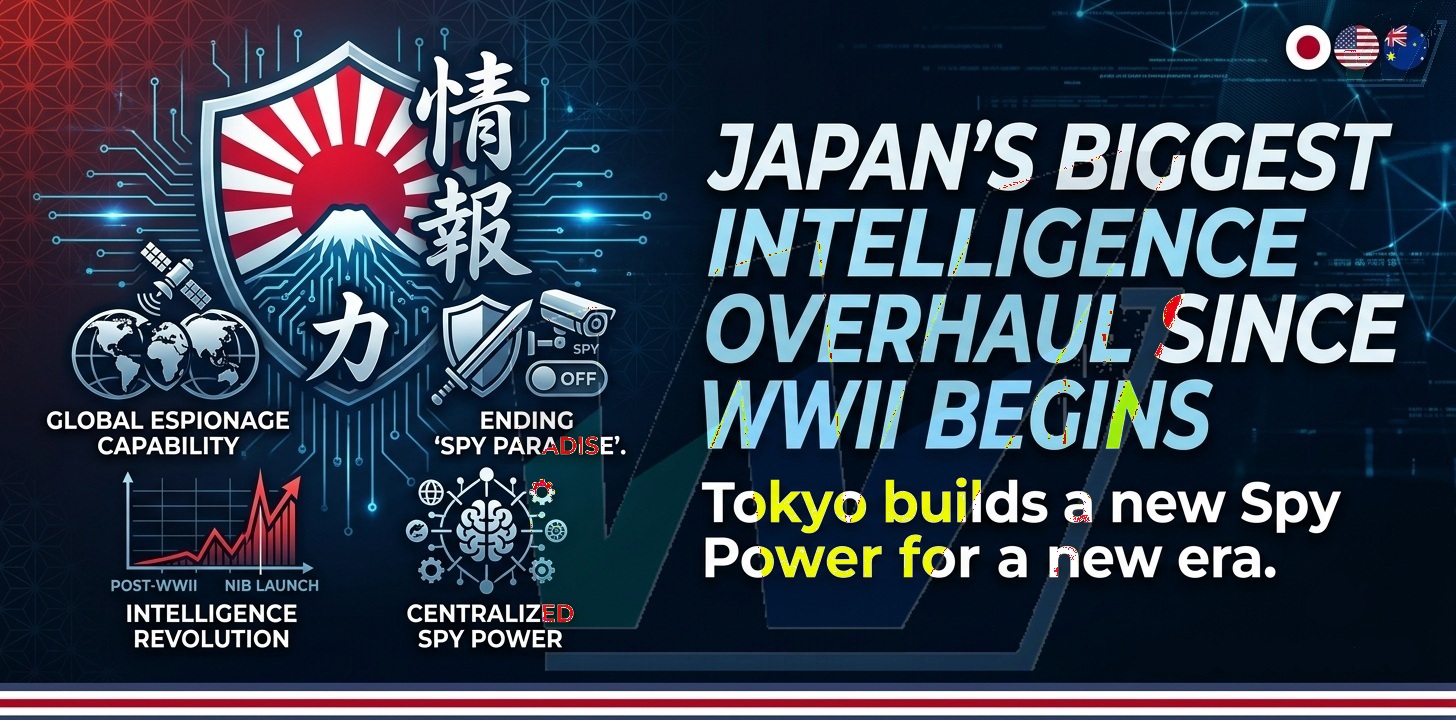
Japan’s Biggest Intelligence Overhaul Since World War II: Why Tokyo Is Building a New Spy Power as Asia’s Security Crisis Deepens
TOKYO — Eight decades after Imperial Japan’s intelligence apparatus was dismantled following World War II, the country has taken one of the most significant national security steps in its modern history.
On Friday, Japan officially launched the National Intelligence Bureau (NIB), the country’s first centralized intelligence organization since 1945, marking a dramatic shift in Tokyo’s security doctrine as tensions across the Indo-Pacific continue to rise.
The move reflects more than bureaucratic restructuring.
It signals Japan’s determination to transform itself from a nation that has long depended on allies for intelligence into a country capable of gathering, analyzing, and protecting strategic information on its own.
With China expanding military influence, Russia intensifying hybrid warfare, North Korea accelerating missile development, and cyber threats multiplying worldwide, Japanese leaders argue the nation can no longer afford fragmented intelligence.
For critics, however, the reform raises uncomfortable historical questions.
Can Japan strengthen national security without reviving the surveillance culture that once defined Imperial Japan?
From “Paradise for Spies” to Intelligence Power
For decades, intelligence experts have described Japan as one of the developed world’s easiest places for foreign espionage.
Former Prime Minister Yasuhiro Nakasone famously labeled the country a “paradise for spies” in 1983, a phrase that continues to haunt Japanese security discussions today.
Unlike virtually every other major U.S. ally, Japan has never maintained a fully integrated foreign intelligence service comparable to:
- America’s CIA
- Britain’s MI6
- Australia’s ASIS
- Canada’s CSIS
- Germany’s BND
Instead, intelligence responsibilities were scattered across numerous ministries, including:
- Cabinet Intelligence and Research Office (CIRO)
- Ministry of Defense
- Ministry of Foreign Affairs
- National Police Agency
- Ministry of Justice
Each collected information independently.
Few shared it effectively.
Analysts have repeatedly warned that this fragmented structure delayed decision-making, weakened counterintelligence, and created opportunities for foreign intelligence services to exploit institutional gaps.
The new National Intelligence Bureau seeks to eliminate those weaknesses by placing intelligence collection, assessment, and coordination under one centralized structure reporting directly to Prime Minister Sanae Takaichi through the newly established National Intelligence Council.
A World Growing More Dangerous
Japan’s intelligence overhaul arrives amid the most volatile international environment since the Cold War.
Security officials increasingly point to what they describe as an unprecedented convergence of threats.
China
Beijing continues expanding military operations around Taiwan while increasing naval and air patrols near Japan’s southwestern islands.
Chinese cyber operations targeting advanced technology, defense contractors, universities, and government institutions have also intensified, according to Japanese and allied intelligence assessments.
Russia
Russia’s invasion of Ukraine fundamentally altered Tokyo’s security calculations.
Investigations published by international media earlier this year alleged that Japanese-made industrial components found their way into Russian missiles and drones through sophisticated procurement networks, highlighting vulnerabilities in Japan’s export controls and intelligence coordination.
Japanese officials now fear espionage aimed at defense technology, sanctions enforcement, and diplomatic strategy.
North Korea
Pyongyang continues conducting ballistic missile launches over or near Japanese territory while advancing nuclear weapons development.
Military cooperation between North Korea and Russia has added another layer of concern, with intelligence sharing among authoritarian governments becoming increasingly visible.
Cyber Warfare
Modern conflicts rarely begin with tanks crossing borders.
They often begin inside computer networks.
Japanese agencies have reported a sharp increase in cyber intrusions targeting:
- Financial institutions
- Semiconductor manufacturers
- Space technology
- Defense industries
- Critical infrastructure
- Government databases
The National Intelligence Bureau will coordinate responses to these evolving hybrid threats.
Why Prime Minister Sanae Takaichi Is Accelerating Reform
Prime Minister Sanae Takaichi has made intelligence reforming one of the defining priorities of her administration.
A conservative advocate of stronger national defense, Takaichi argues that Japan must prepare for what she calls “new methods of warfare,” including cyberattacks, disinformation campaigns, economic coercion, and covert foreign influence operations.
Following her electoral mandate, her government has intensified consultations with close partners—including the United States, Australia, Germany, and the United Kingdom—on modernizing Japan’s intelligence architecture.
Officials view the National Intelligence Bureau as only the beginning of broader reforms expected to unfold over the coming years.
The Next Steps: An Anti-Espionage Law and a Japanese Foreign Intelligence Service?
Security experts believe Friday’s launch represents merely the first phase of a much broader transformation.
Among the proposals under discussion are:
- a comprehensive anti-espionage law,
- stronger protection of classified information,
- expanded cybersecurity authorities,
- tighter export-control enforcement,
- enhanced intelligence cooperation with Five Eyes partners,
- and eventually the creation of Japan’s first overseas intelligence agency.
Such an organization would resemble the operational missions carried out by the CIA or MI6, enabling Japan to gather intelligence abroad rather than relying primarily on allied reporting.
Supporters argue this would make Japan a more equal security partner within the U.S.-Japan alliance.
Balancing Security and Democracy
Not everyone welcomes the reforms.
Civil liberties organizations, constitutional scholars, and opposition lawmakers warn that expanding intelligence powers without sufficiently robust oversight risks repeating mistakes from Japan’s pre-war history.
Before 1945, intelligence and police agencies routinely monitored political opponents, journalists, academics, and ordinary citizens.
Following Japan’s defeat, Allied occupation authorities dismantled much of that security infrastructure precisely to prevent its return.
Critics argue that modern intelligence agencies require equally modern democratic safeguards.
They have called for:
- parliamentary oversight committees,
- independent inspectors,
- judicial authorization for sensitive operations,
- transparent legal limits,
- stronger privacy protections,
- periodic public accountability reports.
The debate reflects a broader challenge confronting democracies worldwide: how to strengthen national security while preserving civil liberties.
What This Means for the Indo-Pacific
The establishment of the National Intelligence Bureau is likely to have consequences extending far beyond Japan.
For the United States, a stronger Japanese intelligence capability could improve alliance coordination, intelligence sharing, and regional deterrence.
For China, Russia, and North Korea, it represents another indication that Japan is steadily abandoning the passive security posture it maintained for decades after World War II.
For neighboring democracies, including Australia, South Korea, India, and European partners, Japan’s reforms reinforce a broader trend toward deeper intelligence cooperation in response to increasingly complex geopolitical competition.
A Historic Turning Point
Japan’s intelligence transformation is about far more than creating another government agency.
It reflects a profound shift in how one of the world’s largest economies views its role in an era defined by cyber warfare, strategic rivalry, economic coercion, and covert influence.
The launch of the National Intelligence Bureau closes one chapter that began with Japan’s defeat in 1945 and opens another in which intelligence is expected to become as central to national defense as military power itself.
Whether the reform ultimately strengthens both security and democracy, or ignites new debates over government power, will depend not only on the bureau’s effectiveness, but also on the safeguards that accompany its expanding authority.
As geopolitical competition intensifies across the Indo-Pacific, Japan has made one point unmistakably clear: in the intelligence age, information is no longer merely an asset, it is a strategic weapon.