Europe Braces for a Rare Cosmic Spectacle: Everything You Need to Know About the August 12 Total Solar Eclipse
On August 12, 2026, millions of people across Europe will witness one of the most extraordinary astronomical events of the century, a total solar eclipse that will briefly transform daylight into twilight across parts of Spain before sunset.
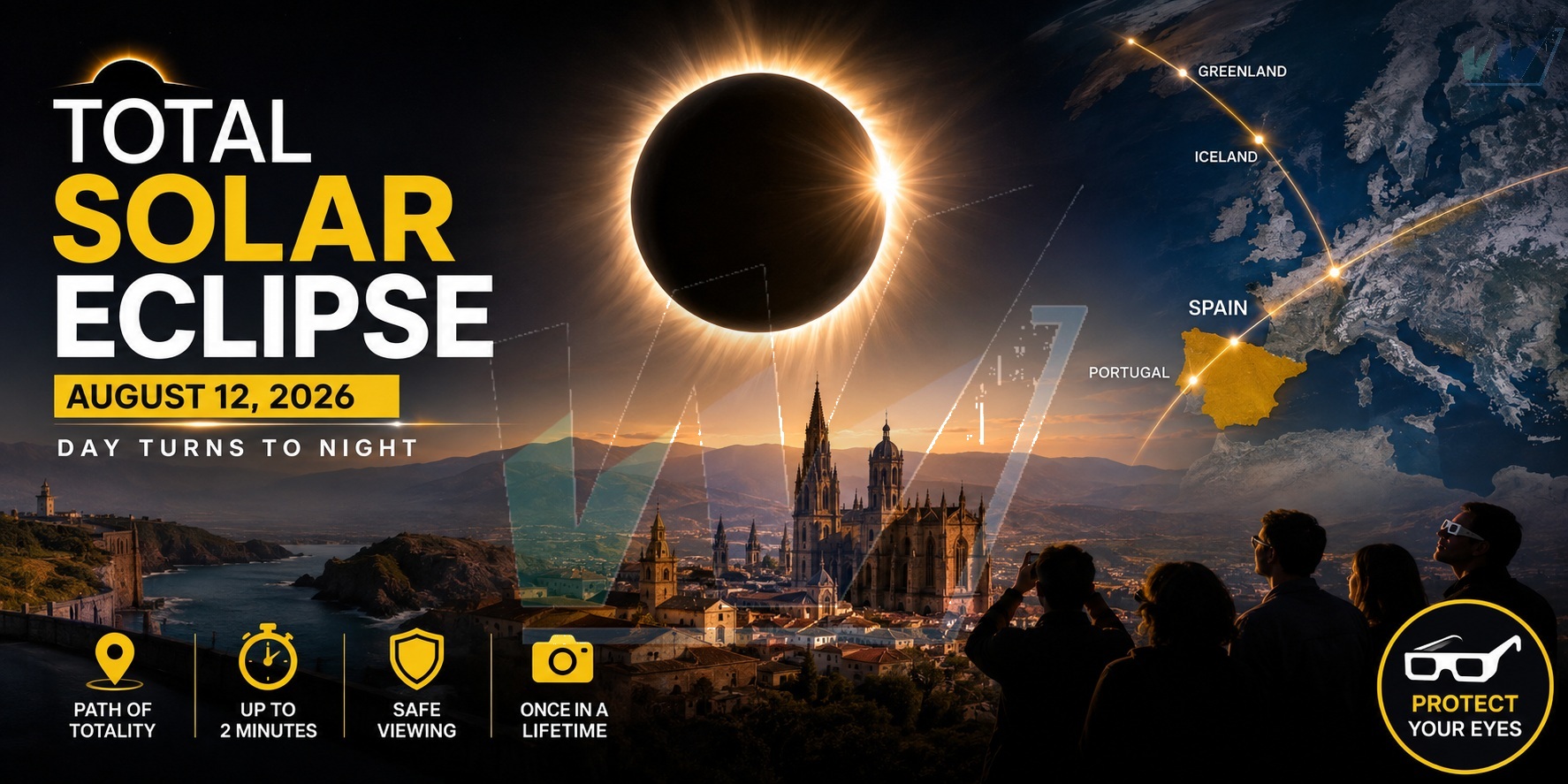
Astronomers, photographers, scientists, and eclipse enthusiasts from around the world are expected to descend upon northern Spain, Iceland, Greenland, and a small section of Portugal to witness a celestial alignment that many people experience only once in a lifetime.
The event marks the first total solar eclipse visible from mainland Europe in more than two decades, making it one of the continent’s most anticipated scientific and tourism events of the decade. NASA, the European Space Agency (ESA), national observatories, meteorological agencies, and governments have spent months preparing for the spectacle.
What Exactly Is a Total Solar Eclipse?
A total solar eclipse occurs when the Moon passes directly between Earth and the Sun, perfectly blocking the Sun’s bright disk.
This remarkable alignment creates a narrow corridor known as the Path of Totality, where observers experience complete darkness for a short period.
During totality:
- The Sun’s brilliant corona becomes visible.
- Temperatures can fall several degrees.
- Birds may stop singing.
- Nocturnal animals often become active.
- The sky resembles twilight even though it is daytime.
NASA describes this phenomenon as a remarkable “cosmic coincidence.”
Although the Sun is roughly 400 times larger than the Moon, it also happens to be about 400 times farther away, allowing the Moon to appear almost exactly the same size in Earth’s sky and completely cover the Sun.
Where Will the Eclipse Be Visible?
The eclipse begins over the Arctic before sweeping across the North Atlantic.
The path of totality will cross:
- Northern Russia
- Greenland
- Iceland
- Northern Spain
- Northeastern Portugal
The greatest excitement, however, is centered on Spain, where millions of residents and visitors will have front-row seats.
Major Spanish locations within the path include:
- Oviedo
- León
- Bilbao
- Burgos
- Zaragoza
- Valencia
- Mallorca
Much of Europe—including France, Germany, Italy, the United Kingdom, Ireland, Belgium, Switzerland, the Netherlands, and Scandinavia—will witness a spectacular partial eclipse.
Partial eclipses will also be visible across:
- Canada
- Northern United States
- Northwest Africa
Spain Becomes the World’s Eclipse Capital
Spanish authorities expect one of the country’s largest astronomical tourism events ever.
Hotels across northern Spain have seen exceptionally strong demand months in advance, while local governments have organized public viewing events, transportation plans, scientific exhibitions, and emergency services.
Because the eclipse occurs just before sunset, viewers will witness one of the rarest sights in astronomy:
A “Sunset Eclipse”
The eclipsed Sun will appear low on the western horizon, creating dramatic photographic opportunities unlike nearly any previous European eclipse.
How Long Will Total Darkness Last?
Unlike Hollywood portrayals, totality is surprisingly brief.
Approximate durations include:
- Spain: around 1 minute 45 seconds to just over 2 minutes
- Greenland: nearly 2½ minutes
- Russia: slightly under 2½ minutes
However, the complete eclipse experience, from the beginning of the partial phase until the Moon fully leaves the Sun, will last roughly 1 hour and 45 minutes.
In Burgos, total darkness is expected to last approximately 1 minute and 48 seconds.
Scientists Are Excited, And Not Just for the View
Solar eclipses provide unique scientific opportunities impossible during normal daylight.
Researchers will study:
- The Sun’s outer corona
- Solar magnetic fields
- Atmospheric temperature changes
- Solar wind activity
- Earth’s ionosphere
- Wildlife behavior during sudden darkness
ESA, NASA, universities, and research organizations are planning coordinated observation campaigns using aircraft, high-altitude balloons, satellites, and ground-based telescopes.
Europe’s Power Grid Is Also Preparing
The eclipse isn’t only attracting astronomers.
European electricity operators are closely monitoring the event because the temporary reduction in sunlight could briefly reduce solar power generation.
Although officials expect only limited impacts due to the eclipse occurring late in the afternoon, grid operators have prepared contingency measures to ensure network stability.
One of the Biggest Tourism Events of 2026
Experts believe the eclipse could generate hundreds of millions of euros in tourism revenue.
Communities across northern Spain are preparing for:
- International visitors
- Astronomy festivals
- Public viewing events
- Scientific conferences
- Astrophotography workshops
- Increased transportation demand
The event is expected to provide a significant boost to rural tourism and “Astro-Tourism,” particularly in smaller communities along the path of totality.
August 12 Will Be an Extraordinary Day for Astronomy
The eclipse is only part of an exceptional day in the sky.
Astronomy enthusiasts will also enjoy:
- The Perseid meteor shower near its annual peak.
- A notable planetary alignment visible before sunrise.
The combination makes August 12 one of the richest astronomical days in recent memory.
Protect Your Eyes, This Is Essential
Experts emphasize one message above all others:
Never look directly at the Sun without proper eye protection.
Viewing the eclipse without certified protection can permanently damage the retina in seconds.
Safe viewing requires eclipse glasses that meet the ISO 12312-2:2015 international safety standard.
Ordinary sunglasses, even very dark ones, are not safe.
Observers should remove eclipse glasses only during the brief period of totality, and only if they are located inside the path of totality. Once the Sun begins to reappear, eye protection must immediately be worn again.
Following the 2024 U.S. eclipse, physicians reported increased public concern over eye discomfort, reinforcing the importance of proper viewing precautions.
How to Photograph the Eclipse
Experts recommend:
- Using a tripod.
- Locking camera exposure manually.
- Including landscapes to capture changing light.
- Avoiding digital zoom.
- Using certified solar filters before and after totality.
- Planning camera settings in advance.
Modern smartphones can produce surprisingly impressive images when paired with eclipse glasses or dedicated solar filters.
Looking Ahead: Even Bigger Eclipses Are Coming
The August 2026 eclipse is only the beginning of an extraordinary series for Europe.
August 2, 2027
A much longer total solar eclipse will cross southern Spain, North Africa, Egypt, Saudi Arabia, and parts of the Middle East.
Totality will last an astonishing 6 minutes and 23 seconds, making it one of the longest eclipses of the 21st century.
January 26, 2028
Spain will witness an annular (“Ring of Fire”) solar eclipse, completing an extraordinary three-year sequence of major celestial events.
The Bottom Line
For less than two minutes, millions across Europe will watch the Moon completely erase the Sun from the sky, a breathtaking reminder of the precision and beauty of our solar system.
With scientists preparing groundbreaking observations, tourists flooding Spain, governments coordinating logistics, and astronomy enthusiasts traveling from every continent, the August 12, 2026, total solar eclipse promises to be far more than an astronomical event.
It will be a historic moment where science, nature, tourism, and human curiosity converge beneath one suddenly darkened sky.