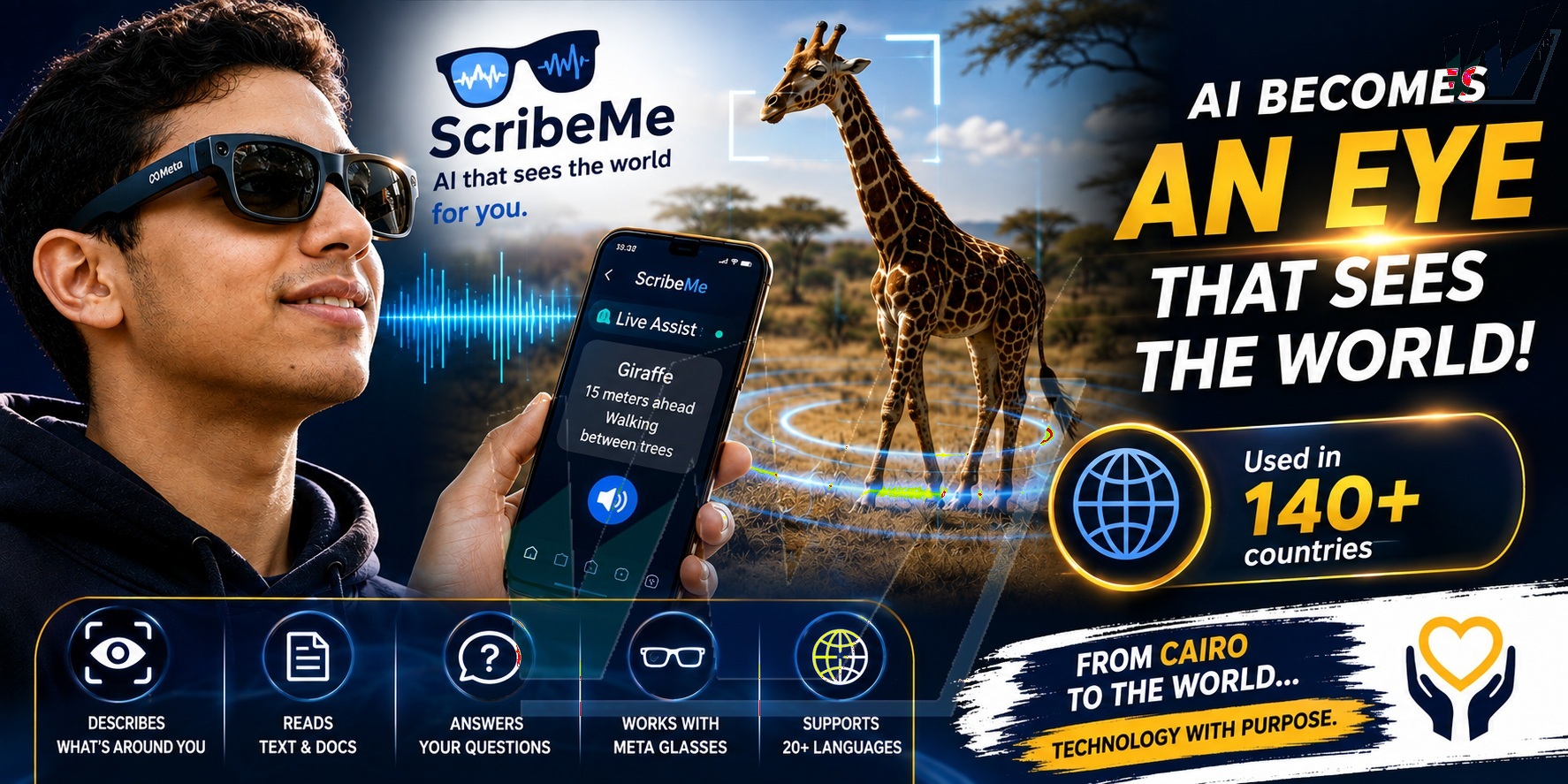
From Cairo to 140 countries, an Egyptian-built AI assistant is helping blind users understand their surroundings in real time, now through Meta smart glasses.
For Mark Morad, losing his sight did not close the door to the world. It opened the door to a different kind of technology, one designed to describe that world back to him.
The Egyptian entrepreneur, who is blind, created ScribeMe, an AI-powered accessibility platform that transforms visual information into spoken guidance. What began as a personal solution to a problem he faced in school has grown into a global tool used in 140 countries, according to Reuters’ latest report on August 18, 2026.
ScribeMe can describe surroundings, identify objects, read documents, analyze images and answer questions, giving blind and visually impaired users a continuous audio window into the world around them.
A Kenyan safari, and the moment everything changed
The most striking demonstration came not in a laboratory, but on a safari in Kenya.
Mark’s younger sister, 16-year-old Karen, also lost her sight after developing the same rare optic-nerve condition that affected her brother.
During the June 2026 trip, Karen used ScribeMe through Meta smart glasses. Instead of relying solely on another person to explain what was happening, she could hear descriptions of the animals around her, their movements, locations and distances.
For Karen, it was more than technological assistance.
It was a way to construct a moving mental picture of a scene she could no longer see.
She described the experience as making her feel, for a moment, as though she could see again.
From losing his sight to learning to code
Mark’s journey began in 2018, when he started experiencing serious vision problems.
Doctors in Egypt and abroad struggled initially to provide a definitive diagnosis. Eventually, the family learned that the rare condition would lead to permanent blindness.
By the end of 2021, both Mark and Karen had completely lost their sight, although their vision deteriorated at very different speeds.
But the greatest challenge was not simply navigating the physical world.
It was navigating a digital world that was still heavily dependent on sight.
At school, Mark struggled particularly with physics and chemistry. Conventional screen readers could handle ordinary text, but often failed when confronted with graphs, tables, equations and other visual material.
He contacted developers working on similar accessibility problems.
There was no answer.
So, Mark decided to build the solution himself.
He taught himself programming through YouTube tutorials and began developing what would eventually become ScribeMe. Within a few years, the project had evolved from a personal experiment into a working product.
A student project becomes an award-winning startup
ScribeMe soon moved beyond Mark’s own needs.
In 2024, the project entered the Vodafone AI Assistive Tools Hackathon, sponsored by USAID and Vodafone, where roughly 200 teams competed for funding and support.
ScribeMe emerged as the first-place winner, receiving financial backing and incubation opportunities.
The original concept focused heavily on making inaccessible PDF and PowerPoint files usable for blind students.
But technology quickly expanded.
ScribeMe became capable of interpreting images, describing environments and providing real-time assistance through a smartphone camera.
The mission had changed.
It was no longer simply about reading documents.
It was about helping blind people understand the visual world.
The “AI eye” moves from the phone to Meta glasses
The biggest leap came with Live Assist, ScribeMe’s real-time AI assistant.
In March 2026, ScribeMe announced Live Assist for Meta smart glasses in beta, enabling hands-free assistance that can continuously describe the environment around the wearer.
The implications are significant.
A blind person may already be holding a cane, carrying a bag or navigating a crowded environment. Having to repeatedly pull out a phone and point a camera can become another obstacle.
With Live Assist running through Meta glasses, the assistance can happen while the user’s hands remain free.
The system can identify objects, describe surroundings, help users locate things and even explain what is happening on television.
ScribeMe’s current App Store description also says Live Assist can provide continuous, real-time assistance through Meta AI glasses and can extend to the user’s phone screen, helping with websites, apps, photographs and other digital content.
From “What is this?” to “What is happening around me?”
That distinction is at the heart of ScribeMe.
The platform can read printed documents aloud, describe images and surroundings, interpret visual information and answer questions about documents and photos. Its OCR capabilities extend across more than 50 languages, according to the application’s current listing.
Its language reach has also expanded rapidly.
The current App Store listing shows support for English plus 18 additional languages, while ScribeMe recently announced five additional languages — Turkish, Estonian, Vietnamese, Polish and Romanian, bringing Live Assist to 20 languages.
Arabic is among the supported languages.
That means technology is moving beyond a simple question such as:
“What is in front of me?”
It is increasingly answering:
“What is happening around me? What does this document say? What is on my screen? Where is the object I am looking for?”
A global footprint built from Cairo
ScribeMe’s growth has accelerated sharply.
In April 2026, Egypt’s University of Informatics reported that the platform was already being used in 130 countries and 15 languages.
Just months later, Reuters reported the newer figure of 140 countries, highlighting the speed at which the platform’s international reach has expanded.
The platform is available as a free download with additional paid features through in-app subscriptions. Its current App Store listing identifies Mark Morad as the developer and describes ScribeMe as an AI-powered visual assistant built specifically for blind and visually impaired users.
A global race to build smarter accessibility
ScribeMe’s rise comes as major technology companies increasingly push AI-powered wearables into the accessibility space.
Meta’s smart glasses are becoming a platform for tools that can help blind and visually impaired people understand their surroundings, read signs and menus, identify objects and access assistance through voice interaction.
ScribeMe is part of that broader technological shift, but its origin gives it a distinctive edge.
This is not a product designed solely by engineers imagining what blindness might be like.
It was created by someone who experienced the problem himself.
Mark did not begin by asking what technology could theoretically do.
He began with a much more urgent question:
“Why can’t I access the information everyone else can see?”
When “impossible” becomes a starting point
Behind ScribeMe is a family story marked by fear, adaptation and persistence.
Mark and Karen’s mother struggled with the shock of watching both children lose their sight. But years later, the family found itself somewhere it could hardly have imagined: two blind siblings, one of whom taught himself to code and build a technology now reaching users around the world.
Their father described how the family eventually stopped saying “impossible.”
That may be the simplest way to understand ScribeMe.
It did not begin inside a Silicon Valley laboratory.
It began with a blind student struggling to understand a graph in a school document.
He could not find the tool he needed.
So, he learned how to build it.
Today, that small idea has moved from a phone screen to smart glasses, and from a bedroom-sized problem in Cairo to users across 140 countries.
As technology companies race to build machines that can see, hear and understand, ScribeMe raises a more human question: