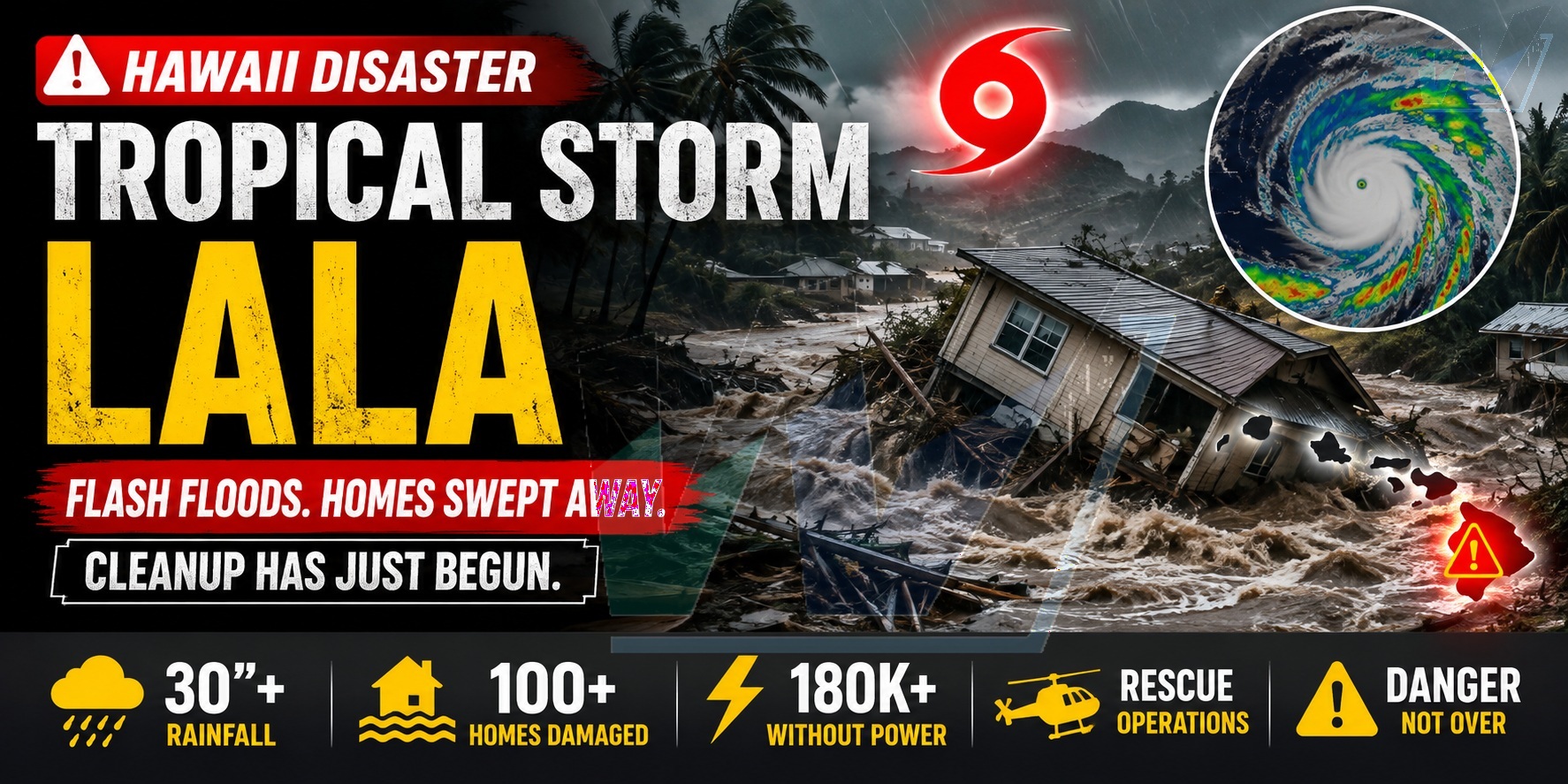
Tropical Storm Lala Batters Hawaii: Flash Floods Sweep Away Homes as Power Fails Across the Islands
HONOLULU — August 17, 2026, the winds are fading, but Hawaii’s emergency is far from over.
Tropical Storm Lala is pulling away from the Hawaiian Islands after first reaching Category 1 hurricane strength and unleashing torrential rain, destructive winds and flash flooding across the Big Island and neighboring islands.
The storm never made a direct landfall. But its eyewall passed close enough to the southern Big Island to turn roads into rivers, knock down trees and power lines, damage infrastructure and send floodwaters rushing through communities.
Now the danger is shifting from the storm itself to its aftermath.
Homes Swept Away as Floodwaters Surge
Southern communities on Hawaii Island suffered some of the most dramatic damage.
Officials reported that at least 100 homes were damaged, while several structures were swept from their foundations by powerful floodwater. In Nā‘ālehu, emergency responders launched search-and-rescue operations after homes were reportedly carried away by rushing water.
The flooding was intensified by Hawaii’s steep terrain, where enormous volumes of rain can rapidly funnel downhill into normally manageable waterways.
AP reported rainfall totals reaching as high as 35 inches in some elevated areas, while other reports put the highest storm totals even higher in localized mountainous terrain.
The result was a dangerous combination: saturated hillsides, swollen streams, debris-choked roads and rapidly rising floodwater.
Officials warned residents to stay off the roads as emergency crews struggled to reach isolated communities.
Lala Weakens, But the Threat Doesn’t Disappear
Lala strengthened into a hurricane on Saturday, reaching maximum sustained winds of 75 mph as it passed south of the Big Island.
Its closest approach brought hurricane-force conditions and intense rainfall to the island without the center crossing land. The storm subsequently weakened into a tropical storm as it moved westward away from the main Hawaiian Islands.
By Sunday, Lala’s sustained winds had fallen to around 65 mph, according to the latest reporting, while the system continued moving west.
That weakening brought relief, but not an immediate end to the danger.
Heavy rain remained possible, particularly across mountainous terrain, while dangerous surfing, rip currents, flooding and mudslides continued to threaten parts of the islands.
More Than 180,000 Without Power
One of Lala’s most disruptive legacies has been the collapse of electricity service.
More than 180,000 utility customers across Hawaii were without power at one point Sunday, according to Reuters. On Oahu alone, outages exceeded 220,000 customers before falling to roughly 130,000.
Downed trees, flooded roads and damaged transmission infrastructure slowed restoration efforts.
Some hospitals were forced to operate on generators, underscoring the pressure placed on Hawaii’s emergency infrastructure.
For residents in more isolated areas, restoring electricity could take substantially longer than in urban communities.
Roads Turn into Rescue Zones
The storm transformed ordinary roads into hazardous channels of water, mud and debris.
Emergency officials described rescue operations complicated by rushing water, boulders, darkness and debris.
The threat was particularly severe around the Big Island’s southern communities, where floodwaters reportedly moved with enough force to dislodge homes.
The damage also extended beyond residential neighborhoods. Roads and bridges were damaged, trees were uprooted and transportation links were disrupted.
Authorities repeatedly urged residents not to drive unless necessary.
Airports and Flights Disrupted
Lala also hit Hawaii’s transportation network.
Hilo International Airport and Ellison Onizuka Kona International Airport were temporarily closed during the height of the storm, while commercial ports on Hawaii Island and Maui County were also affected.
Air travel disruptions mounted rapidly: Hawaiian Airlines reported dozens of cancellations Sunday after roughly 190 flights were delayed or canceled Saturday, according to the reporting compiled during the storm.
Airports subsequently reopened, but officials urged travelers to confirm flight status directly with airlines because road access, weather and residual flooding could continue affecting journeys.
Hawaii Shuts Down as Cleanup Begins
The storm’s effects have been carried directly into Monday.
Hawaii officials ordered the closure of state offices, public schools and other government operations, allowing authorities time to assess damage, restore utilities and determine whether facilities are safe to reopen.
The state’s education department said public schools and offices would remain closed statewide Monday, August 17, while particularly affected schools on Hawaii Island faced longer closures.
The closures are a sign that Lala’s greatest challenge may now be logistical rather than meteorological.
Crews must clear roads, reconnect power, inspect bridges and buildings, remove debris and search for areas affected by flooding.
One Death Reported, But Storm Fatalities Remain Unconfirmed
Hawaii Gov. Josh Green said Sunday that at least one person had died in a vehicle accident near the southern tip of the Big Island.
Officials, however, said there were no confirmed storm-related deaths at that stage. Reuters reported the fatality as a car-related incident rather than confirming it was directly caused by the hurricane or tropical storm.
That distinction remains important as emergency crews continue damage assessments.
A Near-Miss That Still Became a Major Disaster
Lala’s passage exposed just how little distance is required for a Hawaiian hurricane to become dangerous.
The storm’s center stayed offshore, avoiding what would have been an extraordinarily rare direct hurricane landfall on the Big Island. Yet the island still experienced hurricane-force winds, extreme rainfall and destructive flash flooding.
The event is therefore a reminder that landfall is not the only measure of a tropical cyclone’s danger.
A storm can miss an island geographically while striking it physically.
The Next Threat: Water
As Lala disappears into the Pacific, Hawaii’s immediate battle is shifting.
The wind may be weakening, but the landscape remains saturated.
Rivers and drainage channels can continue rising after the heaviest rainfall has ended. Saturated slopes remain vulnerable to landslides, while debris can block roads and bridges. Heavy surfing and dangerous rip currents can also persist after a storm’s center has moved away.
That means the blue skies that may eventually return will not necessarily signal an immediate return to normal.
For Hawaii, the storm is leaving behind a second phase of danger, one measured not by wind speed, but by floodwater, damaged infrastructure and the race to reconnect isolated communities.
And for thousands still without electricity, the storm has not truly passed.
At a Glance
- Storm: Tropical Storm Lala
- Peak strength: Category 1 hurricane, 75 mph winds
- Direct landfall: No
- Hardest-hit area: Big Island, particularly southern and mountainous communities
- Homes damaged: At least 100 reported
- Homes swept away: Multiple structures reported
- Rainfall: More than 30 inches in some high-elevation areas
- Power outages: More than 180,000 customers reaching peak reported by Reuters
- Flights disrupted: Hundreds delayed or canceled across the storm period
- Schools: Hawaii public schools closed statewide Monday, August 17
- Main continuing threats: Flash floods, mudslides, debris, dangerous surf and power outages
Bottom line: Lala is weakening and moving away, but Hawaii is only beginning the difficult work of recovery.