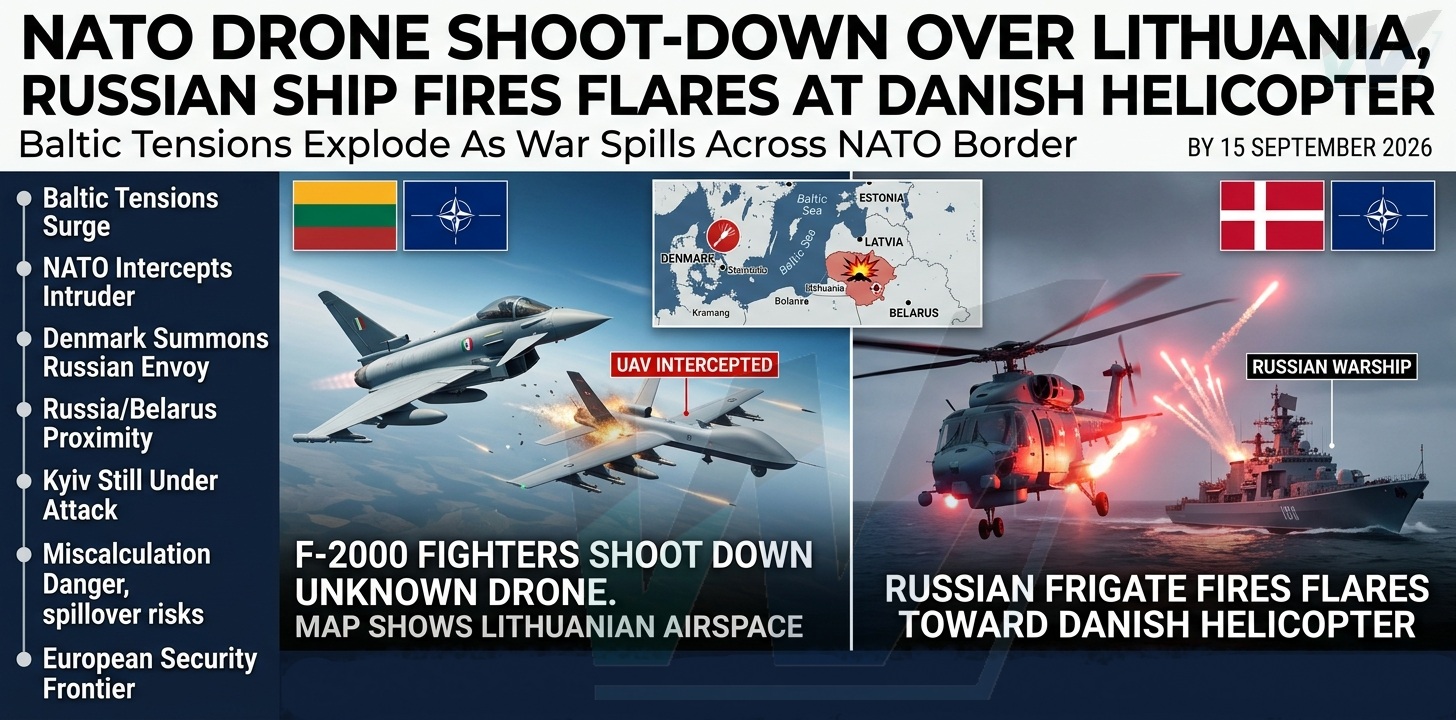
Baltic tensions surge as NATO intercepts an airspace intruder, Denmark summons Russia’s ambassador and Kyiv comes under another drone attack
By 15 September 2026
The war in Ukraine is pushing deeper into NATO’s immediate security perimeter.
Within hours, NATO fighter jets shot down a drone inside Lithuanian airspace, while a Russian frigate fired two signal flares toward a Danish military helicopter in international waters off Denmark — one passing close to the aircraft.
The incidents, separated by hundreds of kilometers but unfolding against the same backdrop, have intensified fears that Russia’s war against Ukraine is increasingly spilling into the Baltic region.
NATO fighters open fire over Lithuania
Shortly after midnight on Tuesday, Lithuanian authorities detected a drone entering the country’s airspace.
NATO aircraft operating from Šiauliai Air Base were scrambled. Italian fighter jets assigned to NATO’s Baltic Air Policing mission intercepted and destroyed the drone at about 00:20 local time, according to the Lithuanian military.
The drone came down near Pratkunai, in the Kaunas region. Lithuanian authorities believe it may have entered from Belarus, but its exact origin and purpose remain under investigation. Officials have also not established whether it was carrying explosives.
The incident triggered air-alert warnings across areas including Vilnius, Trakai and Elektrėnai, while authorities temporarily restricted operations at Vilnius Airport. The alert was later lifted after the drone was destroyed.
Lithuanian President Gitanas Nausėda thanked NATO personnel for the rapid response and stressed that the country must remain prepared for similar incidents.
The significance is immediate: NATO fighter aircraft did not merely scramble to identify an unknown object, they destroyed it inside an Alliance member’s airspace.
The Baltic Sea Confrontation
Then came the second flashpoint.
On Monday evening, a Russian frigate operating in international waters off Gedser, Denmark, fired two flares toward a Danish Air Force Fennec helicopter conducting a routine photographic mission.
One flare passed close to the helicopter.
Denmark’s Defense Command confirmed the incident and said there was no damage to the aircraft or personnel. The flares are normally used as pyrotechnic warning signals at sea.
But Copenhagen treated the incident seriously.
Denmark’s government summoned the Russian ambassador for an explanation, while Defence Minister Jeppe Bruus described the episode as serious and said Russian risk-taking appeared to have crossed a new line.
A Danish defense researcher described the flares as essentially a warning to the helicopter to keep its distance, intimidation rather than an attempt to destroy the aircraft, while stressing that the situation could have become dangerous had a flare struck the helicopter.
Not an isolated Baltic scare
The Lithuanian shoot-down comes after a string of drone incidents involving NATO’s northern and eastern members.
NATO’s Baltic Air Policing mission has operated since the Baltic states joined the Alliance in 2004, with allied fighters rotating through bases in Lithuania and Estonia. NATO says the mission exists to protect the airspace of Estonia, Latvia and Lithuania and to respond rapidly to unidentified or potentially hostile aircraft.
The pattern has accelerated.
NATO aircraft have already intercepted or destroyed drones over Estonia and Latvia this year. Earlier this month, Lithuania also experienced a false alarm when radar detected what initially appeared to be drones but was later identified as a flock of birds.
The latest Lithuanian incident is therefore being viewed against a growing regional pattern rather than as a standalone accident.
Poland also on alert
The pressure is spreading southward.
Poland recently recovered the wreckage of a suspected Russian military drone from the Baltic Sea near its coast and scrambled aircraft during subsequent security alerts. The developments followed a Russian drone attack near the Ukrainian-Polish border that struck a railway line shortly after foreign dignitaries had travelled through the area.
That geography matters.
Lithuania, Latvia, Estonia and Poland form part of NATO’s exposed northeastern frontier, directly adjacent to Russia or Belarus and close to the battlefield in Ukraine.
Every unidentified drone crossing the border now carries a second question: Is this spillover, misdirection, electronic warfare, or deliberate probing?
Meanwhile, Kyiv is still under attack
Inside Ukraine, the war has not paused.
On Tuesday, a Russian drone struck a petrol station in Kyiv, injuring one person, while warehouse facilities in another part of the capital were also hit, according to Kyiv Mayor Vitali Klitschko.
The attacks came only a day after U.S. President Donald Trump said Russia and Ukraine had agreed not to target each other’s energy infrastructure.
But Kyiv has not confirmed the blanket ceasefire.
President Volodymyr Zelenskyy said Ukraine could halt attacks against Russian energy facilities if Russia also stopped striking Ukrainian critical infrastructure and if Washington could guarantee Moscow’s compliance.
The apparent contradiction is stark: Diplomacy is talking about de-escalation while missiles and drones are still moving.
Russia’s air war is also evolving
The military pressure is not confined to conventional Shahed-style drones.
Reuters reported Tuesday that Russia is increasingly deploying jet-powered attack drones, creating a new challenge for Ukrainian air defenses because of their greater speed and maneuverability. Ukraine is developing interceptor drones and other technologies, but officials acknowledge serious difficulties in matching the newer Russian systems.
That technological race matters far beyond Ukraine.
The more sophisticated and numerous drones become, the greater the possibility that weapons or decoys will cross borders, lose navigation, or be affected by electronic warfare, bringing NATO countries directly into the consequences of the conflict.
A Baltic front is taking shape
For NATO, the danger is not necessarily that the Alliance is suddenly at war with Russia.
The immediate danger is miscalculation.
A drone crosses an international border.
A fighter launches.
A warship fires a flare.
A helicopter passes close to a frigate.
A warning becomes an interception. An interception becomes a confrontation.
And suddenly, an incident that began thousands of kilometers from Kyiv can land directly on NATO territory.
NATO has expanded its eastern-flank vigilance precisely because of this risk. The Alliance says its enhanced air-policing measures and Eastern Sentry activity were developed in response to increasing airspace violations and threats along its eastern borders.
The bigger picture
The latest incidents do not prove that Russia deliberately ordered the Lithuanian drone incursion, and Lithuanian authorities have not established the drone’s origin. Nor has Denmark said the Russian frigate intended to attack the Danish helicopter.
But the strategic picture is becoming harder to ignore.
Ukraine remains the battlefield. The Baltic is becoming the warning zone.
With drones crossing or approaching NATO airspace, Russian and NATO aircraft operating in increasingly crowded skies, and warships confronting military aircraft at sea, Europe’s eastern frontier is entering a more dangerous phase.
For NATO, the message from Lithuania is clear: An unidentified drone can now trigger a live military response inside Alliance territory.
And in the Baltic Sea, Denmark’s message is equally blunt: Warning flares fired toward a NATO military helicopter will not be treated as routine maritime behavior.
The question now is not simply where the next Russian strike will land.