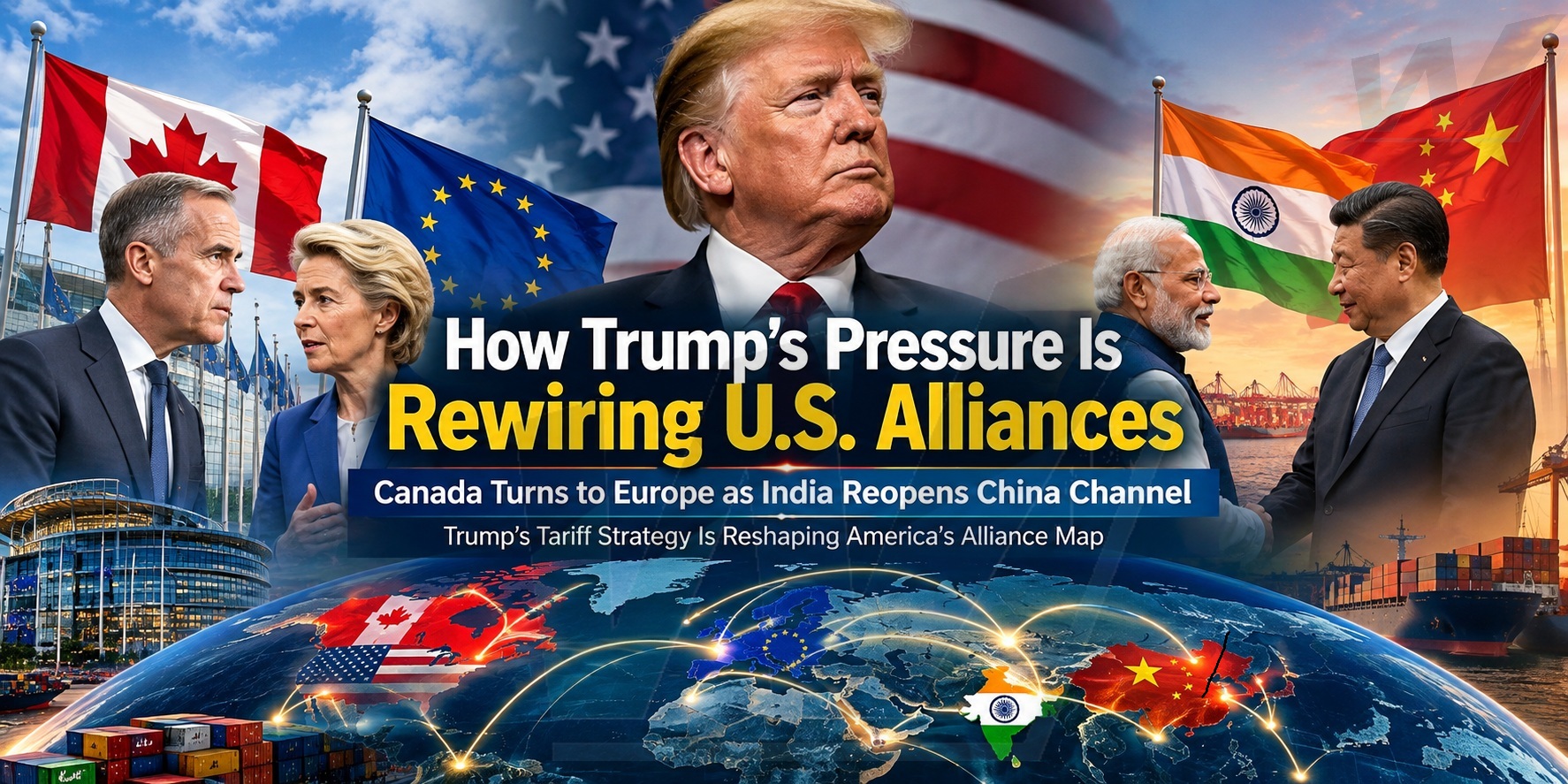
Canada Turns to Europe as India Reopens China Channel
Trump’s Tariff Strategy Is Reshaping America’s Alliance Map
From Canada’s strategic pivot toward Europe to India’s cautious thaw with China, Washington’s tariffs and pressure are pushing allies and partners to widen their options, without necessarily abandoning the United States.
The map of American alliances is not breaking apart overnight. It is being recalculated.
Across the Atlantic and Indo-Pacific, countries that have traditionally depended heavily on Washington are increasingly looking for additional markets, supply chains, security relationships and diplomatic room to maneuver.
Canada is accelerating its strategic opening to Europe. India is simultaneously trying to stabilize relations with China while resisting U.S. pressure over Russian oil. And even Washington’s Asian allies are watching the upcoming Trump-Xi summit for signs of how far U.S. policy may shift.
The emerging pattern is less a wholesale abandonment of the United States than a push for strategic diversification, an effort to make national interests less vulnerable to sudden changes in American policy.
Canada: From Washington to Brussels
The most dramatic example is Canada.
Prime Minister Mark Carney has embraced a deeper relationship with Europe after U.S.-Canada trade negotiations collapsed and Washington imposed steep tariffs on Canadian goods. Axios reported in August that new U.S. tariffs of up to 50% were set to take effect after the talks broke down.
Now Ottawa is looking across the Atlantic.
European Commission President Ursula von der Leyen proposed on September 16 that Canada explore becoming the European Union’s first “associate member”, a status that does not currently exist in EU law. The proposal would seek to take the relationship beyond the existing Canada-EU trade framework and deepen cooperation in defense, energy, critical minerals, artificial intelligence, the Arctic and economic security.
Carney quickly embraced the broader idea, while avoiding making the undefined “associate member” label the centerpiece of his proposal.
Speaking to the European Parliament, he argued that Canada and Europe could build greater strategic autonomy by combining their respective strengths.
Canada brings energy, critical minerals, Arctic geography, AI, space capabilities and capital. Europe brings a huge market, advanced manufacturing, research capacity and a growing defense-industrial base.
The objective is not self-sufficiency. It is collective resilience.
That distinction matters.
Canada is not leaving the United States. Carney has explicitly described Washington as an enduring neighbor and major partner. But Ottawa is trying to reduce the risks of having too many economic and strategic dependencies concentrated on one relationship.
Reuters reports that Canada is already pursuing broader defense and economic arrangements, including participation in the EU’s defense procurement framework, while Ottawa has also signaled interest in new security partnerships outside its traditional U.S.-centered framework.
Brussels opens a door, and Washington fires a warning
The European initiative immediately collided with Washington.
Trump called the Canadian-EU proposal potentially a “hostile act” and warned that the United States could impose heavy tariffs or even restrict trade with Europe if he concluded the initiative was directed against Washington.
That threat has exposed the central paradox of the moment.
The harder Washington pushes against diversification, the greater the incentive for other countries to diversify.
European officials have nevertheless stressed that closer cooperation with Canada is not intended to create an anti-American bloc. The European Commission has described the initiative as an effort to strengthen cooperation among democracies rather than confront another power.
There are also major obstacles.
“Associate membership” has no established legal framework, and EU governments have expressed reservations about the terminology and the practical implications. Any formal arrangement would require agreement among all 27 EU member states.
The October Canada-EU summit in Montreal could therefore become the next major test of whether the political symbolism can be converted into concrete agreements.
India: Washington pressure meets Beijing opportunity
India presents a very different, and potentially more consequential, case.
New Delhi is not abandoning its growing relationship with Washington. But pressure over Russian oil is forcing India to protect its own room for maneuver.
The U.S. House has passed legislation that could allow tariffs of up to 100% on countries purchasing Russian energy, potentially affecting major buyers including India and China. Reuters reports that New Delhi has warned the measure could damage bilateral relations while insisting that energy security remains a national priority.
Indian refiners also face practical difficulties in replacing Russian crude quickly, particularly amid wider disruptions to global energy supplies. Indian industry sources have warned that finding sufficient alternative barrels and shipping capacity could be difficult and expensive.
Then came another signal.
On September 12, Indian Prime Minister Narendra Modi and Chinese President Xi Jinping met on the sidelines of the BRICS summit in New Delhi and agreed to continue efforts to stabilize their relationship.
The two sides discussed trade, transportation, business links, market access and supply-chain issues. Modi emphasized that peace along the disputed border remains fundamental to further progress.
The meeting was significant precisely because India and China remain strategic competitors.
Their relationship was severely damaged by the 2020 Himalayan border clash. Territorial disputes, military deployments, China’s regional influence and India’s concerns about its enormous trade deficit with China remain unresolved. Bilateral trade nevertheless reached a record $155.6 billion in 2025, according to Reuters.
So, this is not a Sino-Indian alliance.
It is something more subtle: both governments appear willing to reopen channels where their interests overlap.
The China factor changes the equation
For Beijing, better relations with New Delhi offer an opportunity to reduce India’s strategic alignment with Washington.
For India, improved relations with China could provide additional economic and diplomatic flexibility while New Delhi faces pressure from the United States over trade and Russian energy.
At the same time, India continues to cultivate relationships with Europe, Britain, Canada and other partners.
Reuters reported that India has been pursuing alternative trade arrangements with the UK, EU and Canada as tensions with Washington persist.
The result is a distinctly Indian strategy: Avoid choosing one camp when multiple relationships can serve different interests.
And Washington is watching China too
The same dynamic is visible elsewhere in Asia.
U.S. allies are closely watching Trump’s upcoming meeting with Xi Jinping. Reuters reports that officials in Taiwan and Japan are concerned about the possibility that Trump could use issues such as Taiwan and arms sales as negotiating leverage in pursuit of economic concessions from Beijing.
The Trump-Xi summit, scheduled for September 24 in Washington, is expected to cover tariffs, critical minerals, artificial intelligence, Taiwan, Iran and fentanyl-related trade issues.
That uncertainty matters to U.S. allies.
If Washington’s position toward Beijing can change rapidly in response to trade or economic negotiations, governments in the region have an additional reason to develop their own diplomatic and economic safeguards.
A world of multiple partnerships
The deeper transformation may therefore not be the collapse of the American alliance system.
It may be the end of exclusive dependence.
Canada can remain a close U.S. security partner while simultaneously building stronger European economic and defense relationships.
India can deepen cooperation with the United States while reopening channels with China and maintaining its relationship with Russia.
European governments can cooperate with Washington while simultaneously strengthening their own industrial, technological and defense capabilities.
These strategies are not necessarily contradictory.
They reflect a world in which governments increasingly want multiple options before a crisis arrives.
Canada itself says its objective is strategic autonomy, not isolation. Its government says it has signed dozens of critical-minerals agreements and more than 20 trade and security deals across five continents, while seeking to expand access to non-U.S. markets.
The alliance map is changing, but not disappearing
The central question is no longer simply “Who is America’s ally?”
It is becoming:
“How dependent does an ally want to be on America?”
That is a very different question.
Trump’s use of tariffs and economic pressure is designed to extract concessions and reshape trade relationships. But the response from Canada, India and others demonstrates a potential secondary effect: governments can begin investing in alternatives precisely because they fear that access to the American market, technology, security umbrella or political relationship could become conditional.
The process is still incomplete.
Canada cannot quickly replace the United States economically or militarily. India cannot erase decades of rivalry with China. Europe still relies heavily on transatlantic security cooperation. And Washington remains indispensable to the strategic calculations of many of its allies.
But the direction is increasingly visible.
The old alliance system was built around dependence. The emerging system is being built around options.
And if that trend continues, Trump’s pressure may produce an unintended geopolitical legacy: not the disappearance of U.S. alliances, but a world in which America’s partners are less willing to rely on Washington alone.