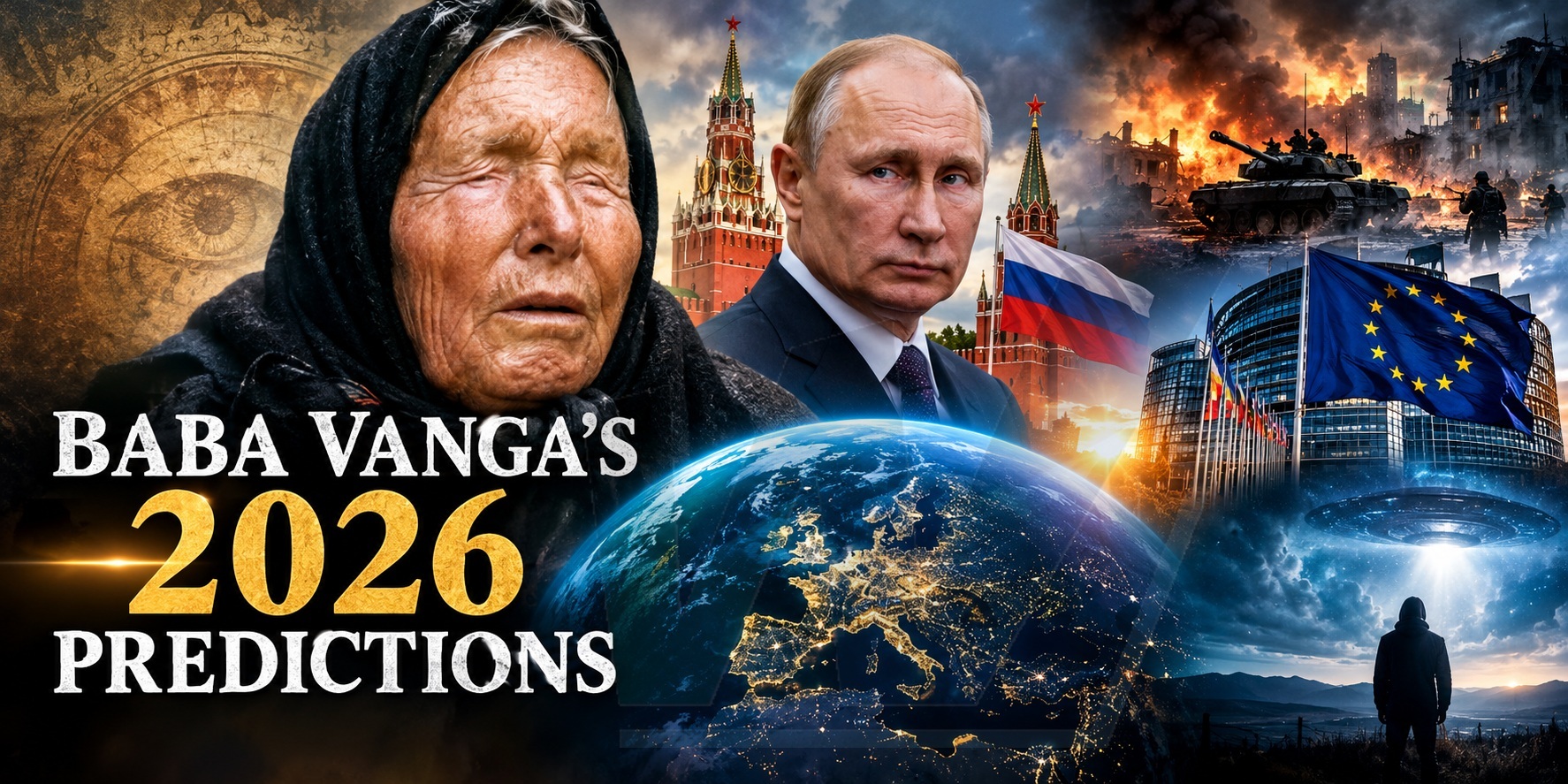
Putin’s Successor, Europe at War, and Baba Vanga: The Truth Behind the 2026 Prophecies
Baba Vanga’s Chilling 2026 Prophecies: World War III, Europe’s Future and the Rumored End of Putin’s Rule
The prophecy making headlines
Could 2026 bring a global conflict, a dramatic political upheaval in Russia or a turning point for humanity? Online stories attributing ominous predictions to Bulgaria’s legendary mystic Baba Vanga have reignited those questions, placing her name alongside fears of World War III, Europe’s future and the possible departure of Russian President Vladimir Putin.
The claims are compelling. They are also difficult to verify.
Recent international coverage has highlighted a fresh wave of stories alleging that Vanga foresaw a new Russian leader, an escalating confrontation between major powers and even an encounter with extraterrestrial life. Yet no authenticated record has been produced to establish that she made these specific predictions for 2026.
As wars, geopolitical rivalries and uncertainty continue to dominate international headlines, the story presents a deeper question: are these genuine prophecies preserved through history, or modern claims projected onto a mysterious figure who can no longer speak for herself?
Who was Baba Vanga?
Baba Vanga (1911–1996)
Born Vangeliya Pandeva Surcheva, she was a Bulgarian mystic and folk healer who became famous across parts of southeastern Europe for allegedly possessing clairvoyant abilities. She lost her sight during childhood and spent much of her later life in Bulgaria, where people sought her advice on personal, family and health matters. She died in August 1996.
Often called the “Nostradamus of the Balkans”, Vanga acquired a reputation that extended well beyond her lifetime. Supporters have credited her with anticipating major disasters, political changes and technological developments.
But there is a fundamental problem with many of the most dramatic claims: there is no reliable, comprehensive collection of authenticated predictions written or recorded by Vanga herself.
The Guardian’s March 2026 investigation into her legacy found that many predictions attributed to her were never recorded and that her name has been used to promote conspiracy theories and political narratives. Accounts published long after the supposed predictions are particularly difficult to verify.
Her historical fame is real. The accuracy and authenticity of individual prophecies must be assessed separately.
What allegedly did Baba Vanga predict for 2026?
The following claims have circulated in news reports, online discussions and prophecy roundups. They should be treated as unverified attributions, not established forecasts.
-
World War III and a wider global confrontation
Some accounts claim Vanga foresaw a major international war in 2026, potentially involving Russia, the United States and other powerful nations. Versions of the story also invoke a broader conflict affecting Europe and Asia.
What is verified? No authenticated, dated statement from Vanga has been established that predicts World War III beginning in 2026. The claim is being circulated against a backdrop of genuine international tensions, but that does not prove the prophecy is authentic.
-
Putin’s replacement and a new Russian leader
One of the most provocative claims alleges that Vanga predicted Putin’s departure and the arrival of a new leader in Russia during 2026.
The story raises questions about succession, political stability and Moscow’s future role in world affairs. But no authenticated original statement establishes that Vanga named Putin, specified his departure in 2026 or identified his successor.
There is no verified prophecy naming Putin’s replacement.
-
Europe facing a period of upheaval
Other stories portray Europe as entering a dangerous period of conflict, instability or decline. Some versions connect these claims to Russia-West tensions and the future of the continent’s political order.
The central difficulty is the absence of verifiable original wording. Broad references to Europe suffering a crisis can be retroactively attached to many different events, making them impossible to test reliably without a clear date and specific prediction.
-
An alleged encounter with extraterrestrial life
Another widely circulated 2026 claim suggests that humanity could encounter extraterrestrial intelligence in November, sometimes described in sensational accounts as a massive spacecraft approaching Earth.
The claim has no authenticated source tying it to Vanga. Nor does the circulation of such a prediction constitute scientific evidence of alien contact.
Why the Putin prediction is attracting attention
The claim that Vanga foresaw the end of Putin’s rule is especially striking because it combines an alleged supernatural forecast with a consequential question in international politics: who would lead Russia after Putin?
A change in Russian leadership could affect the Kremlin’s approach to Ukraine, relations with Washington, European security and the wider balance of power. But those are legitimate geopolitical questions, not evidence that a prophecy exists.
A report published by IBTimes UK on October 13, 2026, discussed claims linking Vanga to the end of Putin’s regime, a new Russian leader and an extraterrestrial encounter. The report also highlighted the absence of an authenticated source for these attributions.
Three distinctions matter:
-
A prediction about Putin: No authenticated original text or recording has been established that reliably attributes a specific 2026 departure forecast to Vanga.
-
A prediction naming his successor: No verified evidence establishes that she identified a future Russian leader who would replace him.
-
A political assessment of Russia’s future: Analysts can examine succession scenarios and Kremlin stability using political, economic and institutional evidence. Such assessments should not be confused with prophecy.
The most responsible conclusion is therefore straightforward: the alleged prediction may attract attention, but it cannot tell us when Putin might leave office or who might succeed him.
Is Europe facing the disaster Vanga supposedly foresaw?
Europe’s security concerns are real, independent of the mystic’s reputation.
The war in Ukraine, tensions between Russia and NATO, military preparedness and uncertainty over the future of transatlantic relations have kept the prospect of a wider confrontation in public debate. These developments help explain why stories about a European catastrophe attributed to Vanga can gain traction.
However, the existence of geopolitical danger does not validate a prophecy.
To establish that a historical prediction was genuine, researchers would need to locate a dated source that predates the events, verify its wording and demonstrate that the statement has not been altered or interpreted retrospectively.
Without that evidence, a broad warning about war could be attached to numerous conflicts across different decades. That is a weakness in the claim, not proof of supernatural foresight.
The Guardian’s investigation into Vanga’s legacy also examined how unverified predictions have been incorporated into political narratives, including stories that reinforce anti-Western or pro-Kremlin messaging.
Did Baba Vanga really predict previous world events?
Stories crediting Vanga with foreseeing major historical events have circulated for years. Popular accounts have linked her to the September 11 attacks, the death of Princess Diana and other disasters.
The crucial issue is not simply whether a prediction sounds similar to an event that later occurred. It is whether the prediction can be independently demonstrated to have existed before the event, in sufficiently precise and unaltered wording.
A credible assessment should ask four questions:
-
Was the original statement recorded or published before the event?
-
Is there a named, reliable witness or an authenticated document?
-
Does the wording describe the event specifically, rather than vaguely?
-
Are failed predictions counted alongside apparent successes?
If the original wording cannot be found, a later claim that Vanga “predicted” an event is not enough to establish that she did.
This is why researchers and journalists have repeatedly questioned the reliability of the long lists of prophecies attributed to her.
Why the Baba Vanga phenomenon keeps returning
Vanga’s enduring appeal rests on a powerful combination: an extraordinary personal story, a reputation for spiritual insight and the human desire to find meaning in uncertain times.
Her name also lends authority to stories that might otherwise attract little attention. A prediction attributed to a famous mystic can turn a speculative online post into a seemingly historical warning.
The process becomes particularly effective during periods of war or political anxiety. A vague statement is circulated, linked to current events and presented as evidence that the future was already foretold.
In its March 2026 reporting, The Guardian described how Vanga’s supposed predictions have been reshaped and repurposed online, sometimes for political purposes. The absence of authenticated records makes it difficult to distinguish genuine historical testimony from later inventions.
That does not mean every person interested in Vanga is deliberately spreading misinformation. It means that repeating a claim and verifying a claim are two different things.
What should readers watch for the rest of 2026?
Rather than treating alleged prophecies as forecasts, readers can follow measurable developments that will determine the international outlook.
The risk of a wider war
Monitor verified military developments, official statements, diplomatic negotiations and changes in NATO-Russia relations. A global war should not be declared imminent merely because an online prophecy claims one is coming.
Russia’s political future
Watch documented political developments, official announcements and credible reporting on succession scenarios. Do not treat unnamed predictions about Putin’s replacement as evidence of an impending leadership change.
Europe’s security
Follow official European security assessments, defense decisions, developments in Ukraine and diplomatic initiatives. These provide a stronger basis for evaluating risks than retrospective interpretations of a mystic’s alleged words.
The evidence behind the prophecy
Look for an original document, dated publication or authenticated recording. If an article cites another article that cites social media, without tracing the claim to a primary source, the attribution remains unverified.
The verdict: prophecy, political anxiety or modern myth?
Baba Vanga remains one of the most recognizable figures in modern prophecy folklore. Nearly three decades after her death, her name continues to surface whenever international events provoke fears about war, political upheaval or humanity’s future.
But the most dramatic claims associated with 2026, World War III, Europe’s supposed downfall, an extraterrestrial encounter and the predicted end of Putin’s rule, lack authenticated evidence establishing that she made those specific forecasts.
The distinction matters. Russia’s political future deserves serious analysis. Europe’s security deserves scrutiny. The danger of military escalation deserves attention. None requires an unverified prophecy to make it important.
The real mystery is not whether Baba Vanga predicted the future of 2026. It is how confidently the modern world continues to attribute predictions to a woman whose supposed words often cannot be independently verified.
Until reliable primary evidence emerges, her 2026 warnings should be treated as claims about a famous mystic story, not as a forecast of what is about to happen.