Tel Aviv–Vienna Flight Diverted: What We Know About the Sofia Emergency Landing
Austrian Airlines Bomb Threat: Tel Aviv Flight Diverts to Bulgaria
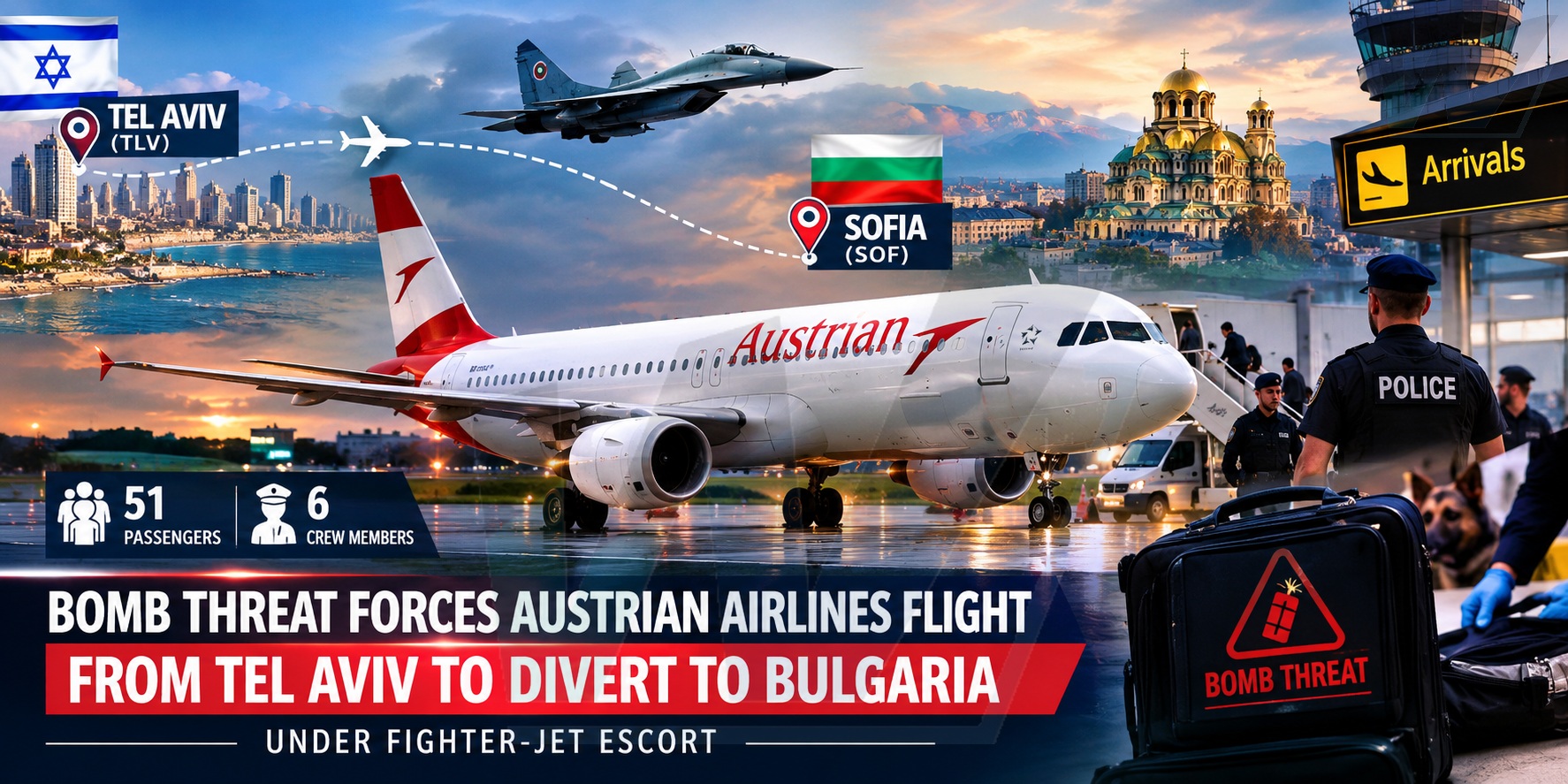
An Airbus A320 carrying 51 passengers and six crew members landed safely in Sofia after a reported bomb threat near the Bulgarian-Romanian border. Authorities launched an investigation as security teams searched for the aircraft.
A routine flight from Israel to Austria turned into a security emergency on Sunday evening when a reported bomb threat forced an Austrian Airlines passenger jet to abandon its route to Vienna and make an emergency landing in Bulgaria.
Flight OS82, an Airbus A320 travelling from Tel Aviv’s Ben Gurion Airport to Vienna, diverted to Sofia after the crew received a bomb-threat alert near the Romanian-Bulgarian border. A Bulgarian Air Force MiG-29 fighter jet escorted the aircraft to the Bulgarian capital, where it landed safely.
The aircraft was carrying 51 passengers and six crew members. All occupants were brought off the plane, while authorities-initiated security checks and an investigation into the threat, according to Bulgarian officials and international news reports.
Emergency diversion triggers fighter-jet response
The alert was reported while the aircraft was approaching the Romanian border. The crew decided to divert to Sofia rather than continue towards Vienna.
Bulgaria’s Transport Ministry confirmed that a fighter jet was scrambled under established procedures to accompany the plane until landing. The response brought military and civilian authorities into an unfolding aviation-security incident, with a crisis-response team assembled to coordinate the subsequent checks.
Flight-tracking information reported by international media showed the aircraft changing course towards Sofia. The flight was identified as OS82, operating between Tel Aviv and Vienna.
Passengers evacuated as aircraft undergo checks
After the aircraft landed, passengers disembarked and a security search was initiated. Austrian Airlines confirmed that a threat had been made against the flight and said passengers would be transferred to alternative flights once the aircraft search was complete.
At the time of the initial reports, authorities had not publicly established the source of the threat or disclosed evidence confirming that an explosive device was aboard. The emergency landing therefore should not be confused with confirmation of an actual bomb.
The investigation is expected to establish how the warning was received, whether it was credible and who was responsible.
Why the incident matters
The diversion highlights the procedures that can rapidly reshape a commercial flight when a potential threat emerges: crews must assess the warning, communicate with authorities and select a safe landing option, while security agencies prepare to respond on the ground.
For Bulgaria, the incident required coordination between aviation authorities, airport security and the air force. For Austrian Airlines, it meant an unexpected interruption to a route linking Israel with the Austrian capital and the need to arrange onward travel for affected passengers.
The episode also comes amid heightened attention to aviation security on routes serving Israel. However, investigators have not established a connection between this threat and any broader campaign or geopolitical actor.
Investigation remains the critical next step
The immediate outcome was reassuring: the aircraft landed safely, and officials reported no injuries in the initial coverage. But the central questions remain unanswered.
Who issued the threat? Was it a hoax, a malicious attempt to disrupt aviation or a warning that required further investigation? And how long would passengers have to wait before continuing their journey to Vienna?
Until authorities release verified findings, the incident remains a serious, reported security alert, not proof that a bomb was present.