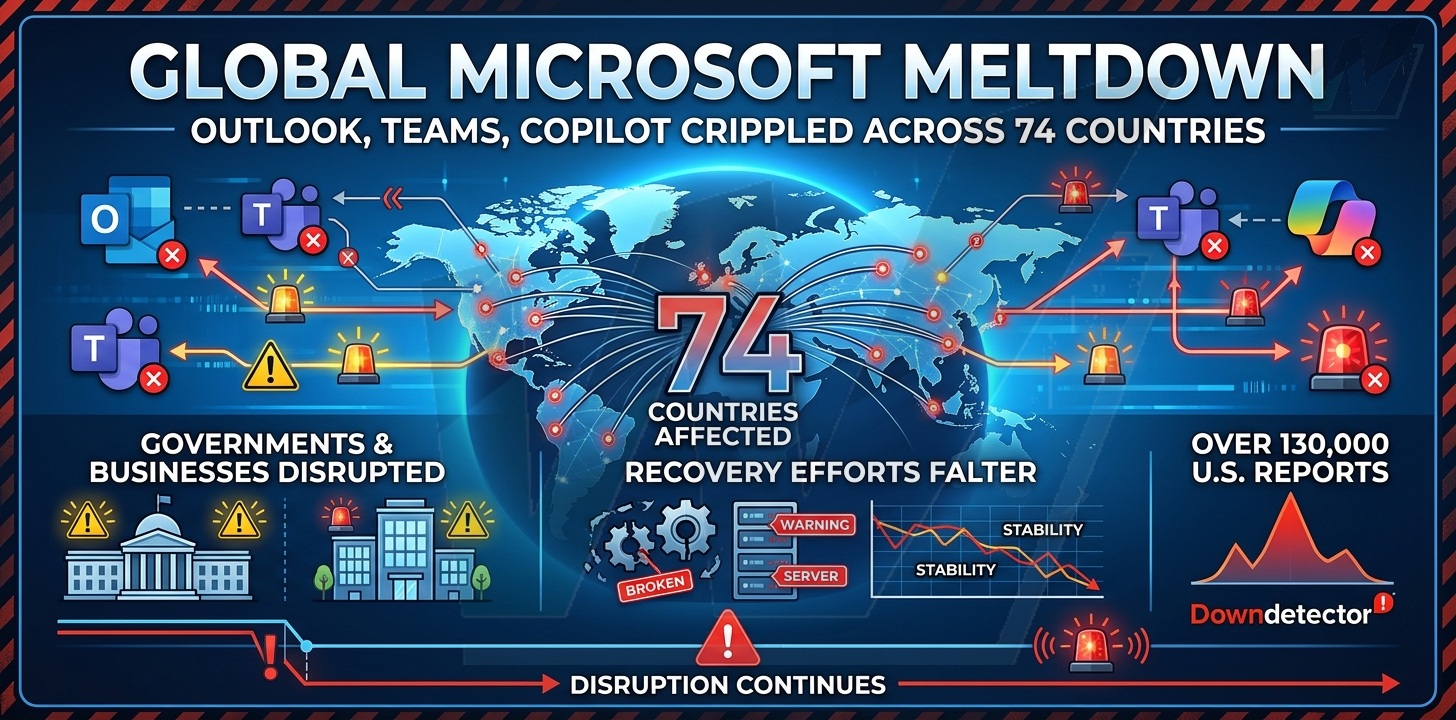
 Microsoft’s Global Meltdown: Outlook, Teams and Copilot Hit Across 74 Countries / Governments and Businesses on Alert
Microsoft 365 in Crisis: Outlook Failure Spreads Across Continents, Disrupting Governments and Businesses
One Infrastructure Failure, 74 Countries: Inside Microsoft’s Global Technology Meltdown A worldwide Microsoft infrastructure failure disrupts businesses, government agencies and digital services. More than 130,000 US Outlook problem reports recorded at the peak as engineers struggle to restore stability.
WASHINGTON / LONDON / SYDNEY
The world’s digital workplace was thrown into turmoil Thursday as a major Microsoft outage swept across 74 countries and territories, disrupting Outlook, Microsoft Teams, Copilot and other Microsoft 365 services.
What began as an apparent regional email failure quickly escalated into a global disruption, leaving employees unable to access inboxes, businesses struggling to communicate and government agencies confronting interruptions to essential digital operations.
At the height of the crisis, Downdetector recorded more than 130,000 US reports of Outlook problems shortly after 1 p.m. Eastern Time. Thousands more reported difficulties with Teams, Copilot and Microsoft 365.
The disruption continued into Friday, November 13, as Microsoft struggled to restore its infrastructure and prevent recovering servers from failing again.
From an email failure to a global technology crisis
Microsoft initially acknowledged connectivity problems affecting Exchange Online users in the Americas.
But the geographical picture changed rapidly.
Within approximately an hour, Downdetector had received reports from 74 countries and territories, with problems spreading across the Americas, Europe, Asia and Africa.
Users reported being unable to open their inboxes, send or receive emails, and connect reliably to Microsoft services.
The disruption extended beyond individual Outlook accounts. Teams, SharePoint Online, Copilot 365 and other enterprise services experienced problems, particularly where their operations depended on Exchange Online.
Microsoft’s servers become the center of the crisis
As the disruption intensified, Microsoft identified elevated infrastructure loads across multiple regions.
The company began redirecting traffic, pausing deployments, restarting affected servers and attempting to restore lost capacity.
But the recovery process proved more complicated than expected.
Some servers returned to service only to become unresponsive again once traffic resumed. Microsoft also identified failures involving automated server health checks and a process responsible for establishing secure connections.
By Friday morning, the company was still investigating traffic imbalances and problems affecting its backend infrastructure.
Its latest technical update described additional pressure on routing services and difficulties synchronizing a recent network change. Microsoft said it was increasing virtual-machine capacity and pursuing further corrective measures.
Although some regions experienced partial recovery, stable, worldwide restoration had not been established in the latest captured update.
Governments and businesses caught in the disruption
The consequences extended far beyond ordinary email users.
In Australia, government agencies, federal police and intelligence services reported impacts. Home Affairs Minister Tony Burke said Microsoft did not believe the incident was a cyberattack, describing the company’s preliminary assessment as resembling a problematic update.
Australia’s National Cyber Security Coordinator began monitoring the incident.
In the United States, the House of Representatives confirmed that its users had been affected, with engineers working alongside Microsoft.
Japanese authorities also acknowledged disruptions to government IT infrastructure.
Schools, public services and businesses faced communication difficulties, while some organizations had to rely on alternative channels.
In Australia, reports indicated that certain school administration systems and government email services were affected.
The AI industry was not immune
The outage also exposed the growing dependence of artificial intelligence platforms on interconnected cloud infrastructure.
OpenAI reported problems with Microsoft 365 connectors, warning that new connections could fail and connected tools might not function as expected.
Anthropic similarly identified an upstream Microsoft-related disruption affecting its Microsoft 365 integration, including email, calendar and search functions.
The incident demonstrated how a failure in one major technology provider can spread into services operated by other companies, even when their own platforms remain operational.
Is this another CrowdStrike-style warning?
Cybersecurity concerns quickly entered the international discussion.
However, Microsoft said there was no indication that malicious activity had caused the incident. Australian officials also relayed Microsoft’s preliminary assessment that the outage was not a cyberattack.
The comparison with the 2024 CrowdStrike disruption has nevertheless gained attention because both incidents illustrate the potentially enormous consequences of technical failures affecting widely used digital infrastructure.
The underlying mechanisms are not established as identical.
Technology experts have also warned that the growing concentration of digital services among a small number of cloud providers creates systemic vulnerabilities.
When businesses, governments and essential organizations depend on the same infrastructure, a technical failure can produce consequences far beyond the company experiencing the original problem.
A costly lesson in digital dependence
The financial consequences are already becoming visible.
Electric-truck manufacturer Workhorse Group postponed its third-quarter financial results announcement from November 12 to November 16, citing business disruption caused by the Microsoft outage.
For thousands of other organizations, the immediate challenge was restoring communications, accessing information and maintaining normal operations.
The incident also raises difficult questions about cloud-service resilience, backup communications, infrastructure redundancy and the risks of concentrating essential business operations within a single technology ecosystem.
The battle to restore confidence continues
Microsoft’s engineers remain under pressure to stabilize the affected infrastructure and return services to normal.
The company has pursued traffic redistribution, server restarts, capacity expansion and network adjustments, but its recovery efforts have encountered repeated obstacles.
The latest available incident report still showed Exchange Online service degradation, with no confirmed final resolution.
For millions of users, the problem is no longer simply whether Outlook will open again. It is whether the digital systems underpinning modern business and government can withstand the failure of a single critical provider.
Thursday’s disruption delivered a powerful warning: in an economy built around uninterrupted connectivity, one infrastructure failure can bring operations across continents to a standstill.