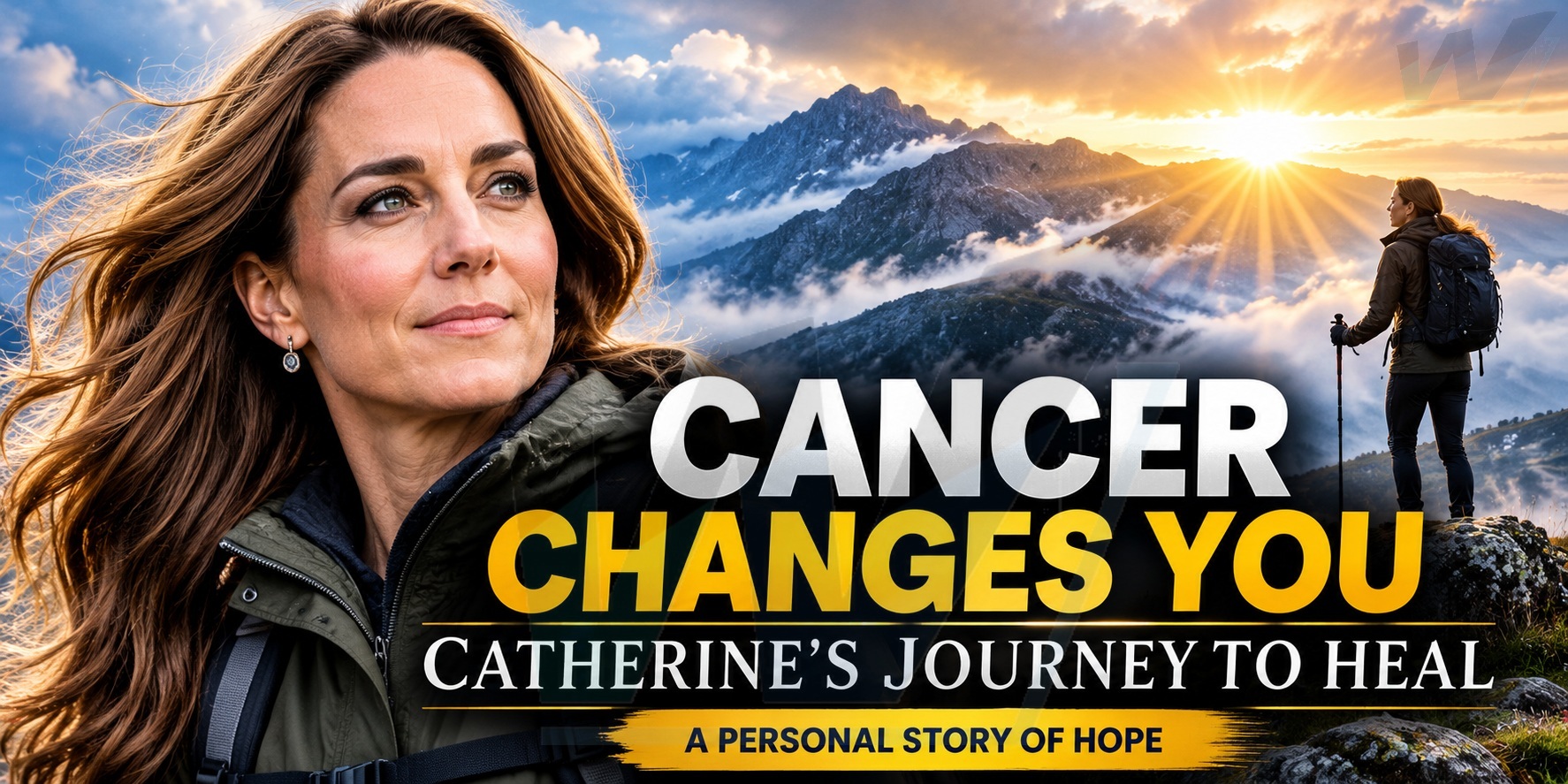
 Princess Catherine’s Cancer Journey: New Documentary “Heal” Reveals Life After Diagnosis and Recovery
Three mountains. One extraordinary physical challenge. And a woman confronting something far more difficult than the climb itself.
High above the British landscape, Catherine, Princess of Wales, undertook the Three Peaks Challenge, scaling the highest mountains in Scotland, England and Wales within 24 hours.
But this was not simply an endurance test.
Behind the journey was a deeply personal story: her experience of cancer, the uncertainty that followed her diagnosis, and the difficult process of discovering who she becomes after an illness that changes both body and mind.
Now, at 44, Catherine is sharing that experience through a new documentary titled Heal, offering an unusually intimate glimpse into a chapter of her life that she has largely kept private.
In its trailer, released by Kensington Palace on November 21, she delivers a powerful reflection:
“Cancer does change you.”
It is a simple sentence, but one carrying a message that reaches far beyond the British royal family.
Because surviving cancer is not always the end of the journey. For many patients, it marks the beginning of another challenge: learning to live with a changed body, new uncertainties, emotional scars and a different understanding of life.
And that is precisely what Catherine wants the world to understand.
The documentary will premiere on BBC One on November 29, with international broadcasts beginning shortly afterwards.
The diagnosis that changed everything: March 2024
In March 2024, Catherine made an announcement that shocked Britain and attracted worldwide attention.
Following major abdominal surgery earlier that year, further medical tests had revealed cancer. She confirmed that she was undergoing preventative chemotherapy.
She did not disclose the type of cancer, choosing to keep that aspect of her medical history private.
The announcement came during an exceptionally difficult period for the British royal family. King Charles III had also revealed a cancer diagnosis in February 2024, placing two senior members of the monarchy at the center of an unprecedented period of public concern.
For Catherine, the immediate priority was treatment, recovery and protecting her family, particularly her three children: Prince George, Princess Charlotte and Prince Louis.
In September 2024, she announced that she had completed chemotherapy.
Then, in January 2025, she shared another important update: she was in remission.
But her message carried an important qualification. Recovery takes time, and life after cancer is not necessarily a return to the life that existed before diagnosis.
As she explained at the time, patients must adjust to what she described as a “new normal”.
That understanding now forms the emotional foundation of Heal.
The Three Peaks Challenge: More than a royal adventure
In June 2026, Catherine took on one of Britain’s best-known endurance challenges.
The Three Peaks Challenge involves climbing:
- Ben Nevis in Scotland, the highest mountain in the United Kingdom.
- Scafell Pike in England, the country’s highest mountain.
- Yr Wyddfa (Snowdon) in Wales, the highest mountain in Wales.
The objective is to complete all three climbs within 24 hours.
Catherine undertook the challenge in support of The Royal Marsden Cancer Charity, connected to the London hospital where she received treatment.
Her achievement was remarkable not simply because of the physical demands involved, but because of what the journey represented.
At the end of the challenge, she was reunited with Prince William and their children, George, Charlotte and Louis, alongside members of her wider family.
The documentary uses the mountains as more than a dramatic backdrop. They become a visual metaphor for the obstacles people face when navigating serious illness.
The climb also connects Catherine’s personal recovery with a wider mission: improving support for people living with cancer, including their emotional wellbeing and quality of life.
The revelation that goes deeper: Facing mortality changes how you see life
On November 23, a new extract from the documentary revealed an even more personal dimension of Catherine’s experience.
She spoke about confronting her own mortality and recognizing that life is not infinite.
The experience, she suggested, softened her heart and changed her understanding of what truly matters.
She also reflected on the difficulty of returning to the person she had been before her diagnosis.
“Once you experience something like that, it’s very hard to go back to the person you were before,” she explained.
In another moment, speaking with her brother James Middleton, Catherine discussed the symbolic idea of ringing the bell that cancer patients sometimes ring when they complete treatment.
“I didn’t ring the bell,” she said.
Her brother offered a different interpretation: perhaps completing the Three Peaks Challenge, and sharing her story through the documentary, was her way of ringing it.
The exchange is particularly moving because it highlights an experience familiar to many cancer survivors: finishing treatment does not necessarily mean feeling that everything is over.
There can be physical recovery, emotional adjustment, uncertainty and the gradual rediscovery of ordinary life.
The documentary does not present healing as a single victorious moment. Instead, it explores it as a continuing process.
Why the documentary is called Heal
The title is significant.
Catherine is not simply revisiting the moment she received her diagnosis. She is exploring what happens afterwards, the complicated period in which patients try to reconnect with themselves, their families and the world around them.
In the trailer, she speaks about finding hope and joy alongside uncertainty.
She also stresses that people are not meant to carry life’s challenges alone.
The film brings her experience into conversation with other people navigating serious health challenges, placing emphasis on the human connections that can help patients through difficult periods.
Its message is particularly relevant to families and caregivers, who often experience the emotional consequences of cancer alongside the person receiving treatment.
The documentary is directed by Benji Jackson, produced by Detail Films and introduced by broadcaster Kirsty Young. It runs for approximately 30 minutes.
Its wider purpose is also charitable: all funds received through international distribution are being directed to The Royal Marsden Cancer Charity, supporting people living with and beyond cancer.
The royal family and cancer: A shared experience that brought the issue into focus
Catherine’s experience unfolded during a difficult period for the British monarchy.
In February 2024, Buckingham Palace announced that King Charles III had been diagnosed with cancer. The monarch subsequently resumed public duties while continuing treatment.
Catherine revealed her own diagnosis the following month.
The fact that two senior members of the same royal family were confronting cancer within weeks of one another brought unprecedented attention to the subject.
But Catherine’s documentary takes a different approach from conventional royal coverage.
Rather than focusing on palace ceremonies, official engagements or institutional responsibilities, it centers on vulnerability, family support and the personal realities of serious illness.
That shift may explain why the film has the potential to resonate well beyond royal watchers.
Its central message is not about royalty. It is about the human experience of uncertainty and the possibility of rebuilding a meaningful life after illness.
Beyond the palace: Why Catherine’s message matters to millions
Cancer touches families across borders, generations and social backgrounds.
For some, the hardest moment is hearing the diagnosis. For others, it is the uncertainty of treatment, the exhaustion of recovery or the emotional struggle that follows when the immediate medical crisis appears to be over.
Catherine’s documentary highlights an often-overlooked dimension of survivorship: the need to rebuild a sense of identity and purpose.
Its message has particular relevance for younger generations, who increasingly encounter conversations about mental wellbeing, resilience, emotional vulnerability and the importance of asking for support.
It also speaks to parents, partners, children and caregivers, reminding them that recovery is rarely an individual journey.
And for the wider healthcare community, the film brings attention to holistic cancer care, an approach that considers not only the disease itself but also the patient’s emotional wellbeing, resilience and quality of life.
There is an important distinction, however: Catherine’s personal experience is not a medical blueprint. Every cancer diagnosis, treatment and recovery journey is different.
What her story can offer is something equally valuable: visibility, empathy and a reminder that life after treatment deserves attention and support.
The final message: Healing is not about becoming the person you were before
Catherine’s story is not a simple narrative of a royal woman overcoming an obstacle.
It is a story about change.
A diagnosis altered her understanding of life. Treatment demanded patience. Recovery required a different kind of strength. And the mountains offered an opportunity to turn a deeply personal experience into a message of solidarity.
Perhaps the most powerful idea in Heal is that recovery does not have to mean returning to exactly who you were before.
Sometimes, it means discovering how to live with a new understanding of yourself.
Catherine has described the importance of hope, joy, family and human connection, even when uncertainty remains.
Her documentary arrives with a message that deserves to travel much further than the walls of a royal palace:
We may not be able to control every challenge life brings, but we do not have to face those challenges alone.
And sometimes, healing begins when we stop measuring life by how quickly we return to the past and start discovering what is still possible in the future.