Trump’s Naked Golden Statue “The Orange Plague” Unveiled at European Parliament in Strasbourg
“King of Injustice”: Naked Golden Trump Statue Takes Aim at U.S. Power in Europe
STRASBOURG, France / October 8, 2026
Donald Trump has arrived at the European Parliament in Strasbourg without a diplomatic motorcade, a speech or a summit, but in gold, naked and perched on the back of a struggling man.
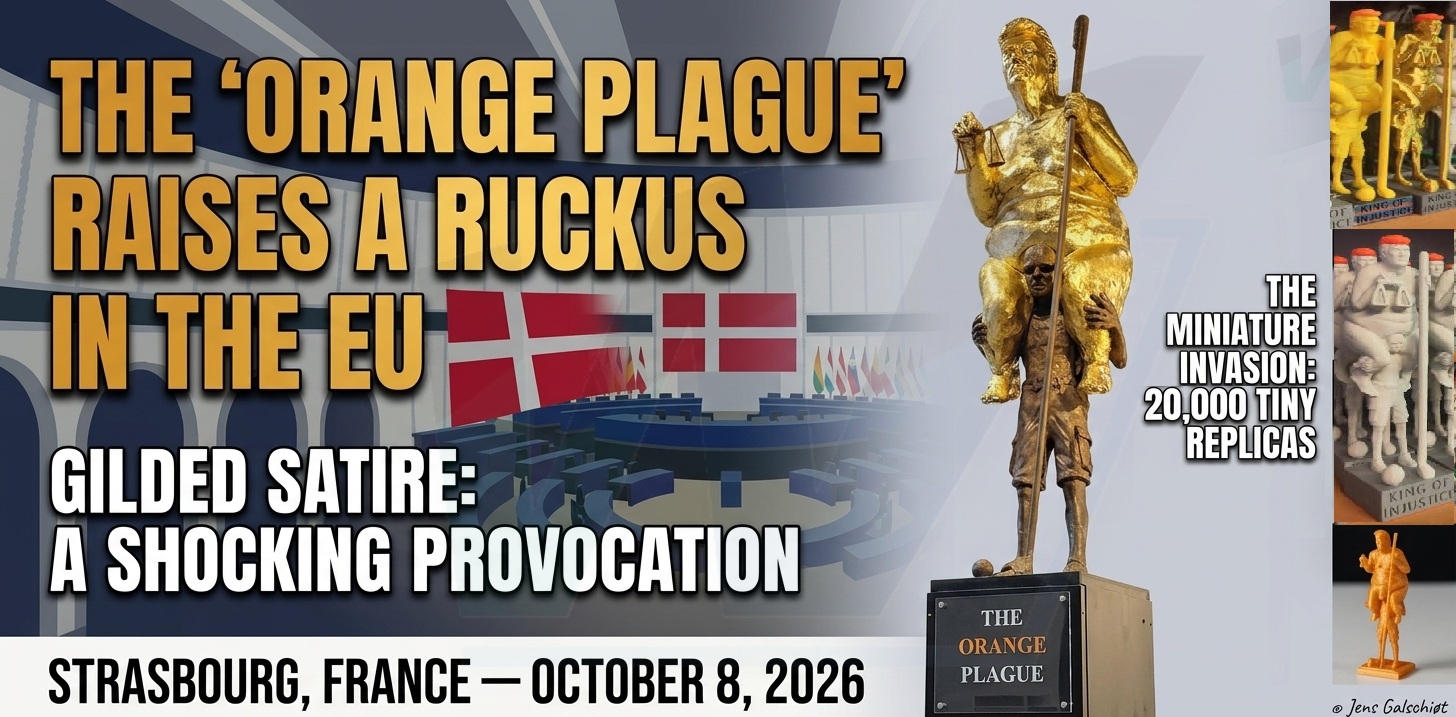
The provocative 2.6-metre sculpture, “The Orange Plague,” by Danish artist Jens Galschiøt, was unveiled this week inside the European Parliament building, transforming one of its busiest corridors into a sharply political stage. The copper figure is covered in 23-karat gold leaf and depicts Trump holding a golf club and the scales of justice while a smaller, frail figure carries his weight.
The work is also known as “The King of Injustice.” Beneath it, a plaque delivers the sculpture’s message in the imagined voice of its subject:
“I am sitting on the back of a man.
He is sinking under my burden.
I will do anything to help him.
Except stepping down from his back.”
The imagery is deliberately blunt: power above, the powerless below, and a president associated by the artist with wealth, dominance and political pressure literally sitting on another man’s shoulders.
From Andersen’s Emperor to Trump’s Gold
Galschiøt says the sculpture was inspired by Hans Christian Andersen’s “The Emperor’s New Clothes,” the classic Danish tale in which an emperor parades in imaginary finery until a child exposes the obvious truth.
The artist has turned that idea into a modern political provocation. His Trump is not merely naked; he is gold-plated, a visual reference Galschiøt says is linked to Trump’s well-known attraction to gold and his use of gold in his surroundings.
“Trump likes gold,” the artist told CNN. “In a way, I think he would like this sculpture.”
Galschiøt describes the piece as a “satirical outcry” against what he sees as Trump’s climate policies, foreign policy and challenge to the rules-based international order. On his website, he argues that governments and NGOs may hesitate to confront Trump’s policies because they fear tariffs, funding cuts, deportations or other forms of pressure.
His message is therefore larger than the statue itself: he wants the sculpture to force a confrontation with power that political language, in his view, has failed to deliver.
Why the European Parliament?
The sculpture’s location is part of the provocation.
It was brought to Strasbourg at the invitation of Danish MEP Per Clausen, a member of the left-wing group The Left. The exhibition was approved under Parliament’s procedures governing MEP-sponsored cultural events; it does not represent an official position of the European Parliament as an institution.
Clausen has openly defended the decision.
Asked whether he feared a reaction from Trump, he said that anyone too sensitive to tolerate such a sculpture being displayed in the European Parliament had no place on the world stage.
The setting is calculated: politicians, EU officials, lobbyists, journalists and visitors pass directly through the area where the sculpture has been installed. The artwork was displayed for a limited period and is scheduled to leave Strasbourg on Thursday, October 8.
A Statue Designed to Travel and Multiply
“The Orange Plague” is not a one-day stunt.
The sculpture previously appeared at COP30 in Belém, Brazil, at demonstrations supporting Greenland in Copenhagen, and at the Munich Security Conference. Galschiøt plans to take it next to COP31 in Antalya, Türkiye, in November.
But the artist has gone further than simply moving one giant statue from city to city.
Thousands of small 3D-printed replicas have been produced as protest tokens. Galschiøt says he made roughly 20,000 miniatures, distributing them to visitors and European Parliament staff. The idea turns a temporary installation into something people can carry away and reproduce.
The artist has also made files available so people can print their own versions.
Not Everyone Is Laughing
The sculpture has attracted attention, laughter and applause, according to Galschiøt and reporting from the exhibition. But the reaction has not been uniformly amused.
Right-wing European lawmakers have attacked the installation as insulting and inappropriate. Belgian MEP Barbara Bonte, of the Vlaams Belang party, called it a disgrace and argued that the display showed a lack of respect for the president of a friendly country.
That clash is precisely the territory Galschiøt’s work is designed to occupy: when does political satire become legitimate protest and when does it become political humiliation?
The exhibition has turned that question into part of the artwork itself.
Trump Has Not Responded Yet
As of October 8, Trump had not publicly responded to the Strasbourg sculpture, according to multiple reports. The absence is notable because the president has frequently responded forcefully to criticism, particularly when it involves his public image.
For now, the statue speaks for itself.
A gilded Trump sits above a man who can barely carry him. A golf club points toward the floor. The scales of justice remain in his hand. And the words beneath him accuse the powerful figure of refusing to get off the back of the person carrying him.
The sculpture’s political message is impossible to miss.
Europe has turned Trump’s image into a monument and then stripped the monument of its clothes.
For Galschiøt, that is the point.
The question now is whether the statue’s next stop at COP31 in Türkiye will make the same image a passing provocation or turn it into a wider symbol of resistance to Trump’s influence over climate policy, international relations and the global order.
For a sculpture called The Orange Plague, the artist clearly wants it to travel far beyond Strasbourg.