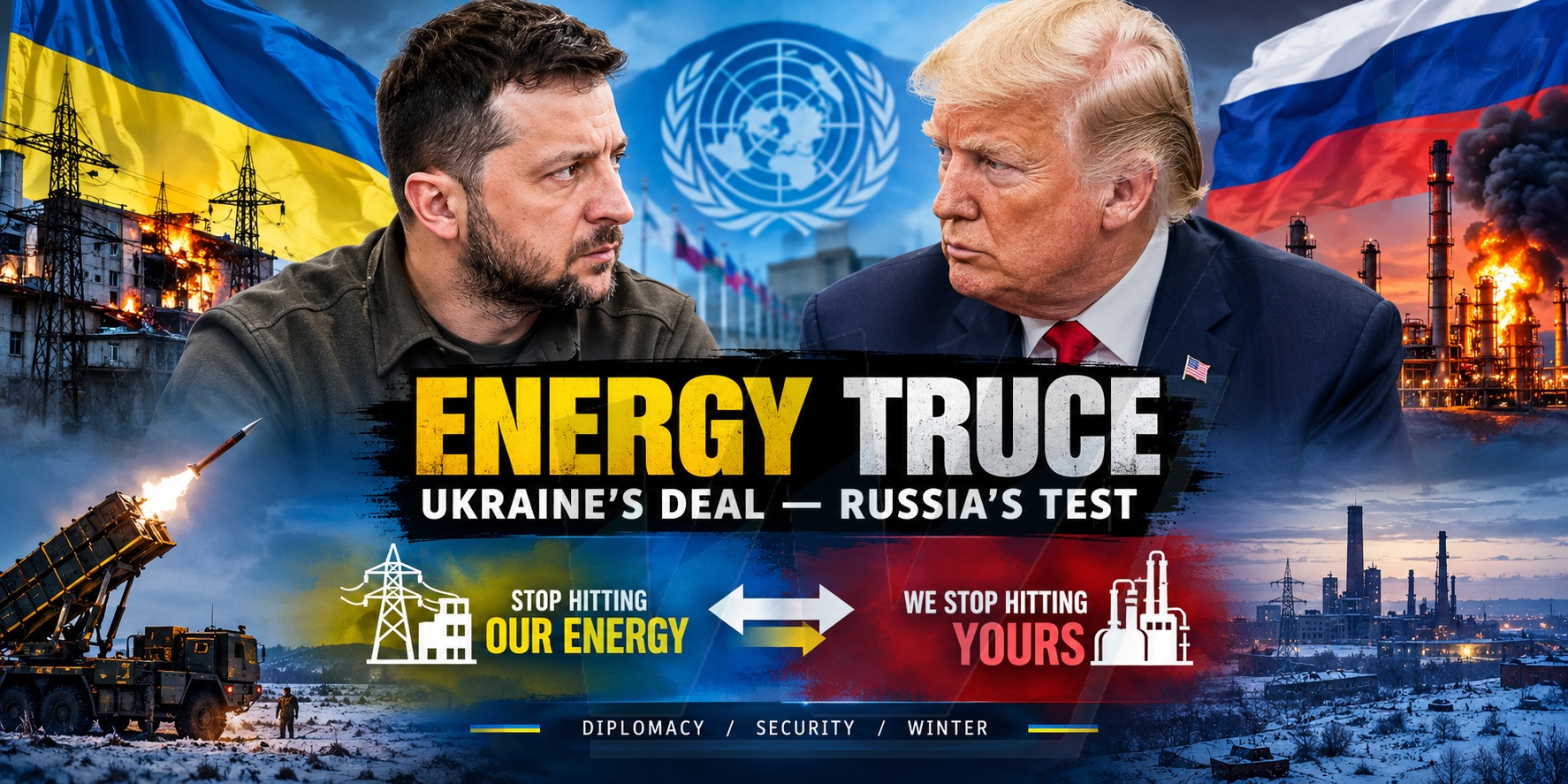
Zelenskyy Draws a Line After Trump Talks: “Stop Hitting Our Energy, We Stop Hitting Yours”
Ukraine is ready to stop striking Russian energy facilities if Moscow halts attacks on Ukraine’s power, heating and water systems, Zelenskyy says after a 40-minute meeting with Trump at the UN.
September 23, 2026
The battlefield is moving into a new phase, and this time the target is the energy war.
After a 40-minute meeting with U.S. President Donald Trump in New York, Ukrainian President Volodymyr Zelenskyy said Kyiv is ready for a mutual “energy ceasefire” with Russia, potentially opening another path toward wider negotiations.
But there is a crucial catch: Ukraine will not stop unilaterally.
Zelenskyy said Kyiv would halt attacks on Russian refineries and other energy facilities if Moscow stops striking Ukraine’s electricity, heating, water and wider energy infrastructure. U.S. representatives are expected to carry the Ukrainian proposal to Russia.
For now, however, this remains a proposal, not a ceasefire in force.
Trump-Zelenskyy meeting opens a new diplomatic track
The meeting took place on the sidelines of the 81st UN General Assembly as Washington again pushes for an end to Russia’s war against Ukraine.
Zelenskyy said both Washington and Kyiv want the war ended before winter and described their discussion as focused on potential de-escalation measures that could reopen a diplomatic path.
The Ukrainian presidency confirmed that the two leaders discussed steps toward diplomacy, a winter air-defense package and continued work on producing Patriot interceptors in Ukraine.
Zelenskyy later told reporters that Trump did not demand that Ukraine stop attacking Russian energy targets on its own.
Instead, Kyiv’s position was straightforward: if Russia stops hitting Ukrainian energy infrastructure, Ukraine is prepared to stop responding against Russian energy facilities.
That distinction matters.
It transforms the issue from a unilateral Ukrainian concession into a proposed reciprocal arrangement.
From refineries to power grids: The energy battlefield
The energy question has become one of the most dangerous pressure points in the war.
Russia has repeatedly targeted Ukrainian power and critical infrastructure, while Ukraine has expanded long-range strikes against Russia’s oil industry, including refineries and other facilities that help sustain Moscow’s war economy.
The consequences now extend beyond the battlefield.
Russia remains a major participant in global fuel markets, and disruptions to refining and exports have contributed to international concerns over diesel supplies and prices. Trump has repeatedly criticized Ukrainian attacks on Russian fuel facilities, arguing that they are worsening pressure on diesel markets.
Trump’s concern is particularly significant because global energy markets are already under pressure from the wider Middle East conflict and disruptions surrounding the Strait of Hormuz.
The energy war in Eastern Europe is therefore no longer only a Ukraine-Russia issue.
It has become part of a broader global fuel-security equation.
The first attempt has already collapsed
The latest proposal comes after an earlier U.S.-backed effort to stop attacks on energy infrastructure.
Trump had said in September that Ukraine and Russia had agreed to stop attacking each other’s energy facilities. But strikes continued, and both Kyiv and Moscow subsequently treated the arrangement as incomplete or conditional rather than as a functioning ceasefire.
Reuters reported that Zelenskyy had already expressed conditional support for an energy moratorium, provided Washington could establish that Russia was genuinely prepared to comply.
CNN likewise reported that there was no active energy ceasefire, despite conciliatory statements from both sides.
The lesson from that failed attempt is now shaping the new proposal: verification, reciprocity and enforceability matter as much as the announcement itself.
Zelenskyy wants Patriots before winter
Behind the diplomatic push is an urgent military calculation.
Winter is approaching, and Ukraine expects Russia to continue targeting its energy infrastructure.
During the Trump meeting, Zelenskyy pressed for stronger air defenses, including additional Patriot interceptor missiles and progress toward licensed production of Patriot missiles inside Ukraine.
The Ukrainian presidency said the two leaders discussed a winter air-defense package and continued cooperation on Patriot interceptor production.
Zelenskyy has also been seeking arrangements under which Ukraine could obtain additional Patriot interceptors for the coming winter while future deliveries from European partners replenish stocks later.
The urgency is clear: Russia’s ballistic missiles and drones can threaten the infrastructure that supplies electricity and heating to millions of Ukrainians.
Ukraine’s strategy is therefore developing along two parallel tracks:
Diplomacy to reduce attacks.
Air defense to survive them if diplomacy fails.
Europe is pushing the same idea
The energy-ceasefire initiative is not limited to Washington and Kyiv.
French President Emmanuel Macron said after meeting Trump that France and the United States would work together to secure a moratorium on attacks against energy infrastructure and Ukrainian civilian infrastructure.
British Prime Minister Andy Burnham also raised the issue with Trump and Zelenskyy in New York, according to British government reporting and international coverage.
The wider European concern is straightforward: another winter of systematic attacks on Ukrainian infrastructure could deepen the humanitarian and economic consequences of the war while increasing pressure on European governments.
Moscow’s answer is the missing piece
The central question now moves from Kyiv to Moscow.
Ukraine has publicly placed its condition on the table. The United States is expected to communicate the proposal to Russia, while U.S. Secretary of State Marco Rubio and Russian Foreign Minister Sergei Lavrov are also expected to engage in diplomacy in New York.
But no Russian acceptance of the new bilateral energy ceasefire has been established in the reporting reviewed for this article.
That means the next move could determine whether the initiative becomes a genuine de-escalation mechanism or another short-lived diplomatic announcement.
Zelenskyy keeps the door open to a larger summit
The Ukrainian president has also reiterated his willingness to meet Russian President Vladimir Putin, including in a possible trilateral format involving Trump.
Zelenskyy has argued that a broader diplomatic process could begin with smaller, measurable steps, and an energy ceasefire could become one such test.
He has also urged Trump to bring China into the diplomatic effort, arguing that Chinese President Xi Jinping has influence over Moscow.
The strategy is increasingly clear: build pressure, create limited areas of de-escalation and use them as a bridge toward a larger settlement.
The clock is ticking
The coming weeks could be decisive.
Ukraine needs its energy network protected before temperatures fall. Russia’s oil industry is under increasing pressure from Ukrainian long-range attacks. Washington wants the war brought toward negotiations while global energy markets remain volatile. Europe wants to prevent another winter of attacks from destabilizing Ukraine and widening the economic consequences.
The proposed energy truce offers a narrow opening.
But it also creates a test.
Will Moscow accept a reciprocal halt to attacks on energy infrastructure, and can both sides enforce it?
Until those questions are answered, the war continues.
For Kyiv, the offer is now public: stop hitting our energy system, and we will stop hitting yours.
The next move is to Moscow.