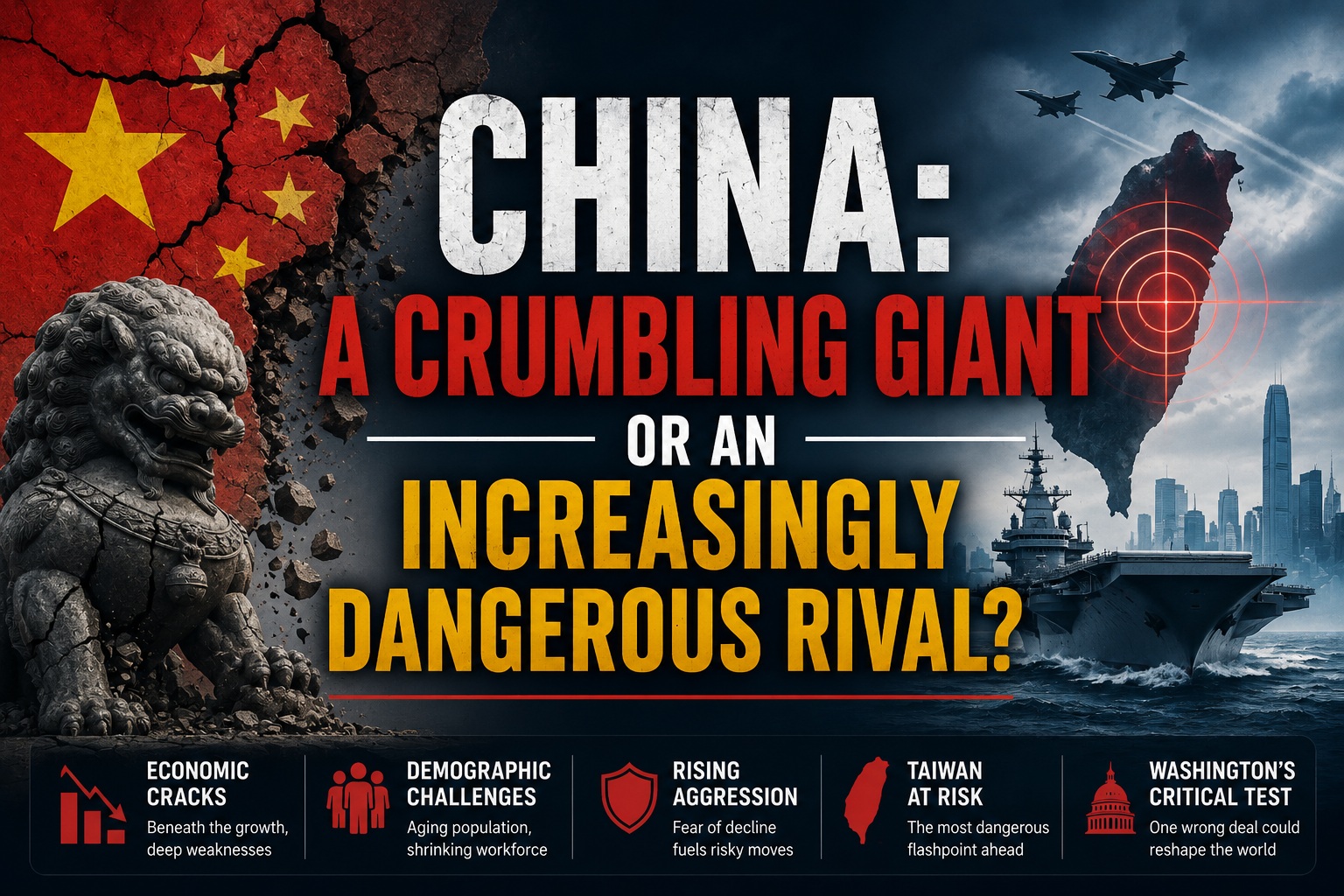
As the world remains fixated on China’s rise as a superpower challenging the United States for global dominance, American writer Bret Stephens offers a far more unsettling warning: the real danger may not lie in Beijing’s strength, but in the growing fragility hidden beneath its image of power and control.
In an opinion piece published by The New York Times, Stephens paints a troubling portrait of a nation that appears formidable on the surface, yet is quietly battling deep economic, political, and demographic crises that could push it toward far more aggressive and dangerous actions in the near future.
A Power That Looks Unstoppable… But Isn’t Stable
Amid the political tension surrounding U.S. President Donald Trump’s summit with Chinese President Xi Jinping in Beijing, Stephens argues that the United States still holds a long-term strategic advantage because of what he describes as “the strength of open societies.”
History, he says, has repeatedly shown that nations built on political freedom, competitive markets, and innovation are ultimately more resilient than authoritarian systems where the state dominates the economy, production, and political decision-making.
Yet the dangerous paradox, according to Stephens, is that China’s growing sense of slowdown and insecurity could make it more impulsive — and far less willing to wait.
A Massive Economy… Built on Fractured Ground
Stephens sharply criticizes Xi Jinping’s economic strategy, arguing that Beijing has poured hundreds of billions of dollars into massive state-driven projects and strategic industries, including electric vehicles, robotics, military technology, and lithium battery production, in an effort to secure rapid global supremacy.
But behind the spectacle of growth, Stephens warns, lie serious structural cracks within the Chinese economy.
He points to the collapse of China’s real estate bubble and the rise of infamous “ghost cities” as symbols of a deeper crisis shaking the foundations of the country’s economic model.
According to the article, millions of Chinese citizens have seen their savings eroded, while local governments struggle under crushing financial pressure. At the same time, foreign investment is declining and youth unemployment continues to climb to alarming levels.
The crisis, Stephens argues, extends far beyond economics. China is also facing severe demographic challenges, including a shrinking population, an aging society, and a declining workforce — trends that threaten the country’s long-term growth and stability.
The Greatest Danger… When Great Powers Begin to Fear Decline
Stephens’ most alarming argument is that confident rising powers tend to act patiently, while nations that fear decline are often more willing to take reckless risks.
For that reason, he compares Xi Jinping’s current position to that of Russian President Vladimir Putin before the invasion of Ukraine, when fears of diminishing Russian influence helped trigger a decision that reshaped global politics.
The writer warns that the most dangerous scenario may be a Chinese military move against Taiwan — whether through a direct invasion or an economic and military blockade — despite the potentially catastrophic global consequences.
Washington Faces a Defining Test
In the final part of the article, Stephens criticizes the Trump administration’s approach toward China, arguing that Washington appears economically confrontational while remaining strategically ambiguous about its security commitments to allies, particularly Taiwan.
He warns that any future political deal with Beijing involving reduced American military support for Taiwan in exchange for Chinese cooperation on issues such as Iran or rare earth minerals could become “a major strategic failure” capable of reshaping the global balance of power for years to come.
And as China continues to project strength before the world, the article leaves behind a far more unsettling question:
When a giant begins to fear falling, does it become even more dangerous?
Source: The New York Times