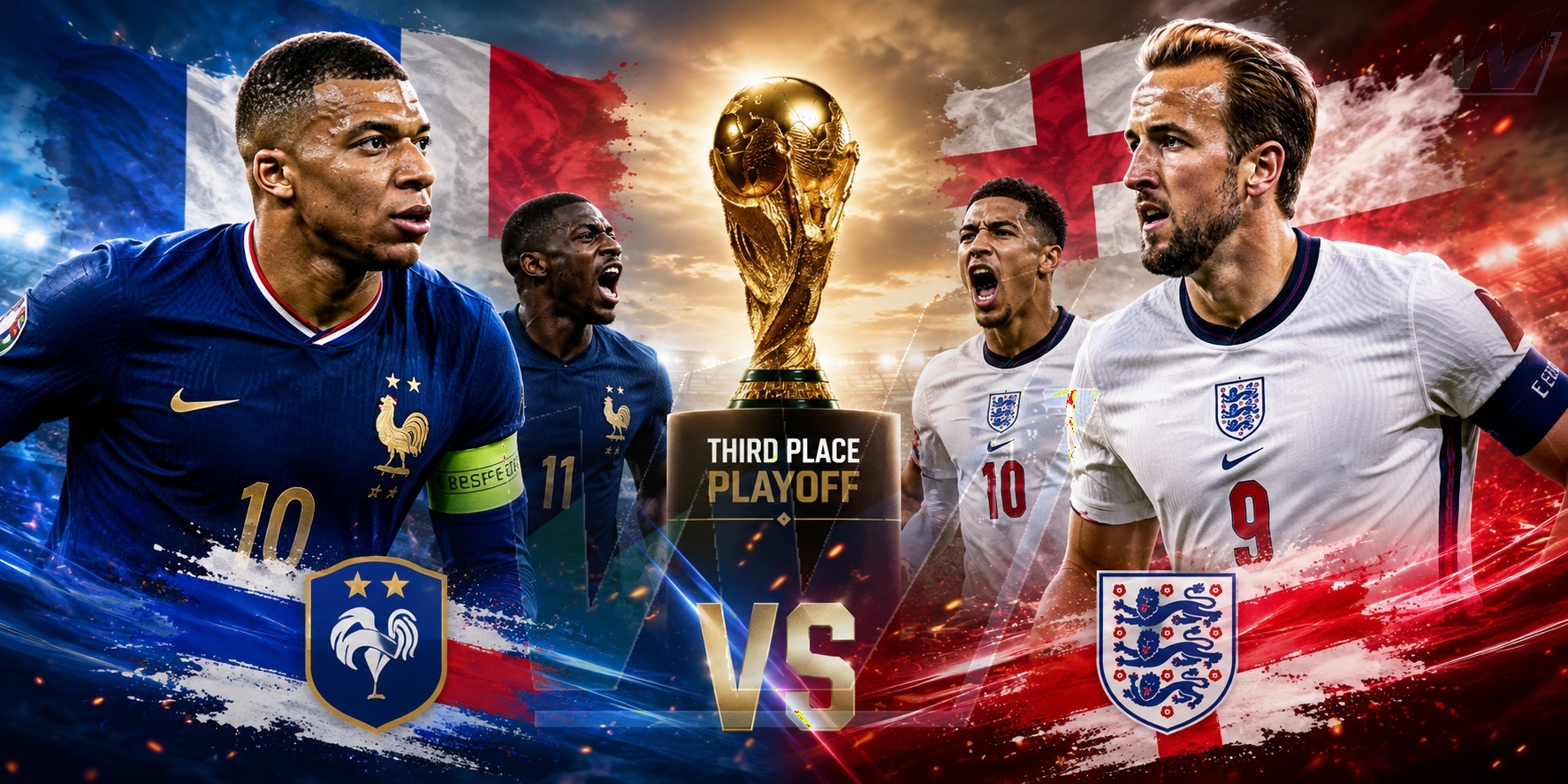
France and England Fight for Pride, Legacy, and History in World Cup Third-Place Showdown
Mbappé Chases Messi. Kane Faces an Uncertain Future. Deschamps Bids Farewell. A Match Neither Team Wanted Has Suddenly Become One of the World Cup’s Most Emotional Stories.
MIAMI GARDENS, Florida —
The World Cup was supposed to end with glory.
Instead, for two of football’s proudest nations, it ends with heartbreak.
France and England will meet Saturday in the FIFA World Cup 2026 third-place playoff, a match that neither side ever imagined playing. After falling painfully short in the semifinals, the European heavyweights now find themselves competing for bronze rather than gold, a consolation prize that many players, coaches and supporters admit they would rather avoid altogether.
Yet history suggests these matches often become something far greater than a battle for third.
They become legacy contests.
They become emotional farewells.
They become defining moments for careers standing at a crossroads.
A Match Nobody Wanted
The mood surrounding both camps could hardly be more different from the anticipation that preceded the semifinals.
France was tactically dismantled by a relentless Spain in a 2-0 defeat that exposed weaknesses few expected to see from Didier Deschamps’ experienced squad.
Twenty-four hours later, England suffered perhaps an even crueler fate.
Leading Argentina deep into the second half after Anthony Gordon’s breakthrough, Thomas Tuchel’s side appeared within touching distance of a first World Cup final in six decades.
Then everything collapsed.
Argentina struck in the 85th minute before delivering the knockout blow during stoppage time, turning English dreams into another chapter of football heartbreak.
For England supporters, the defeat instantly joined a painful collection of near-misses stretching back generations.
Deschamps Says What Everyone Is Thinking
Few coaches have spoken more honestly about the third-place playoff than France manager Didier Deschamps.
“The best thing for France and England would be for this match not to exist.”
The comment quickly resonated across international media.
Players spend years dreaming of lifting the World Cup—not competing in football’s least desired fixture.
Still, professionals understand that representing their country never becomes meaningless.
National pride remains.
So does history.
The End of an Extraordinary Era
Saturday also marks the end of one of international football’s most successful managerial reigns.
After fourteen remarkable years, Didier Deschamps will manage France for the final time.
His résumé ranks among the greatest in modern football:
- FIFA World Cup champion (2018)
- World Cup finalist (2022)
- Multiple deep tournaments run
- Architect of one of France’s greatest football generations
His farewell carries enormous emotional weight.
“I had the privilege to experience incredible moments,” Deschamps reflected before his final match.
Regardless of Saturday’s result, his legacy is already secure.
Mbappé’s Historic Chase Isn’t Over
Even after France’s semifinal disappointment, Kylian Mbappé still has history within reach.
The French captain enters the match tied with Lionel Messi on eight goals in the Golden Boot race.
Another standout performance could:
- Secure back-to-back World Cup Golden Boots.
- Move him past Messi in the tournament scoring race.
- Extend one of the greatest World Cup careers ever seen.
Already sitting on 20 career World Cup goals, Mbappé trails Messi’s all-time record by only one entering the final weekend.
For a player still in his twenties, the achievement is staggering.
Despite the individual milestones, Mbappé made clear where responsibility lies.
“As captain, I take full responsibility,” he said after France’s elimination.
The words reflected both frustration and leadership.
England’s Pain Runs Deeper
England’s defeat may prove even harder to process.
Thomas Tuchel’s tactical decisions have sparked fierce debate among analysts across Europe.
Leading 1-0 entering the final minutes, England retreated defensively instead of pressing for a decisive second goal.
Argentina seized the initiative.
Two goals later, England’s World Cup dream was over.
British media immediately questioned whether England became too cautious precisely when courage was needed most.
Tuchel, however, defended both his players and the overall performance.
“There are no regrets,” he insisted.
“The team gave everything.”
While many pundits praised England’s organization throughout the tournament, others argued the semifinal exposed recurring concerns over game management in high-pressure moments.
Kane’s Last Great World Cup?
For Harry Kane, Saturday carries particular significance.
The England captain turns 33 later this month, raising inevitable questions about whether this could be his final appearance on football’s biggest stage.
Kane refuses to think that far ahead.
He points instead to Lionel Messi.
At 39, Messi continues performing at the highest level while inspiring Argentina toward another World Cup triumph.
Kane believes age alone should never define ambition.
Still, football’s calendar is unforgiving.
Another World Cup lies four years away.
Nothing is guaranteed.
Bellingham Continues His Rise
While Kane represents England’s established generation, Jude Bellingham embodies its future.
The midfielder has emerged as one of the tournament’s standout performers, combining maturity, leadership and decisive attacking contributions.
With six goals, he also remains mathematically alive in the Golden Boot race.
Regardless of Saturday’s outcome, his World Cup has confirmed his place among football’s global elite.
Golden Boot Drama Continues
Although Sunday’s final will ultimately determine the tournament champion, Saturday’s bronze-medal clash also carries enormous individual stakes.
Current Golden Boot Race
| Player | Nation | Goals |
| Lionel Messi | Argentina | 8 |
| Kylian Mbappé | France | 8 |
| Harry Kane | England | 6 |
| Jude Bellingham | England | 6 |
| Ousmane Dembélé | France | 5 |
Every goal could reshape football history.
More Than Bronze
Historically, third place matches often produce some of the tournament’s most entertaining football.
Freed from the suffocating pressure of a final, teams frequently attack with greater freedom.
Goals become more common.
Young talents receive opportunities.
Veterans receive emotional farewells.
For France, victory would soften the disappointment of missing consecutive finals.
For England, bronze would still equal one of the country’s finest World Cup performances in generations.
Neither outcome erases semifinal heartbreak.
Both offer closure.
A Final Chapter Before the Final
Saturday’s match also serves as an emotional bridge between two eras.
For France:
- Farewell to Didier Deschamps.
- Another historic chapter for Mbappé.
- One last opportunity to reward supporters.
For England:
- Kane’s uncertain World Cup future.
- Bellingham’s emergence as a generational leader.
- Questions over Thomas Tuchel’s tactical philosophy moving forward.
Global Attention Remains High
Although third place matches traditionally attract less attention than the final, worldwide interest remains substantial.
Fans are eager to witness:
- Didier Deschamps’ final match in charge of France.
- Mbappé’s pursuit of another Golden Boot.
- Harry Kane’s possible World Cup farewell.
- Two European giants determined to leave the tournament with dignity rather than despair.
Final Whistle
Nobody dreams of playing for third place.
Not France.
Not England.
Not their supporters.
Yet football rarely grants perfect endings.
Sometimes greatness is measured not by lifting the trophy, but by how champions respond after watching someone else reach the final.
On Saturday in Miami Gardens, there will be no World Cup to lift.
Only pride.
Only legacy.
Only ninety minutes to prove that even broken dreams deserve one final fight.