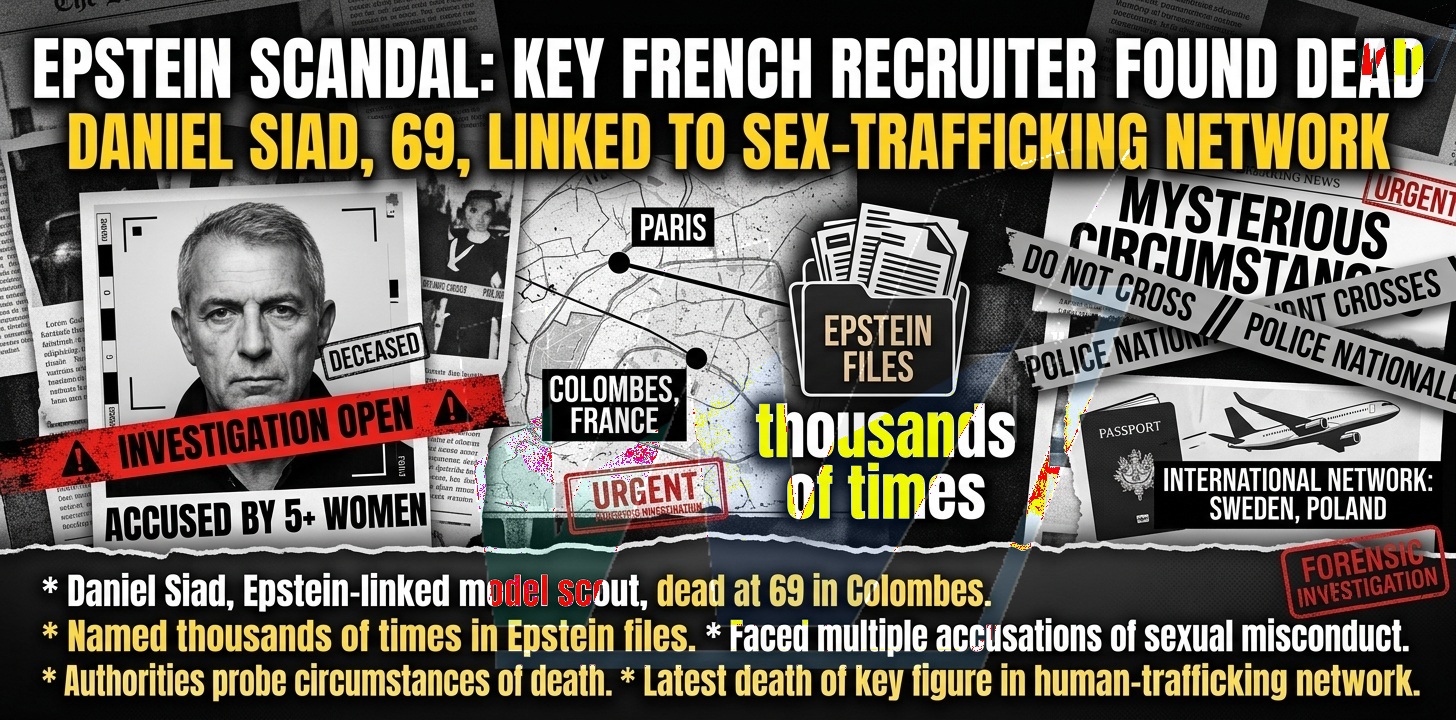
The 69-year-old recruiter, whose name appeared thousands of times in newly released Epstein files and who faced accusations from multiple women, was found unresponsive at his home in Colombes. Authorities have opened an investigation into the circumstances of his death.
COLOMBES, France —
A new and unsettling chapter has opened in the long-running Jeffrey Epstein scandal.
Daniel Siad, a 69-year-old French-Swedish model scout accused of helping connect young women with convicted sex offender Jeffrey Epstein, has been found dead at his home outside Paris, French authorities said Wednesday.
The death comes at a moment when the French dimension of the Epstein case is facing renewed scrutiny, following the release of millions of pages of documents linked to the late American financier and a series of complaints filed by women who say they were drawn into a network operating behind the promise of modeling opportunities.
Siad had been under investigation in France and had denied wrongdoing.
A death that brings a new shock to the Epstein investigation
According to reports from French media, Siad was found unresponsive at his home in Colombes, in the Hauts-de-Seine department west of Paris. Emergency responders attempted to revive him, but he could not be saved.
The exact circumstances and cause of death had not been officially established in the initial reports. French authorities opened an investigation to determine what happened.
Some media reports cited sources suggesting a possible cardiac arrest, but the cause remained subject to official medical and forensic findings.
That uncertainty immediately placed the death under intense scrutiny—not because authorities have publicly alleged foul play, but because Siad had become a central figure in renewed investigations into Epstein’s international network.
His name appeared thousands of times in the Epstein files
The renewed attention surrounding Siad began after the publication of vast quantities of documents connected to Jeffrey Epstein.
According to reporting by major European media, Siad appeared extensively in the released material, including emails exchanged with Epstein over years.
The documents portrayed a relationship centered on the international scouting of potential models. According to reporting based on the files, Siad traveled across several countries and communicated information about young women to Epstein, including photographs and personal details.
The Guardian reported that newly released documents showed extensive correspondence between the two men over more than a decade. The newspaper said the records included discussions involving potential models, travel arrangements and scouting activities across several regions.
Siad’s name also surfaced in reporting about investigations extending beyond France. Reuters reported in March that Polish prosecutors had launched a human-trafficking investigation involving alleged recruitment under false pretenses and the movement of women and girls for sexual exploitation. The investigation was expected to seek assistance from France and Sweden, countries connected to Siad’s background and activities.
Five women have accused Siad of sexual misconduct
The case against Siad was not limited to his alleged relationship with Epstein.
At least five women have accused him of sexual misconduct, according to French media reports. One of the most prominent accusations came from former Swedish model Ebba P. Karlsson, who accused Siad of rape dating back to 1990.
A French woman also filed a complaint alleging that Siad had introduced her to men, including Epstein, after presenting opportunities connected to the modeling world.
Other women reportedly described similar patterns involving promises of prestigious castings or modeling opportunities.
Siad strongly denied the allegations.
In interviews with French media in May, he rejected accusations of rape and denied acting as a recruiter for Epstein’s criminal activities. He said he had no knowledge of any abuse involving women he had introduced and maintained that he had done his work professionally.
Those allegations had not been adjudicated in court, and Siad died before any trial could determine criminal responsibility.
The French side of the Epstein scandal is expanding
For years, France was viewed as one of the most important European settings in Epstein’s international orbit.
The financier owned a substantial property in Paris and maintained relationships with figures in business, science, politics and the fashion world.
The release of new documents has now intensified questions about the structure of the network that operated around him.
French investigations and media reporting have increasingly focused on the role of intermediaries—people who allegedly helped Epstein meet women or gain access to potential victims.
Among the names repeatedly examined is Jean-Luc Brunel, the French modeling agent and longtime Epstein associate who died in a Paris prison in 2022 while awaiting trial on rape and sexual-trafficking charges. Brunel denied wrongdoing before his death.
Siad’s death now adds another dramatic development to a case already marked by the deaths of several key figures.
A pattern that continues to haunt the investigation
Jeffrey Epstein died in a Manhattan jail in August 2019 while awaiting trial on federal sex-trafficking charges. His death was officially ruled a suicide.
Ghislaine Maxwell, his longtime associate, was later convicted in the United States for her role in recruiting and grooming minors for Epstein and was sentenced to 20 years in prison.
The continuing release of documents has ensured that the scandal has not disappeared.
Instead, it has expanded across borders—from the United States to France, Sweden, Poland and other European countries—raising new questions about how young women were identified, approached, transported and introduced into Epstein’s orbit.
The emerging picture is not of a single isolated operation, but of an international web involving recruiters, intermediaries, social connections and powerful institutions.
What investigators will now examine
The immediate priority for French authorities is determining the precise cause and circumstances of Daniel Siad’s death.
That investigation is separate from the allegations against him and does not, by itself, establish any connection between his death and the Epstein case.
But the timing is certain to intensify public interest.
Siad had become an increasingly important figure in efforts to understand how Epstein operated in Europe. He had been accused by multiple women, was the subject of legal scrutiny and had appeared extensively in documents connected to the financier.
Now, one of the men whose name has emerged repeatedly from the shadow of the Epstein files is dead.
The unanswered questions are likely to multiply.
And as investigators continue examining the evidence left behind, emails, financial records, testimonies and international connections, the French chapter of the Epstein scandal may be entering an even more consequential phase.