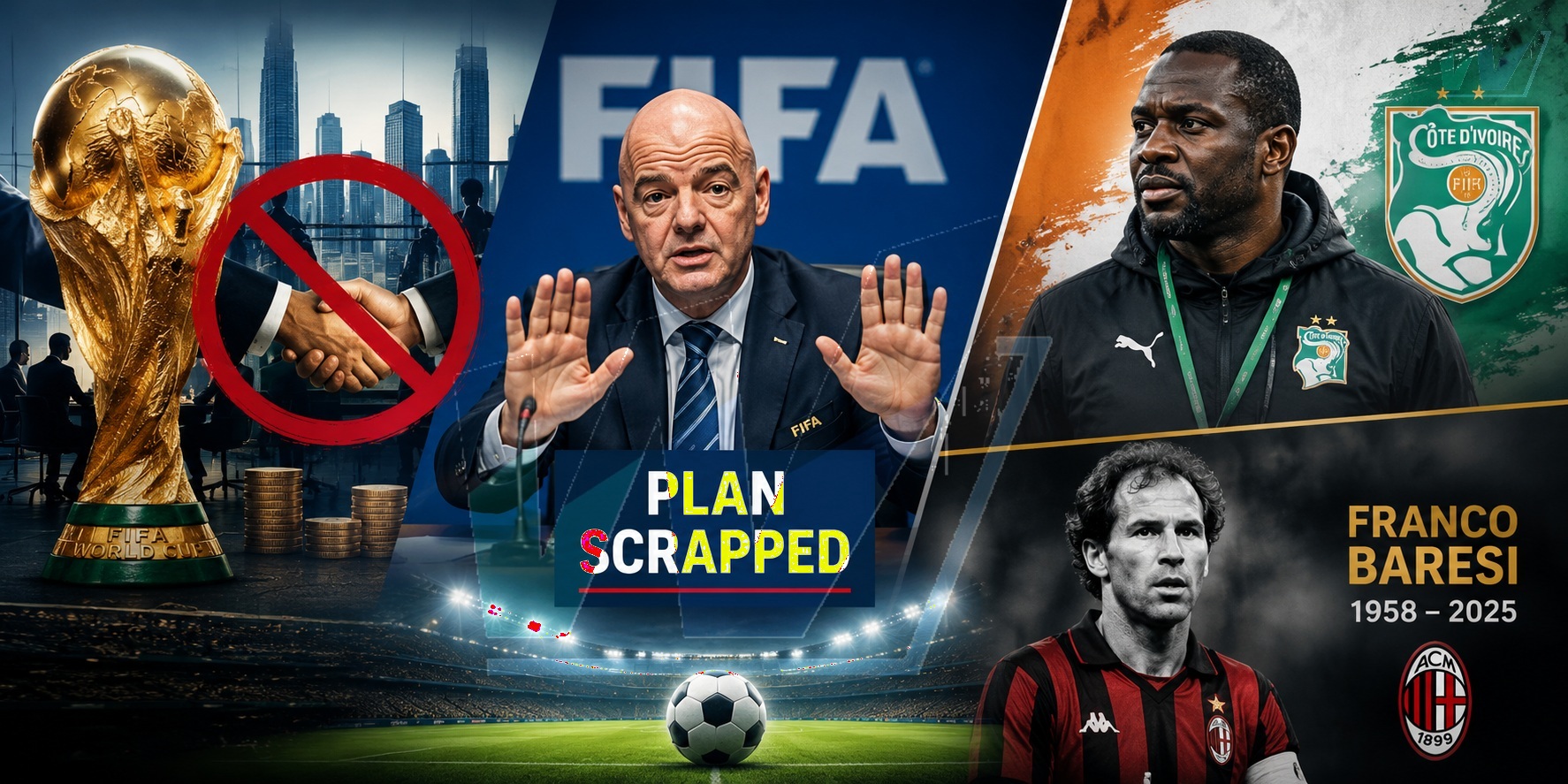
Historic Backlash Forces FIFA President to Abandon Controversial Investment Proposal as African Champion Ivory Coast Parts Ways with Emerse Faé and Football Mourns Franco Baresi
The world’s most powerful football organization has been forced into one of the most dramatic reversals in its modern history.
After facing an extraordinary wave of opposition from football federations, continental confederations, club officials, and even senior figures within FIFA itself, President Gianni Infantino has abandoned his controversial proposal to open part of the FIFA World Cup’s commercial business to private investors, a plan critics described as crossing a red line that threatened the very soul of the game.
The stunning retreat marks one of the biggest political setbacks of Infantino’s presidency and comes amid growing questions over FIFA’s governance, commercial ambitions, and leadership ahead of future elections. At the same time, African football is entering a new chapter as Ivory Coast confirms the departure of its successful national team coach, while Italy mourns the passing of one of football’s greatest defenders.
FIFA Retreats After Unprecedented Global Revolt
Only days after unveiling plans to create a new commercial entity that would allow outside investors to purchase a minority stake in the business surrounding FIFA’s flagship tournaments, including the men’s and women’s World Cups, Infantino announced that the proposal would not move forward.
In a statement explaining the reversal, Infantino acknowledged that the initiative had created deep divisions throughout world football.
Rather than strengthening sport’s future, he said, the proposal had become a source of conflict, making it impossible to achieve its intended objective of promoting global football development.
The decision represents a remarkable U-turn for FIFA after initially presenting the project as a transformative financial strategy capable of generating billions of dollars for football development worldwide.
The Plan That Sparked Worldwide Anger
The proposed structure centered on creating FIFA Forward Enterprise (FFE), a new commercial subsidiary that would manage FIFA’s major competitions.
Under the proposal:
- FIFA would sell roughly a 20% minority stake to private investors.
- The new company was valued at around $20 billion.
- FIFA hoped to raise approximately $4.2 billion immediately.
- Officials argued the proceeds would fund global football development and increase financial support for all 211 member associations.
Infantino had promoted the project to unlock the commercial value of the World Cup without surrendering sporting control.
Critics, however, viewed it very differently.
UEFA Draws a Line
Opposition came swiftly, and from nearly every corner of international football.
UEFA led the resistance, declaring that football’s governing institutions should never commercialize ownership interests linked to the World Cup.
European football leaders argued that no organization should treat the game’s premier tournament as a financial asset available for investor participation, warning that such a move risked undermining the integrity and independence of football governance.
Reports indicated that UEFA even discussed the possibility of boycotting future FIFA competitions if the proposal advanced.
Soon afterward, major organizations including CONCACAF and the Asian Football Confederation also voiced serious concerns, leaving FIFA increasingly isolated.
Internal FIFA Crisis
The controversy did not remain confined to external criticism.
Reports indicate that senior FIFA officials questioned both the substance of the proposal and the way it had been developed.
The dispute reportedly triggered internal resignations, including senior adviser Carlos Cordeiro, while criticism also emerged regarding the consultation process before the announcement.
For many observers, the episode exposed growing tensions within FIFA over the organization’s increasingly aggressive commercial strategy.
A Blow to Infantino’s Leadership
The failed initiative has become one of the most politically damaging moments of Gianni Infantino’s presidency.
For years, Infantino has overseen an unprecedented expansion of FIFA competitions, including the enlarged World Cup, expanded Club World Cup, and increased commercial partnerships.
Supporters argue those reforms have dramatically increased FIFA revenues and funding available for developing football worldwide.
Critics, however, contend that the attempted sell-off revealed an organization placing commercial growth ahead of football’s traditional governance principles.
While Infantino insists FIFA remains committed to unity and development, analysts believe the controversy may influence political dynamics ahead of FIFA’s next presidential election.
Ivory Coast Begins a New Era
While FIFA grappled with institutional turmoil, African football witnessed another major development.
The Ivorian Football Federation confirmed that it will not renew the contract of national team coach Emerse Faé, whose agreement expires on August 1.
Faé leaves after one of the most successful managerial spells in the country’s modern football history.
He guided the Elephants to a memorable triumph at the 2024 Africa Cup of Nations, producing one of the tournament’s greatest comeback stories before leading Ivory Coast to an impressive World Cup campaign that further elevated the nation’s international standing.
His departure now opens one of African football’s most attractive managerial vacancies.
Italy Says Goodbye to Franco Baresi
Italian football is mourning the loss of one of its greatest icons.
Franco Baresi, widely regarded as one of the finest defenders ever to play the game, has died at the age of 66.
A legendary captain for both AC Milan and Italy, Baresi defined an era through exceptional leadership, tactical intelligence, elegance, and defensive excellence.
His career included multiple domestic titles, European triumphs, and unforgettable performances on the international stage.
Tributes from clubs, former teammates, players, and football federations quickly poured in, celebrating a career that influenced generations of defenders and helped shape modern football.
Football Faces a Defining Moment
These three major developments reflect a sport undergoing profound change.
FIFA’s abandoned investment proposal highlights the growing tension between commercial expansion and football’s traditional values.
Ivory Coast’s coaching transition signals another shift among Africa’s emerging football powers.
Meanwhile, the passing of Franco Baresi reminds supporters of an era when legendary players became symbols of loyalty, excellence, and sporting integrity.
Together, the stories capture football at a crossroads, where business ambitions, institutional governance, competitive evolution, and enduring legacy continue to collide.
As FIFA regroups following one of its most significant political setbacks in years, the future direction of world football may now depend less on financial innovation and more on restoring confidence among the global game’s stakeholders.