Miracle Beneath the Waves: Drone Captures the First-Ever Aerial Birth of a Humpback Whale in a Historic Wildlife Moment
Blood in the Water, then a New Life Emerges: Extraordinary Drone Footage Off Australia Offers Scientists an Unprecedented Window into the Secret Birth of a Giant of the Oceans
For just a few breathtaking seconds, the ocean turned crimson.
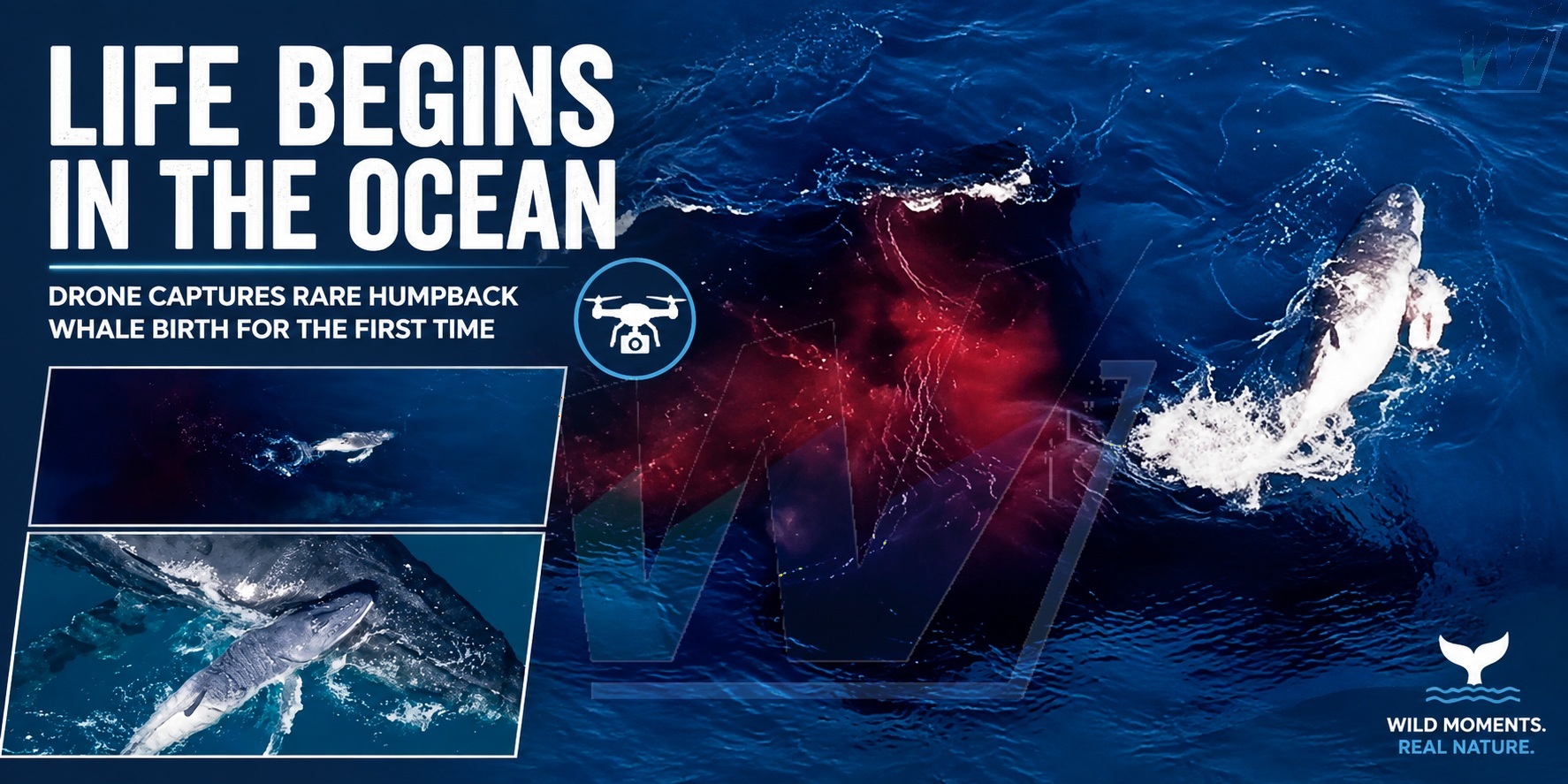
Then, from beneath the surface off Australia’s east coast, a tiny humpback whale calf emerged into the world, instinctively rising toward its very first breath.
The extraordinary sequence, captured entirely from the air by a drone, has stunned marine scientists and wildlife experts across the globe. What began as a routine whale-monitoring mission rapidly transformed into one of the rarest wildlife events ever documented: the first-known aerial recording of a humpback whale giving birth in the wild. Researchers believe it is only the fourth complete humpback whale birth ever filmed anywhere on Earth, marking a milestone for marine science and wildlife filmmaking.
The Whale That Was Moving Too Slowly
The historic encounter occurred on July 28 off the coast of New South Wales, during Australia’s annual northbound humpback migration.
Wildlife filmmaker Alexander Forrest, working alongside the Organization for the Rescue and Research of Cetaceans in Australia (ORRCA), noticed something unusual.
While thousands of humpback whales were steadily migrating north, one female appeared almost motionless.
At first, Forrest believed she was resting.
Instead, he was witnessing one of nature’s most closely guarded secrets.
As he launched his drone camera toward the whale, she suddenly rose to the surface, not to breathe, but to give birth.
Moments later, a cloud of blood spread through the water before a newborn calf surfaced beside its mother, taking its first life-saving breath only seconds after entering the ocean.
“I Wasn’t a Filmmaker Anymore”
Forrest later described the experience as one that completely changed his perspective.
Instead of concentrating on camera angles or technical details, he said he became simply a witness to one of the planet’s rarest natural events.
The mother remained nearly motionless for several moments after birth before instinctively turning back toward her calf.
The newborn quickly aligned itself beside its mother, beginning what scientists call one of the most critical bonding periods in a whale’s life.
Why Scientists Are Calling This a Breakthrough
Unlike many terrestrial mammals, humpback whales spend virtually their entire lives at sea.
That makes observing births extraordinarily difficult.
Most calves are born far from coastlines, often at night or in remote tropical breeding grounds where researchers rarely have continuous visual access.
Until now, only three scientifically documented humpback births had ever been captured on film, and none had been filmed from the air.
The drone’s overhead perspective revealed details impossible to obtain from boats, including:
- the mother’s body positioning during delivery,
- the calf’s immediate ascent for air,
- the first maternal reunion,
- early swimming behavior,
- the dispersal of birth fluids,
- and interactions with nearby whales.
Marine biologists say these observations may improve scientific understanding of whale reproduction, neonatal survival, and maternal care.
A Critical First Few Hours
Following the birth, ORRCA researchers continued tracking the mother and calf for several hours.
Those first hours are considered among the most dangerous in a whale’s life.
Newborn calves must:
- surface immediately to breathe,
- remain close to their mothers,
- begin nursing,
- learn coordinated swimming,
- and avoid predators attracted by the scent of blood.
The extended observations allowed researchers to document maternal behavior during this vulnerable period, information that has rarely been available in such detail.
The Great Migration Along Australia’s Coast
The birth occurred during one of Earth’s largest annual wildlife migrations.
Each austral winter, roughly 50,000 humpback whales travel along Australia’s eastern coastline.
The whales leave the icy Antarctic feeding grounds, where they spend the summer consuming vast quantities of krill, and migrate thousands of kilometers to warmer subtropical waters to mate and give birth.
While calves are generally expected to be born farther north, scientists have occasionally documented births during migration, suggesting that timing and location may vary more than previously understood.
From the Brink of Extinction to a Conservation Success
Only a few decades ago, such a sight might have been impossible.
Commercial whaling devastated humpback whale populations throughout the 20th century.
By the 1970s, humpback whales had been listed as endangered in the United States, and the global moratorium on commercial whaling introduced in the mid-1980s became a turning point for the species.
Today, many humpback populations have rebounded dramatically, although some distinct population groups remain endangered or threatened.
Australia’s east coast population is now considered one of the world’s greatest marine conservation success stories, having grown from only a few hundred animals decades ago to tens of thousands today.
Drone Technology Is Transforming Marine Science
The event also highlights how rapidly advancing drone technology is reshaping wildlife research.
Modern drones allow scientists to observe whales from above without placing boats directly alongside them, reducing disturbance while collecting exceptionally detailed behavioral data.
Researchers increasingly use aerial surveys to:
- estimate whale populations,
- identify individual animals,
- monitor body condition,
- document feeding behavior,
- track migration,
- and now, remarkably, record birth itself.
The footage may become an invaluable scientific reference for marine mammal researchers worldwide and could help refine conservation strategies for humpback whales and other large cetaceans.
A Rare Reminder of Nature’s Greatest Wonders
In an era dominated by climate change, marine pollution, ship strikes, fishing-gear entanglements, and biodiversity loss, the footage offers something increasingly uncommon: a reminder that nature still holds moments capable of astonishing even the most experienced scientists.
For Alexander Forrest and the ORRCA research team, the encounter was more than an extraordinary wildlife spectacle.
It became a scientific milestone that may deepen humanity’s understanding of one of the ocean’s most majestic creatures, capturing not simply the beginning of one whale’s life, but a historic chapter in marine biology itself.