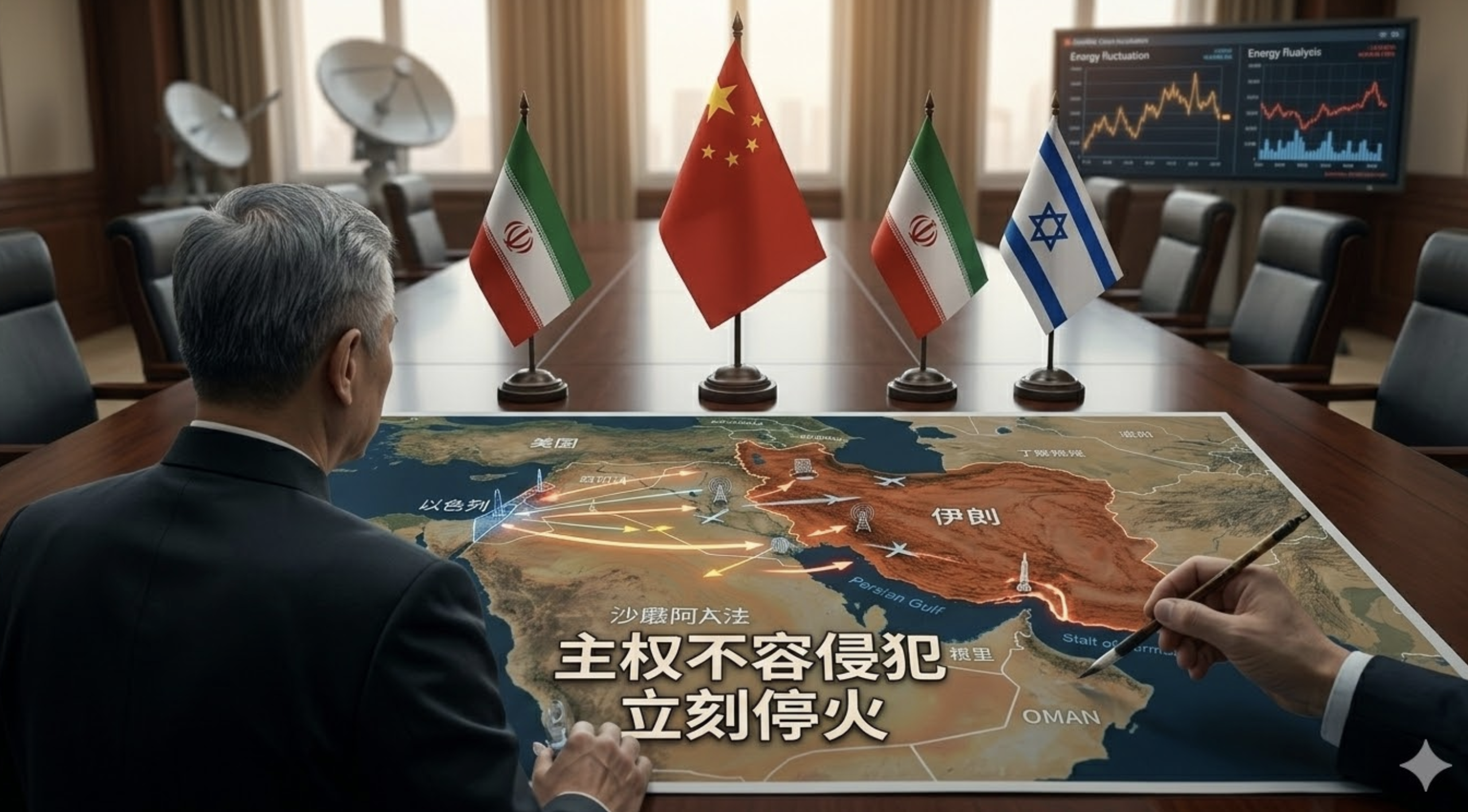
Beijing has decisively abandoned its traditional posture of “concerned observer” in Middle East conflicts. As the military confrontation between Israel, the United States, and Iran rapidly escalates, China has dramatically shifted its diplomatic gear, emerging as an aggressive proponent of immediate de-escalation and a fierce critic of Western military intervention. This pivot represents Beijing’s most significant attempt to date to position itself as a stabilizing global counterweight to Washington, leveraging its unique relationships across the fractured region.
OFFICIAL CONDEMNATION AND THE SOVEREIGNTY PRINCIPLE
China’s current political position is defined by an unambiguous condemnation of the recent, expanding US-Israeli military strikes against Iranian targets. The rhetoric emanating from the Ministry of Foreign Affairs has grown increasingly sharp, moving beyond calls for “restraint” to a principled defense of national sovereignty.
Rejection of Force: In a series of urgent diplomatic communiqués, China has articulated a firm “No to Force” policy. Foreign Minister Wang Yi has argued that “military superiority is not a license for arbitrary attacks,” a direct critique of the US-led operations. Beijing’s position is that force cannot resolve the deep-seated political and security grievances that fuel the conflict.
The “Law of the Jungle” Warning: A key pillar of China’s argument is the defense of the international rule of law. Beijing has warned that allowing these strikes to proceed unchecked risks returning the global order to a “law of the jungle,” where powerful nations ignore the UN Charter at will. This stance resonates powerfully with many developing nations that view Western interventionism with suspicion.
THE MEDIATION BLITZ: THE “ZHAI JUN” MISSION
China’s shift is not merely rhetorical; it is backed by a surge in high-level diplomatic activity. Beijing is capitalizing on its status as one of the few global powers maintaining productive working relationships with all major actors: Jerusalem, Tehran, Washington, Riyadh, and Moscow.
Special Envoy Deployment: On March 5, 2026, Beijing announced the immediate deployment of Zhai Jun, China’s Special Envoy on the Middle East Issue, on a multi-nation mission. His mandate is clear: facilitate direct dialogue and build consensus for an immediate ceasefire.
Wang Yi’s Phone Diplomacy: Simultaneously, Foreign Minister Wang Yi has engaged in a rapid series of telephone consultations with his counterparts from Israel, Iran, Saudi Arabia, the UAE, Oman, France, and Russia. China is seeking to forge a unified international front that can exert maximum diplomatic pressure for de-escalation.
THE ECONOMIC AND STRATEGIC IMPERATIVES
China’s aggressive entry into the diplomatic fray is propelled by acute national interest. Regional stability is essential for China’s economic health and energy security.
The Strait of Hormuz Red Line: Beijing has issued stark warnings regarding the safety of critical energy corridors, particularly the Strait of Hormuz. As a leading importer of Gulf oil, China views any sustained disruption to this waterway as a direct threat to its economy and global trade. Protecting these lifelines is a non-negotiable strategic imperative.
Regional Spillover Concerns: China has expressed “grave concern” following reports of the conflict spilling over into Iran’s neighbors, including Azerbaijan. Beijing views this rapid geographical expansion as confirmation that a “controlled conflict” is an illusion, threatening to draw in a wider array of regional and global powers.
CONCLUSION: CHINA’S “FOUR NOS” POLICY
China’s current strategy can be summarized by a pragmatic, “Four Nos” approach that defines its new Middle East doctrine (March 2026):
No to Force: Total rejection of military strikes as a tool for political change.
No to Interference: Absolute defense of state sovereignty and rejection of externally-imposed regime change.
No to Escalation: Active, multifaceted mediation to contain spillover into neighboring states.
No to Double Standards: Demanding that the international community apply the UN Charter equally, without exception for major powers.
Beijing’s mediation gamble is a high-stakes play. Success would establish China as a truly indispensable global peacemaker. Failure, or being seen as shielding Iran, could isolate China from key Western partners. For now, Beijing is betting that the world’s desire for stability will validate its aggressive push for a diplomatic alternative to war.