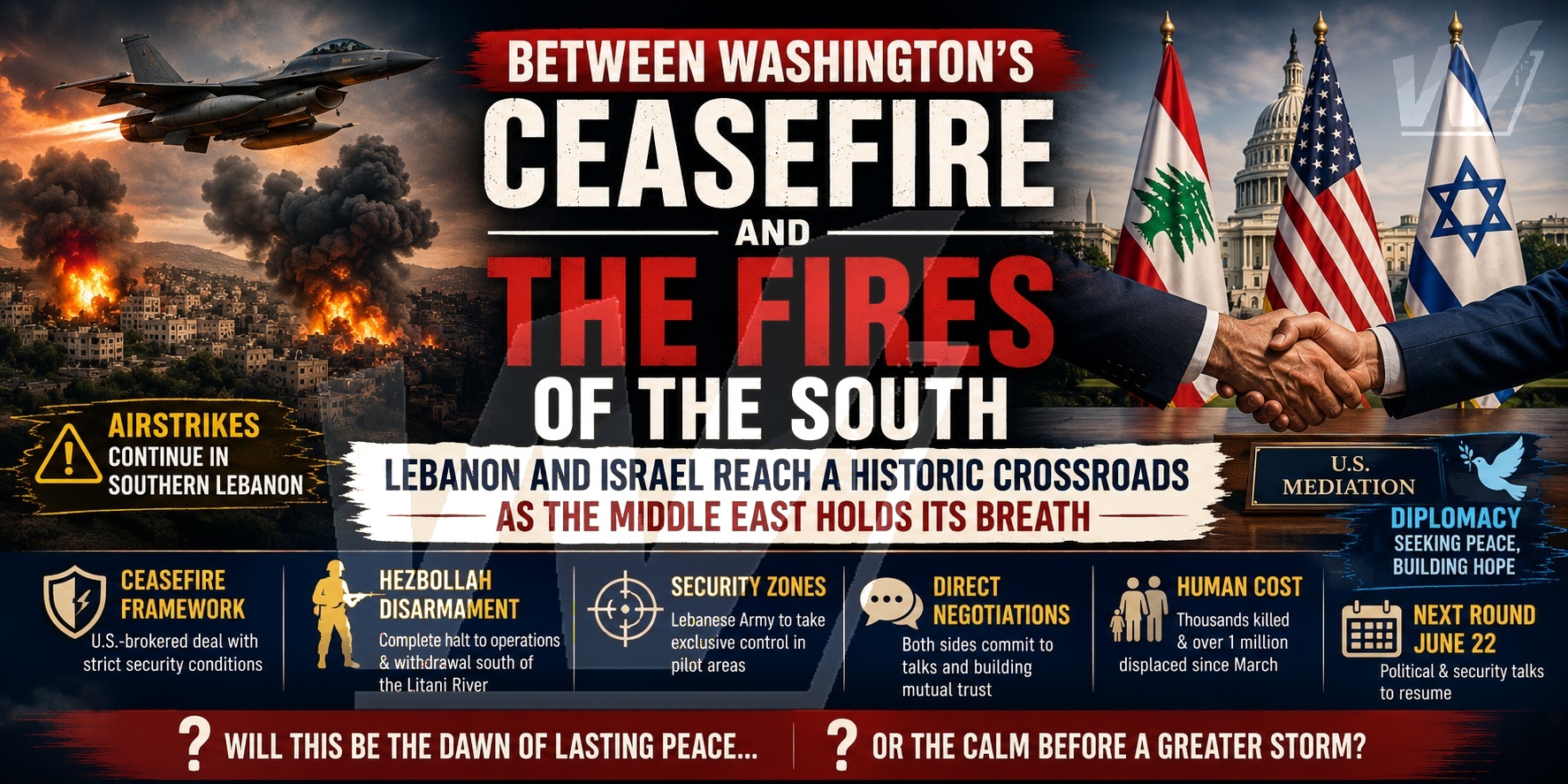
In one of the most delicate moments the region has faced in recent years, the roar of warplanes over southern Lebanon collided with the hushed negotiations unfolding behind closed doors in Washington. Out of this stark contrast emerged what could prove to be the most consequential diplomatic breakthrough since months of relentless bloodshed along the Lebanese-Israeli frontier.
At dawn on Thursday, the United States announced that Lebanon and Israel had agreed to a comprehensive ceasefire framework. Yet the declaration arrived while Israeli airstrikes were still pounding southern towns, leaving casualties and destruction in their wake—a dramatic reminder of the widening gap between diplomatic promises and the brutal realities on the battlefield.
The announcement followed a fourth round of high-level trilateral talks held on June 2 and 3 under U.S. sponsorship. Representatives from Lebanon and Israel concluded the negotiations with what officials described as a new understanding designed to halt the spiral of escalation and open the door to broader political and security arrangements that could eventually evolve into a comprehensive agreement on peace and stability.
But this is no ordinary ceasefire.
Washington tied the agreement’s full implementation to a series of stringent security conditions. Chief among them is a complete halt to Hezbollah military operations, the withdrawal of all Hezbollah personnel from the area south of the Litani River, and the rapid establishment of “pilot security zones” where the Lebanese Armed Forces would exercise exclusive control, eliminating the presence of any armed groups operating outside state authority.
The framework signals an ambitious American effort to fundamentally reshape the security landscape of southern Lebanon. Delegations reportedly discussed a new security architecture based on previous consultations at the Pentagon, one that includes dismantling non-state armed organizations and preventing their future re-emergence.
In a message aimed not only at the negotiating table but at the broader region, the joint statement emphasized that the future relationship between Lebanon and Israel must be determined solely by the sovereign governments of both nations. It rejected any external guardianship or interference from regional actors and non-state entities while affirming that neither side harbors hostile intentions toward the other.
Both governments also pledged to continue direct negotiations, address unresolved disputes, and pursue confidence-building measures that could pave the way toward a more durable settlement.
Yet even as diplomats exchanged carefully crafted language in Washington, southern Lebanon was enduring some of its most intense hours of violence in weeks.
Israeli aircraft launched a sweeping wave of strikes targeting multiple towns and villages, including Majdal Zoun, Hanawiyeh, Al-Maaliyeh, Ghaziyeh, Al-Marwaniyeh, Froun, Kfardounine, Arab al-Jal, Houmine al-Tahta, and areas surrounding the city of Tyre. Reports indicated casualties among civilians, including displaced families caught inside a building struck in the Ghaziyeh area.
At the same time, Israeli drones filled the skies over Tyre and neighboring villages, while field reports described mounting casualties from what observers called the most intense bombardment campaign in recent memory.
Hezbollah, meanwhile, continued its military operations despite the diplomatic breakthrough. The group announced attacks using explosive drones against Israeli command positions near the Beaufort Castle area, known locally as Qalaat al-Shaqif. It also reported launching rocket barrages against Israeli military concentrations across several border sectors.
In another escalation, Hezbollah claimed it had forced two Israeli drones to retreat after targeting them with surface-to-air missiles, underscoring the fragile and volatile reality confronting the newly announced agreement.
The exchange of fire highlights the immense obstacles standing in the way of the ceasefire’s success. It raises serious questions about whether political commitments can survive the pressures of an active battlefield where mistrust, military calculations, and regional rivalries continue to shape events.
Since March, the Lebanese front has witnessed one of the deadliest chapters of the conflict. Thousands have been killed or wounded, while more than one million people have been displaced according to official figures, leaving entire communities trapped between war and uncertainty.
Washington, acting as the principal mediator, has pledged to maintain communication channels between both sides throughout the transition period. U.S. officials also reaffirmed their commitment to strengthening the Lebanese Armed Forces, positioning the army as the sole legitimate authority capable of enforcing state sovereignty across Lebanese territory.
Israel, for its part, reiterated that its security cannot be guaranteed without the dismantling of Hezbollah’s military infrastructure and the disarmament of the organization. Lebanon, meanwhile, stressed the need for full respect of internationally recognized borders, an immediate cessation of hostilities, and the preservation of its sovereignty and territorial integrity.
With both sides agreeing to resume political and security negotiations during the week beginning June 22, the entire Middle East now finds itself facing a defining test.
Can American diplomacy transform a fragile ceasefire into a historic agreement capable of ending decades of confrontation?
Or will the flames on the battlefield once again outrun the language of diplomacy, dragging the region back toward a wider and potentially more devastating conflict?
For now, southern Lebanon hangs suspended between two dramatically different futures: the first light of a long-awaited peace—or a temporary truce concealing an even greater storm gathering beyond the horizon.