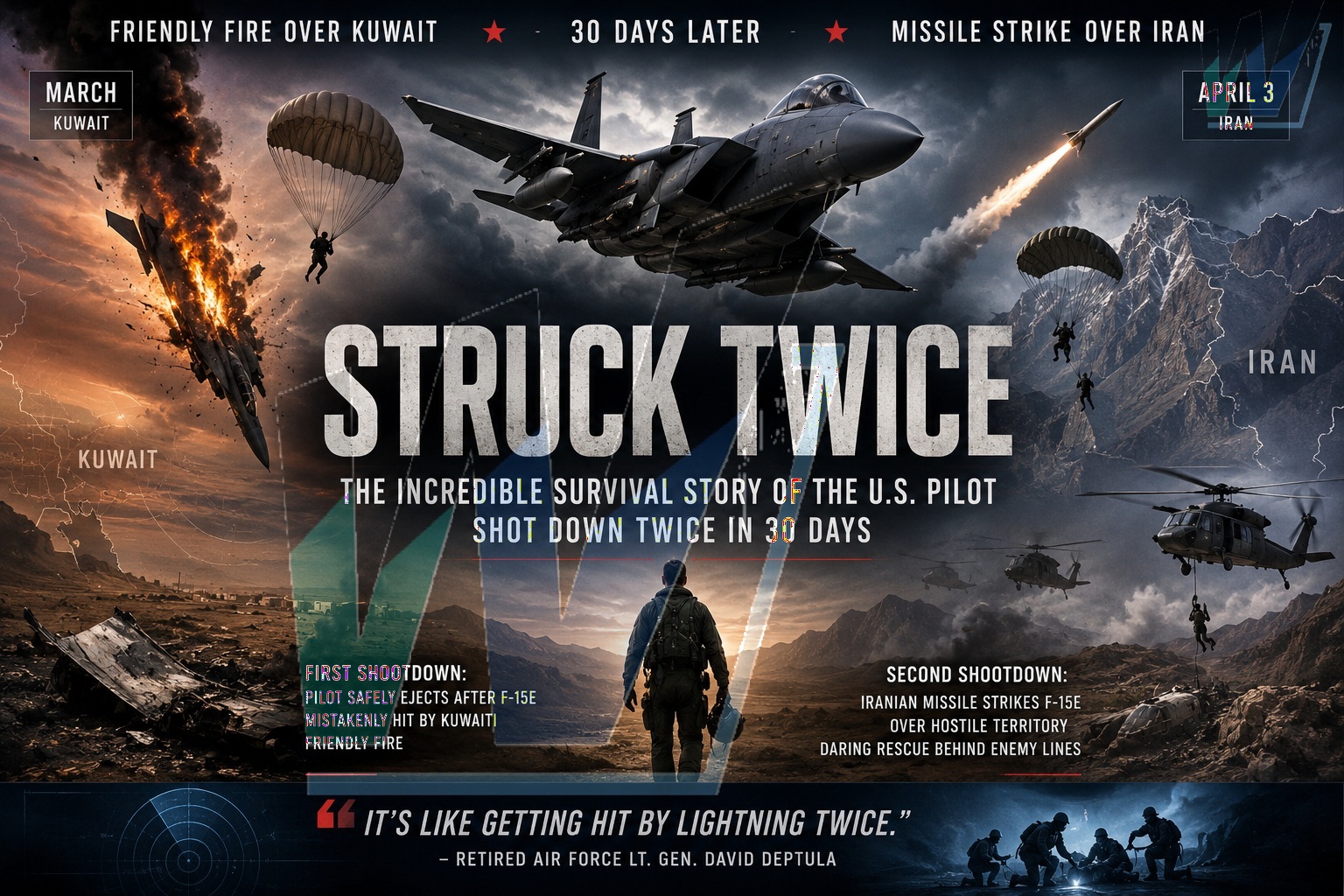
In a twist so improbable that veteran military strategists struggle to find a historical parallel, the American pilot whose F-15E Strike Eagle was brought down deep over Iran had already survived another shootdown only weeks earlier—this time by allied forces in a tragic friendly-fire incident.
According to sources familiar with both events, the pilot was among the aircrew members forced to eject during the opening days of the conflict after three F-15E Strike Eagles were mistakenly engaged and destroyed by Kuwaiti air defenses. The incident, which unfolded over Kuwaiti airspace, sent shockwaves through military circles and highlighted the chaos that often accompanies the first moments of war.
Yet fate had not finished testing the pilot.
Just over a month after surviving that dramatic escape, the same aviator was once again flying into danger—this time on a combat mission over Iranian territory. On April 3, disaster struck when an Iranian surface-to-air missile found its target, tearing into the aircraft and forcing the crew to eject over hostile terrain.
What followed was a high-stakes rescue operation worthy of a wartime thriller.
Separated behind enemy lines, the pilot and weapons systems officer faced hours—and in one case nearly two days—of isolation while evading capture. Rescue forces launched a complex recovery mission amid mounting uncertainty about the crew’s fate.
The pilot, who suffered serious injuries, was eventually extracted after several tense hours. The second crew member endured nearly forty-eight hours in hiding before rescue teams successfully brought them home.
“The courage demonstrated by both the pilot and the weapons system officer while isolated and evading the enemy cannot be overstated,” Chairman of the Joint Chiefs of Staff General Dan Caine said following their rescue. He praised the crew’s determination, discipline, and unwavering confidence in the forces tasked with bringing them back.
Military historians describe the sequence of events as almost unheard of.
Retired Air Force Lieutenant General David Deptula, former principal attack planner for Operation Desert Storm, called the dual shootdowns an astonishing coincidence. Speaking to CBS News, he noted that he could not recall another pilot being shot down in two separate incidents during the same military campaign, possibly dating back to the Vietnam War era.
His assessment was blunt and memorable:
“It’s like getting hit by lightning twice.”
The Pentagon has declined to provide further details, referring inquiries to U.S. Central Command, which has also refrained from commenting on the incidents.
As the conflict continues to reshape the regional battlefield, the pilot’s story stands as one of the most extraordinary accounts of survival to emerge from the war—a tale marked by misfortune, resilience, and an almost unimaginable encounter with danger on two separate fronts.
In a war already filled with dramatic turns, few stories capture the unpredictability of combat more vividly than that of the pilot who survived being shot down not once, but twice in little more than thirty days.