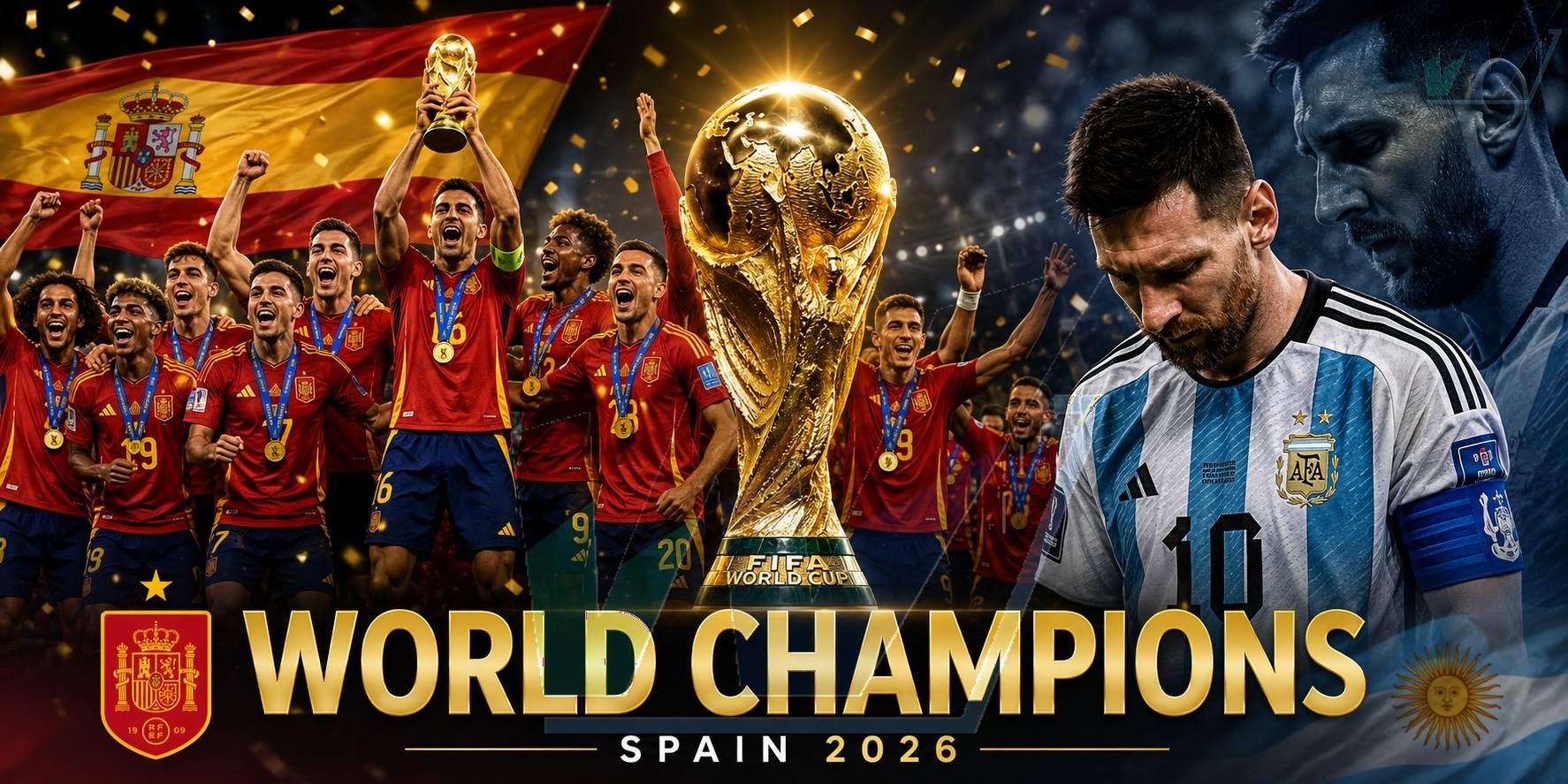
Ferran Torres Breaks Argentine Hearts as Spain Completes Historic Euro–World Cup Double; Messi’s Emotional Farewell Ends in Defeat
EAST RUTHERFORD, NEW JERSEY — Football has a new king.
After 120 minutes of tactical warfare, relentless pressure, breathtaking drama, and emotional heartbreak, Spain defeated defending champions Argentina 1-0 after extra time to lift the 2026 FIFA World Cup, securing only the second world title in the nation’s history and confirming the arrival of a new global football dynasty.
Under the bright lights of MetLife Stadium, in front of 80,663 spectators and millions watching around the globe, Ferran Torres delivered the defining moment of the tournament with a thunderous finish in the 106th minute, ending one of the most captivating World Cup finals in recent memory.
For Spain, it was history.
For Argentina, it was heartbreak.
And for Lionel Messi, it almost certainly marked the final chapter of one of football’s greatest careers.
A New Era Begins
Sixteen years after Andrés Iniesta’s unforgettable strike in Johannesburg delivered Spain’s first World Cup in 2010, another generation has etched its own place into football immortality.
Luis de la Fuente’s side didn’t merely win the tournament.
They dominated it.
Already crowned European champions, Spain has now completed one of the rarest achievements in international football—the European Championship and World Cup double, confirming La Roja as the undisputed benchmark of modern international football.
Their possession-based philosophy has evolved into something more ruthless, blending technical brilliance with vertically attacking football and remarkable defensive discipline.
Argentina Never Found an Answer
Much of the pre-match discussion centered on whether Argentina could disrupt Spain’s fluid passing game through physicality and tactical fouls.
That prediction proved accurate.
From the opening whistle, the defending champions repeatedly attempted to break Spain’s rhythm through aggressive challenges.
Alexis Mac Allister, Lisandro Martínez, Nicolás Tagliafico, and Enzo Fernández were all involved in controversial tackles as referee Slavko Vinčić struggled to maintain control.
Argentina’s defensive resilience kept them alive.
Their attack never truly arrived.
One astonishing statistic tells the entire story:
Argentina failed to register a single shot on target in 120 minutes.
For a team led by Lionel Messi, Julián Álvarez, and Lautaro Martínez, it was almost unimaginable.
Spain controlled possession, territory, and nearly every meaningful chance throughout the evening.
Ferran Torres Delivers Football Immortality
Extra time finally broke Argentina’s resistance.
After Nico Williams had a goal ruled out following a contentious foul decision, Spain refused to lose momentum.
Pedro Porro floated a perfect cross toward Williams at the back post.
Williams intelligently nodded the ball across goal.
Waiting was Ferran Torres.
The Barcelona striker unleashed a devastating first-time finish that exploded into Emiliano Martínez’s net.
MetLife Stadium erupted.
The Spanish bench emptied.
Millions celebrated across Spain.
The goal instantly joined the pantheon of iconic World Cup moments.
Speaking afterward, Torres remained humble.
“The goal belongs to 47 million Spaniards.”
Messi’s Final World Cup Ends in Tears
No player entered the final carrying greater emotional weight than Lionel Messi.
Already considered by many the greatest footballer in history, the 39-year-old hoped to become only the second captain ever to lift two World Cups.
Instead, Spain’s relentless midfield denied him space, time, and influence.
Rodri, Pedri, Martín Zubimendi, and Álex Baena suffocated Argentina’s creative engine throughout the match.
Messi rarely found dangerous positions and spent much of the evening chasing possessions rather than dictating them.
When the final whistle sounded, television cameras captured the Argentine legend in tears while receiving his runners-up medal.
If this truly proves to be Messi’s final World Cup appearance, it closes to one of football’s greatest international careers, not with triumph, but with dignified heartbreak.
Rodri Wins the Midfield War
If Ferran Torres produced the winning goal, Rodri orchestrated the victory.
The Manchester City midfielder controlled tempo, intercepted attacks, dictated passing lanes, and completely neutralized Argentina’s transitions.
Many analysts across Europe described it as one of the finest midfield performances ever seen in a World Cup final.
Spain’s defensive organization was equally exceptional.
Young defender Pau Cubarsí delivered another mature display, while goalkeeper Unai Simón enjoyed one of the quietest evenings of his international career thanks to Spain’s complete territorial dominance.
Luis de la Fuente Completes a Football Revolution
Few national-team coaches have transformed a squad as quickly as Luis de la Fuente.
Having already guided Spain to UEFA Nations League and European Championship success, he now joins Vicente del Bosque among Spain’s greatest managers.
His willingness to trust youth has reshaped Spanish football.
Lamine Yamal.
Nico Williams.
Pau Cubarsí.
Pedri.
Gavi.
Ferran Torres.
Together they represent the beginning, not the end, of Spain’s golden generation.
After lifting the trophy, De la Fuente summarized the achievement:
“We have won everything. This generation is a source of enormous pride for Spain.”
Controversy Shadows the Spectacle
The final was not without controversy.
The extended halftime show—featuring performances by Madonna, Shakira, and Justin Bieber—lasted approximately 27 minutes, prompting debate among players, broadcasters, and football traditionalists over whether FIFA is increasingly prioritizing entertainment over sporting rhythm.
Political attention also surrounded the match.
U.S. President Donald Trump attended the final alongside FIFA President Gianni Infantino and participated in the trophy presentation.
As Trump entered the pitch, sections of the crowd responded with loud boos while others applauded, creating one of the evening’s most politically charged moments.
The ceremony itself proceeded without incident.
Enzo Fernández Sent Off
Argentina’s frustrations eventually boiled over.
Deep into stoppage time, Enzo Fernández received a straight red card following a dangerous challenge on Pau Cubarsí.
Although Spain already held overwhelming control, the dismissal removed Argentina’s final chance of forcing penalties and symbolized a difficult evening for the defending champions.
Tactical Masterclass
Spain’s triumph reflected months of tactical preparation.
Their pressing forced Argentina into long clearances.
Their midfield triangles eliminated passing lanes.
Their full-backs stretched Argentina’s defensive shape.
Most importantly, Spain prevented Messi from finding the half-spaces where he has punished opponents throughout his legendary career.
Statistically, Spain dominated possession, completed significantly more passes, created the overwhelming majority of chances, and kept Argentina without a shot on target.
For many tactical observers, it ranks among the most complete World Cup final performances of the modern era.
Spain’s Historic Achievement
With victory in New Jersey, Spain joins football’s elite nations with multiple World Cup titles.
The triumph also cements one of the most successful periods in Spanish football history.
Their journey now includes:
- 2010 FIFA World Cup Champions
- UEFA Euro 2024 Champions
- 2026 FIFA World Cup Champions
- UEFA Nations League winners
For a country once criticized for underachieving on football’s biggest stage, Spain has once again become the sport’s global standard.
Argentina Leaves with Pride Despite Defeat
Although the defending champions surrendered their crown, Argentina’s run to another World Cup final reinforces the extraordinary consistency established under Lionel Scaloni.
Back-to-back World Cup finals, Copa América success, and continued competitiveness ensure Argentina remains among world football’s elite.
Yet Sunday belonged to Spain.
The World Has a New Champion
As fireworks illuminated the New Jersey skyline and red shirts danced beneath football’s most coveted trophy, one truth became undeniable.
The balance of power has shifted.
Spain didn’t simply win the 2026 FIFA World Cup.
They announced the beginning of a new era.
One built on fearless youth, tactical brilliance, relentless pressing, and football played at its purest.
The Messi era may have reached its emotional conclusion.
The Spanish era may only just be beginning.