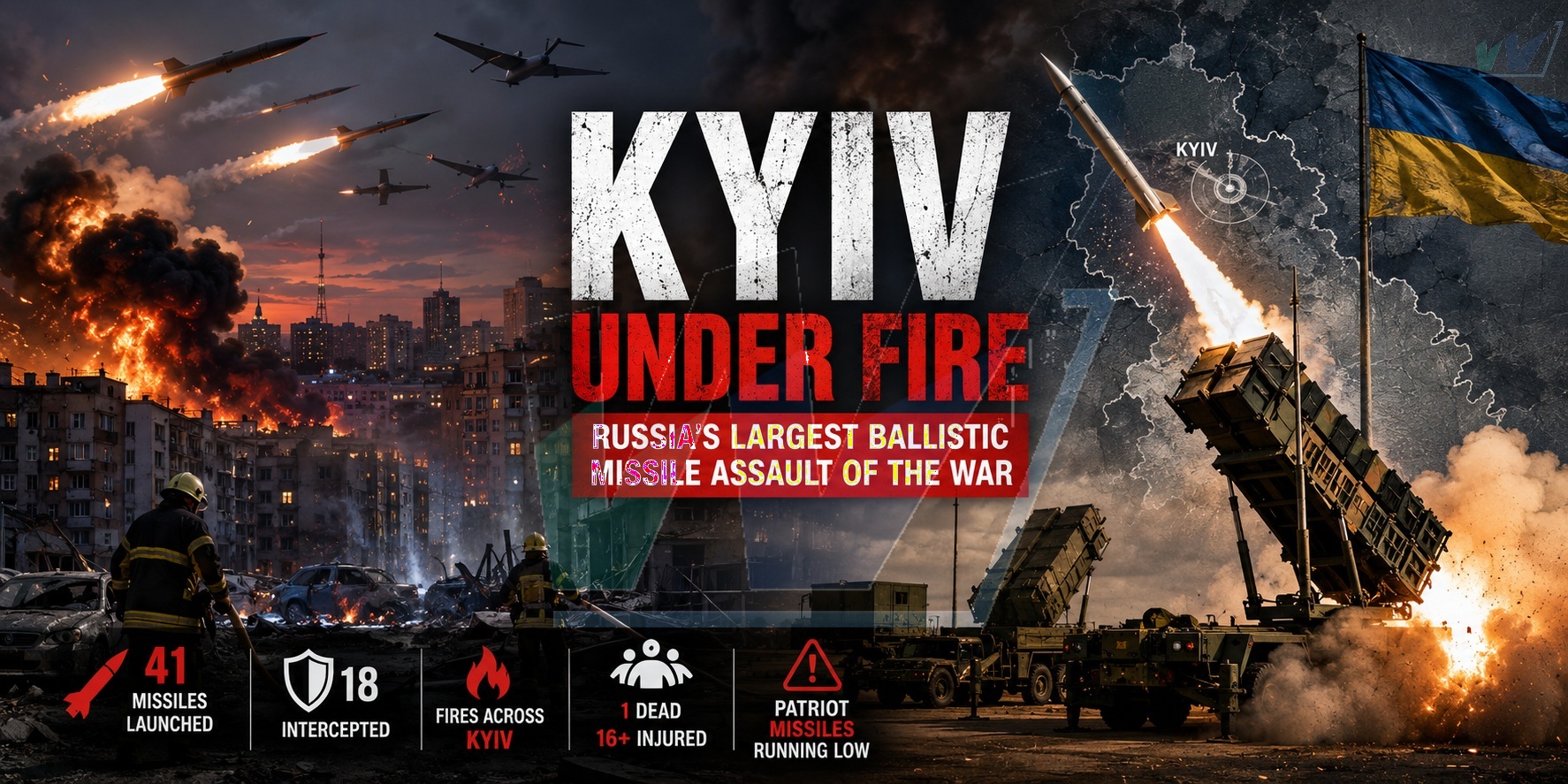
Russia Unleashes Largest Ballistic Missile Assault of the War as Ukraine’s Air Defenses Face Critical Test
Deadly Barrage Rocks the Ukrainian Capital, Patriot Missile Shortages Raise Alarm, and a New Phase of the War Begins
KYIV —
Before dawn broke over Ukraine’s capital, air-raid sirens once again shattered the silence.
Then came the explosions.
Dozens of Russian ballistic missiles and attack drones descended on Kyiv in what Ukrainian officials describe as the largest ballistic missile assault on the capital since Russia’s full-scale invasion began in February 2022. Fires erupted across residential neighborhoods, rescue crews rushed into burning buildings, and terrified families spent hours sheltering underground as air defenses fought to intercept one of the war’s most dangerous barrages.
The attack marks another dramatic escalation in Moscow’s long-range strike campaign and underscores a growing strategic concern: Ukraine is running dangerously low on Patriot interceptor missiles, the only Western system capable of reliably destroying Russian ballistic missiles.
Russia Launches Its Most Powerful Ballistic Strike Yet
According to Ukraine’s Air Force and Foreign Minister Andrii Sybiha, Russia fired 41 missiles overnight alongside waves of drones targeting multiple regions across the country.
Military officials said:
- 18 missiles were intercepted.
- Numerous ballistic missiles penetrated Ukrainian defenses.
- Several drones were also destroyed before reaching their targets.
Unlike cruise missiles, ballistic missiles travel at hypersonic speeds during parts of their trajectory, giving defenders only seconds to respond.
The result was devastation across six districts of Kyiv, including:
- Residential apartment blocks
- Private homes
- Industrial facilities
- Office buildings
- Student dormitories
- Civilian vehicles
One civilian was confirmed dead, while at least 16 people were injured, though authorities warned the casualty toll could still rise.
Fires Across the Capital
Emergency crews battled blazes for hours.
In Kyiv’s Sviatoshynskyi district, firefighters rescued four residents trapped inside a burning private home.
In Shevchenkivskyi district, rescue workers evacuated civilians from a three-story residential building engulfed in flames.
Additional fires erupted in:
- Solomyanskyi
- Dnipro
- Desnianskyi
Ukraine’s State Emergency Service described multiple simultaneous rescue operations continuing well after sunrise.
Images released by officials showed burned apartment blocks, collapsed roofs, shattered windows, destroyed vehicles, and smoke rising across several neighborhoods.
“A Brutal Terrorist Attack”
Foreign Minister Andrii Sybiha condemned the assault in unusually strong language.
“This was a brutal terrorist attack against the Ukrainian capital.”
He urged Western governments to intensify sanctions and military support.
“We need devastating pressure on Moscow to end this terror.”
President Volodymyr Zelenskyy echoed the appeal.
“Our highest priority remains protection against ballistic missiles,” Zelenskyy wrote.
“Interceptors are needed every single day.”
Patriot Missile Shortage Reaches Critical Point
Military analysts say the latest attack exposed Ukraine’s greatest defensive weakness.
Ballistic missiles can only be reliably intercepted by advanced systems such as:
- Patriot PAC-3
- SAMP/T (limited capability)
- Some newer Western missile-defense platforms
Ukraine possesses only a limited number of Patriot batteries.
More importantly, officials acknowledge that interceptor missiles themselves have become increasingly scarce after months of relentless Russian bombardments.
Western intelligence officials have warned for months that Russia appears to be deliberately exhausting Ukraine’s air-defense inventory before launching larger ballistic strikes.
The latest attack appears consistently with that strategy.
Trump Administration Signals New Patriot Production Plan
President Donald Trump recently indicated that Washington is prepared to authorize Ukraine to produce Patriot interceptor missiles domestically under license.
Although no implementation timeline has been announced, the proposal could significantly alter Ukraine’s long-term defensive capabilities if approved.
Defense analysts caution, however, that licensed production would likely require:
- technology transfers,
- manufacturing infrastructure,
- trained personnel,
- and months—possibly years—before meaningful output.
Ukraine’s immediate challenge remains obtaining ready-to-use interceptor missiles.
Russia Expands Multi-Front Pressure
Sunday’s attacks were not limited to Kyiv.
Russian strikes also hit:
Dnipropetrovsk Region
Drone attacks killed one civilian near the eastern frontline.
Zaporizhzhia
A Russian drone struck a passenger train.
Ukraine’s railway company confirmed the train conductor was killed.
Photographs released by Ukrainian Railways showed scorched rail cars and heavy fire damage.
Ukraine Hits Back in the Black Sea
Even as Kyiv absorbed one of its heaviest bombardments, Ukrainian forces launched another maritime strike.
Officials reported attacks on two Russian oil tankers operating in the Black Sea, continuing Kyiv’s strategy of disrupting logistics supporting occupied Crimea.
Over the past year Ukraine has increasingly targeted:
- fuel depots,
- naval facilities,
- bridges,
- rail infrastructure,
- shipping routes supplying Crimea.
The campaign seeks to weaken Russia’s ability to sustain military operations in southern Ukraine.
Political Turbulence Inside Kyiv
The military escalation comes amid rare domestic political controversy.
President Zelenskyy’s recent cabinet reshuffle—including the replacement of Defense Minister Mykhailo Fedorov—has generated criticism from opposition figures, military veterans, and some frontline soldiers.
Critics argue leadership changes during an active phase of the war risk disrupting defense planning at a critical moment.
Supporters insist the government is restructuring ministries to improve wartime efficiency.
The debate reflects increasing pressure on Ukraine’s leadership as the war enters another exhausting year.
Russia’s Summer Missile Campaign Intensifies
Military observers note that Moscow has significantly increased ballistic missile attacks throughout July.
Unlike previous waves dominated by drones or cruise missiles, recent operations increasingly feature:
- Iskander ballistic missiles,
- Kinzhal hypersonic missiles,
- combined drone saturation tactics.
Experts say Russia is attempting to overwhelm Ukrainian air defenses by launching multiple weapon types simultaneously.
The strategy forces defenders to expend scarce interceptor missiles before additional projectiles arrive.
Western Intelligence Watches Closely
Western officials continue monitoring Russia’s evolving missile campaign amid concerns that Moscow has rebuilt parts of its precision-strike arsenal despite years of international sanctions.
Recent assessments from European defense analysts suggest Russia has increased domestic production of:
- ballistic missiles,
- cruise missiles,
- Shahed-type attack drones produced with Iranian-designed technology,
- long-range precision weapons.
At the same time, NATO governments continue debating how rapidly additional air-defense systems can be delivered to Ukraine.
Several European allies have pledged further Patriot support, but deliveries remain constrained by limited inventories and competing security commitments.
A War Entering a Dangerous New Phase
More than four years after Russia’s invasion began, Ukraine now faces a battlefield increasingly defined not only by trench warfare but by the race between missile production and missile interception.
Each Russian barrage tests the resilience of Ukraine’s shrinking air-defense stockpiles, while every successful interception depends on increasingly scarce Patriot missiles.
Sunday’s unprecedented ballistic assault on Kyiv illustrates how the conflict is evolving into a contest of industrial capacity, strategic endurance, and international support.
For millions of Ukrainians, however, the reality remains immediate and deeply personal: another night spent beneath sirens, another morning counting the damage, and another reminder that peace remains painfully out of reach.