12 Dead as Russia Strikes Kyiv: EU Scrambles for Ukraine’s Missing Missiles
EUROPE / UKRAINE WAR / AIR DEFENCE / RUSSIA / PATRIOT MISSILES / EU SECURITY
Kyiv Under Fire as Europe Searches for Interceptors
WICKLOW, Ireland — September 1, 2026
The message reaching Europe from Ukraine is becoming harder to ignore: the missiles are running short, the Russian attacks are intensifying, and the next wave could test the limits of Ukraine’s air-defense shield.
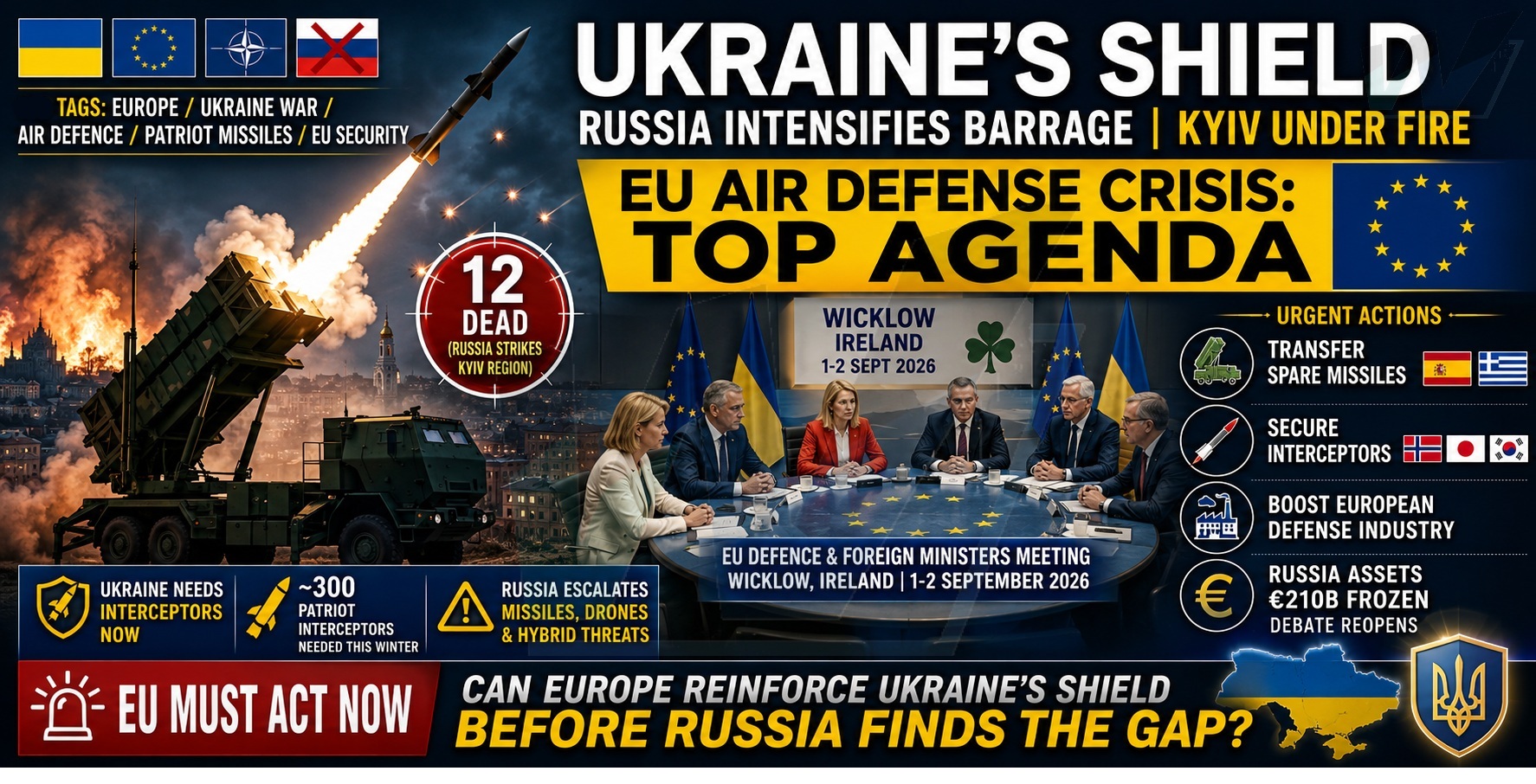
EU defense ministers are meeting in County Wicklow on Tuesday with Ukraine’s air-defense needs at the center of the agenda, just hours after Russian missiles and drones killed at least 12 people in Kyiv and the surrounding region.
The overnight barrage struck railway infrastructure in Kyiv, residential areas around Boryspil and critical facilities in Odesa, while Ukraine said its forces intercepted hundreds of incoming aerial targets. President Volodymyr Zelenskyy again called for more air-defense systems and interceptor missiles.
The timing has transformed the EU meeting from another strategic discussion into an urgent test of Europe’s ability to supply Ukraine with the weapons it needs before Russia’s next major barrage.
The Patriot problem
EU foreign-policy chief Kaja Kallas put the issue bluntly as she arrived in Wicklow: “The main issue is air defense. They are lacking interceptors.”
Kallas urged European countries holding interceptors that are approaching the end of their service life to transfer them to Ukraine rather than allow potentially usable missiles to sit in storage. She also said the EU is looking beyond its own borders for additional interceptor supplies while working with Kyiv on developing European alternatives.
The pressure is increasingly focused on Spain and Greece, which are understood to possess significant stocks of Patriot interceptors. European officials are examining ways to move additional missiles to Ukraine, including proposals involving third countries such as Norway.
The shortage has become more acute as Russia increasingly combines ballistic missiles, cruise missiles and increasingly sophisticated drones in attacks designed to overwhelm Ukrainian air defenses.
Zelenskyy has warned that Kyiv needs roughly 300 Patriot interceptors to prepare for the coming winter. Earlier this summer, he told Axios that U.S. Patriot stocks were under additional pressure because of the war involving Iran, complicating Washington’s ability to replenish allies and Ukraine simultaneously.
And Europe cannot build a replacement overnight. Ukraine has pushed for a European anti-ballistic missile capability, but European defense programs remain years away from replacing the immediate protection provided by American-made systems.
Russia’s pressure campaign moves beyond Ukraine
The threat confronting European ministers is not confined to Ukrainian skies.
Across Europe, governments are increasingly focused on what they describe as Russia-linked hybrid warfare — sabotage, cyberattacks, drone operations, espionage and other activity designed to disrupt infrastructure and test Western responses without triggering an open NATO-Russia confrontation.
Germany is now preparing to publicly attribute the suspected August drone incident at Leipzig/Halle Airport to Russian intelligence services, according to a Reuters report citing German media. The incident involved drones near a Ukrainian cargo aircraft at a strategically important air-freight hub. Moscow has rejected the accusations.
The episode has intensified European fears that the battlefield is no longer confined to Ukraine.
The Wall Street Journal has separately reported growing concern over Russian grey-zone operations, including sabotage, cyberattacks and drone activity targeting Ukraine’s European allies.
For European governments, the calculation is increasingly uncomfortable: wait for attacks to become unmistakably military or respond earlier to operations designed to remain below that threshold.
Sanctions return to the battlefield
The EU is also preparing for another economic strike.
Kallas said last month that Brussels plans one of its most extensive sanctions expansions against Russia, potentially adding around 1,600 individuals and organizations to the bloc’s existing list. The package is expected to focus heavily on Russia’s military-industrial complex, as well as actors linked to cyberattacks, disinformation and other hybrid operations.
But sanctions are only one part of the financial battle.
Four EU countries, the Netherlands, Poland, Spain and Sweden, have called for the bloc to reopen the debate over Russia’s frozen sovereign assets, arguing that the existing €90 billion EU support loan may not be enough to cover Ukraine’s needs through 2027.
Around €210 billion in Russian Central Bank assets are immobilized in Europe, with roughly €185 billion held through Belgium-based Euroclear, according to Reuters. Belgium remains wary of assuming the legal and financial risks associated with using the assets directly.
The EU has already committed €90 billion to Ukraine for 2026 and 2027, including substantial defense funding. The first €3.2 billion instalment was disbursed in June, with further money directed toward defense procurement and Ukraine’s defense industry.
The question now is whether Europe can keep financing Ukraine at the same pace while simultaneously rebuilding its own military stockpiles.
Ireland becomes the center of Europe’s security debate
The Wicklow meetings are being hosted by Ireland during its 2026 presidency of the Council of the EU.
Tuesday’s defense-minister discussions include support for Ukraine, defense-industrial cooperation, the EU’s Ukraine Support Loan and mobilization of the European Peace Facility. Ukraine’s acting defense minister Andrii Khmara is taking part alongside NATO and European officials.
The foreign ministers’ Gymnich meeting follows on September 1–2, also in Wicklow, with broader discussions about Europe’s geopolitical role and response to a rapidly changing international environment.
That broader agenda matters.
Europe is simultaneously dealing with Russia’s war in Ukraine, rising hybrid attacks, pressure on its defense industries, uncertainty over American military capacity and a wider international security environment stretching from the Middle East to the Arctic.
Europe faces a dangerous equation
The central problem is now brutally simple.
Ukraine needs interceptors immediately. Europe has limited stocks. Russia is increasing the scale and sophistication of its attacks. And rebuilding Western missile inventories takes years, not weeks.
The EU can search for spare Patriot missiles. It can pressure countries such as Spain and Greece. It can seek supplies from partners outside Europe. It can accelerate domestic missile production and impose another round of sanctions.
But none of those measures can instantly replace the interceptor that Ukraine fires tonight.
And after the latest Russian barrage, Kyiv has once again demonstrated why its air-defense network remains one of the most consequential battle lines in Europe.
The question hanging over Wicklow is therefore larger than another weapons package:
Can Europe reinforce Ukraine’s shield before Russia finds the gap?
For now, the answer remains uncertain, and the skies over Ukraine are getting louder.