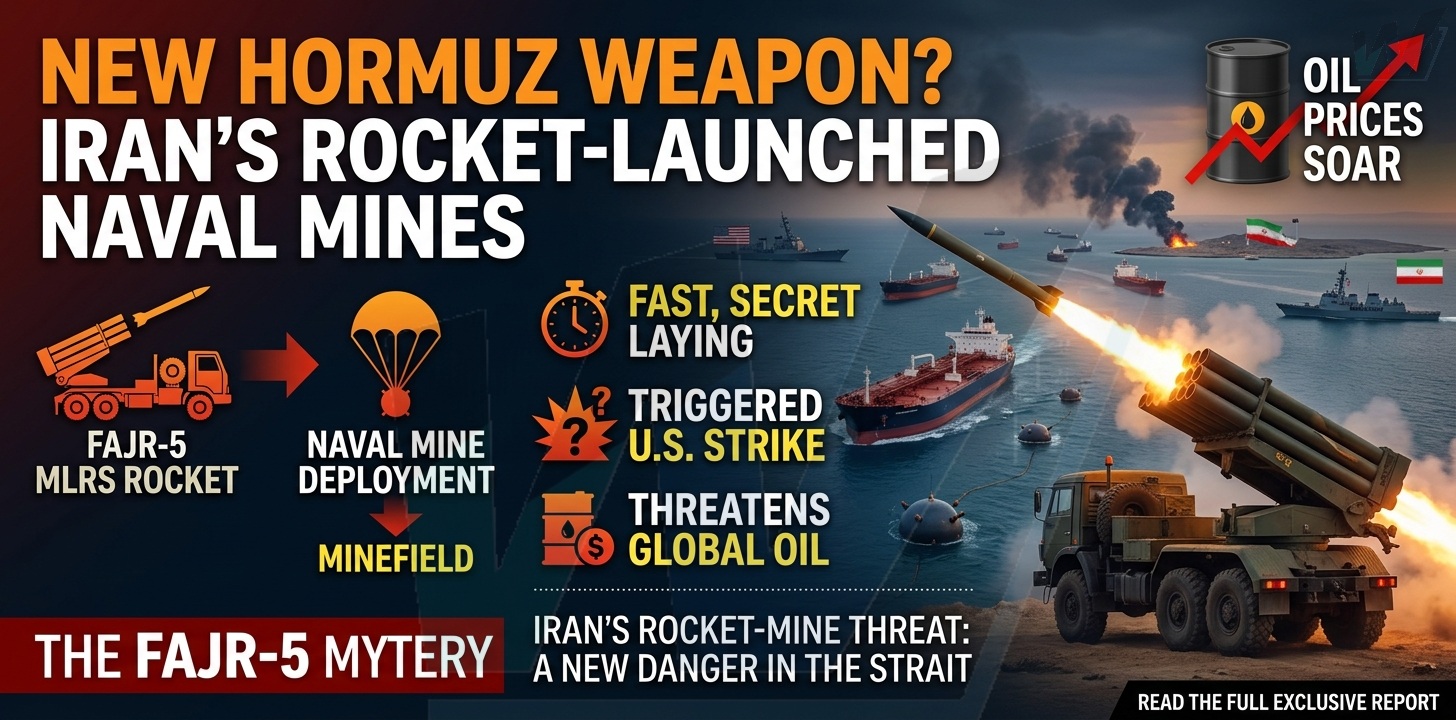
Iran’s New Hormuz Weapon? The Rocket-Mine Threat That Triggered a U.S. Strike
Iran’s Fajr-5 Mystery: Has Tehran Turned Rockets into Naval Mine Launchers for the Strait of Hormuz?
A weapon once demonstrated in an Iranian military exercise may now have triggered a U.S. strike, and could threaten one of the world’s most important energy lifelines.
The Strait of Hormuz has become a battlefield again.
On August 30, U.S. forces struck two Iranian rocket launchers on Larak Island, ending a month-long pause in direct U.S.-Iran military action. Washington said the operation was launched after Islamic Revolutionary Guard Corps forces were observed preparing to fire rockets carrying sea mines into the Strait of Hormuz.
Iran retaliated with ballistic-missile attacks against U.S. military positions in Jordan, while regional tensions spread across the Gulf. Global oil prices immediately reacted, with Brent climbing above $90 a barrel.
But the most consequential question is not simply why the United States struck Larak.
It is whether Iran has actually turned a conventional rocket artillery system into a long-range mine-delivery weapon.
The Fajr-5 mystery
The idea is not entirely new.
In January 2025, Iranian state media showed footage from a naval exercise in which a Fajr-5 multiple-launch rocket system appeared to be used to deliver naval mines into the sea. The system normally fires 333mm artillery rockets, but the demonstrated configuration appeared to replace the conventional explosive warhead with a mine payload.
The Fajr-5’s reported range, around 75 kilometers for the standard system, with longer-range variants available, would theoretically give Iran enough reach to threaten large portions of the Strait from the Iranian coast.
That makes the Larak deployment particularly significant.
The island sits inside the Strait, close to Iran’s southern coast and near one of the world’s most sensitive maritime chokepoints.
If the U.S. assessment is correct, Iran may have been preparing to deploy mines without sending vulnerable small boats, submarines or aircraft into the immediate mine-laying area.
That would change the tactical equation.
A minefield without a mine-laying boat
Traditionally, Iran has relied heavily on small fast craft and other naval platforms to deploy mines.
Those operations are dangerous.
A boat carrying mines must approach the target area, deploy the weapons and escape—while facing surveillance, drones, aircraft and naval forces.
A rocket launcher changes the equation.
Load. Fire. Move.
A mine-delivery rocket could potentially release its payload over a designated area while the launcher remains on land.
Military analysts say such a system would offer speed and reduce the exposure of Iranian crews. The concept could also complicate U.S. efforts to monitor every potential mine-laying operation.
But there is a major catch.
Rockets are not magic mine-layers.
A naval mine is heavy and must survive the rocket’s acceleration, flight and descent. A conventional rocket impacting directly into the sea could destroy or damage its own payload.
The mine therefore has to separate from the rocket before impact and descend safely—potentially using a parachute or another mechanism.
That makes the system technically complicated and raises questions about how many mines a single rocket can realistically deliver.
The evidence is real, but incomplete
This is where the story becomes murky.
Iran has demonstrated the concept publicly.
What remains unclear is whether the launchers destroyed by the United States on Larak Island on August 30 were actually configured with mine-carrying rockets at the time of the strike.
CENTCOM has not publicly released the intelligence, imagery or technical evidence that would independently establish the precise payload of the launchers.
Iran, meanwhile, has not publicly confirmed that it was preparing to launch mines from those particular systems.
That distinction matters.
The evidence supports the conclusion that rocket-delivered naval mines are technically plausible and that Iran has publicly demonstrated such a capability.
It does not, by itself, prove that the Larak launchers were loaded and ready to fire on August 30.
Why the United States struck first
Washington had already declared a zero-tolerance policy toward new mine-laying operations.
U.S. Central Command said it had completed clearing mines from the international shipping routes through the Strait only days before the Larak strike. The discovery of Iranian forces preparing another mine deployment therefore represented, from the U.S. perspective, an immediate challenge to that effort.
The strike was described by CENTCOM as limited and precise.
The message was unmistakable:
Clear the mines and stop Iran from putting them back.
Iran answered almost immediately.
The IRGC said its forces launched ballistic missiles against U.S. bases in Jordan. Jordan said eight missiles were intercepted, while U.S. officials reported no significant impact on American forces.
The temporary military lull was over.
Then came the tanker claims
The danger escalated further on September 2.
Iran’s IRGC claimed that two oil tankers struck sea mines in the Strait of Hormuz, caught fire and were disabled after attempting to use what Tehran described as an unauthorized route.
But the claim remains disputed.
The IRGC did not publicly identify the vessels, provide their flags or release independently verifiable evidence of the alleged mine strikes. Analysts and U.S. officials have disputed or questioned the account.
That uncertainty is crucial.
If mines really were deployed after the U.S. strike, the central question becomes how they got there.
Were they planted earlier?
Were they released by conventional naval assets?
Or did Iran actually employ the rocket-based system?
Public evidence does not yet answer that question.
Why Hormuz changes everything
This is not an ordinary stretch of water.
The Strait of Hormuz links the Persian Gulf with the Gulf of Oman and the Arabian Sea. At its narrowest point it is only about 29 nautical miles wide, with designated shipping channels even narrower.
In the first half of 2025, approximately 20.9 million barrels of oil per day moved through the strait—about one-fifth of global petroleum liquids consumption and roughly one-quarter of global seaborne oil trade.
More than 20% of global LNG trade also transited the waterway.
That is why a mine does not have to sink a supertanker to have a global impact.
It only has to make shipowners hesitate.
Insurance premiums rise.
Captains slow down.
Tankers wait offshore.
Cargoes are diverted.
Oil prices jump.
And suddenly a weapon costing far less than a warship can generate billions of dollars of economic disruption.
The real weapon may be uncertainty
That may be Iran’s greatest advantage.
A mine is dangerous because it is hidden.
A suspected minefield can be almost as powerful.
The moment commercial operators believe mines might exist beneath their ships, normal navigation becomes a high-risk calculation.
Reuters reported this week that tanker traffic through Hormuz had fallen sharply amid the renewed confrontation, while Brent crude climbed toward $97 a barrel as investors priced in the possibility of further supply disruption.
The economic battlefield is therefore expanding alongside the military one.
Iran does not necessarily need to close Hormuz completely.
It may only be needed to make passage sufficiently dangerous, uncertain or expensive.
A desperate adaptation, or a new capability?
There are two competing interpretations.
One sees the rocket-based mine system as an improvised adaptation.
U.S. strikes earlier in the conflict reportedly destroyed large numbers of Iranian fast-attack craft around the Strait, potentially making traditional mine-laying missions far more dangerous. A shore-based launcher could allow Iran to continue threatening maritime traffic while reducing the risk to its crews.
The other interpretation is more skeptical.
Some maritime-security specialists argue that rocket-launched mines are inefficient, imprecise and potentially dangerous to Iran itself. Free-floating mines can drift, making their eventual location difficult to predict, including for the force that deployed them.
That creates a strategic paradox:
A weapon designed to deny the enemy access could also make Iran’s own maritime routes more dangerous.
The psychological battlefield
There is another possibility.
The rocket-mine story may be partly about psychological warfare.
Iran has an interest in demonstrating that the destruction of portions of its conventional naval forces has not eliminated its ability to threaten Hormuz.
The United States has an equally strong interest in demonstrating the opposite: that American forces can detect and destroy Iranian attempts to mine the waterway before commercial shipping is trapped.
The result is a dangerous contest of perception.
Iran wants shipping companies to believe Hormuz can be denied.
Washington wants them to believe Hormuz can be protected.
The truth may lie somewhere between the two.
What happens next?
Three developments will determine whether the rocket-mine threat becomes a genuine new chapter in the war.
First: independent evidence of the Larak launchers and their payloads.
Second: credible confirmation of how the alleged mines that later affected shipping were deployed.
Third: whether Iran attempts another mine-laying operation after the U.S. strike.
For now, the strongest conclusion is neither that Iran has invented a revolutionary weapon nor that the threat is merely propaganda.
It is more unsettling than either.
Iran appears to have demonstrated that conventional rocket artillery can be adapted to deliver naval mines.
The United States says it caught that capability being prepared for operational use at Larak.
The public evidence has not yet independently proved every part of that claim.
But the capability exists as a demonstrated concept—and the Strait of Hormuz is precisely the kind of battlefield where even an imperfect weapon can have an outsized effect.
The bottom line
The question is no longer simply whether Iran can put mines into Hormuz.
It is whether Tehran can do it quickly enough, secretly enough and repeatedly enough to keep the world’s tankers guessing.
Because in the Strait of Hormuz, the most powerful weapon may not be the mine that explodes.
It may be the mine that nobody can prove isn’t there.