U.S.-Greenland Security Deal Explained: What Trump, Denmark and Greenland Agreed
Trump Claims “Permanent Control” of Greenland Security, What the New U.S.-Denmark Deal Really Means
WASHINGTON/COPENHAGEN/NUUK
A confrontation that threatened to fracture the NATO alliance has suddenly moved toward a diplomatic off-ramp.
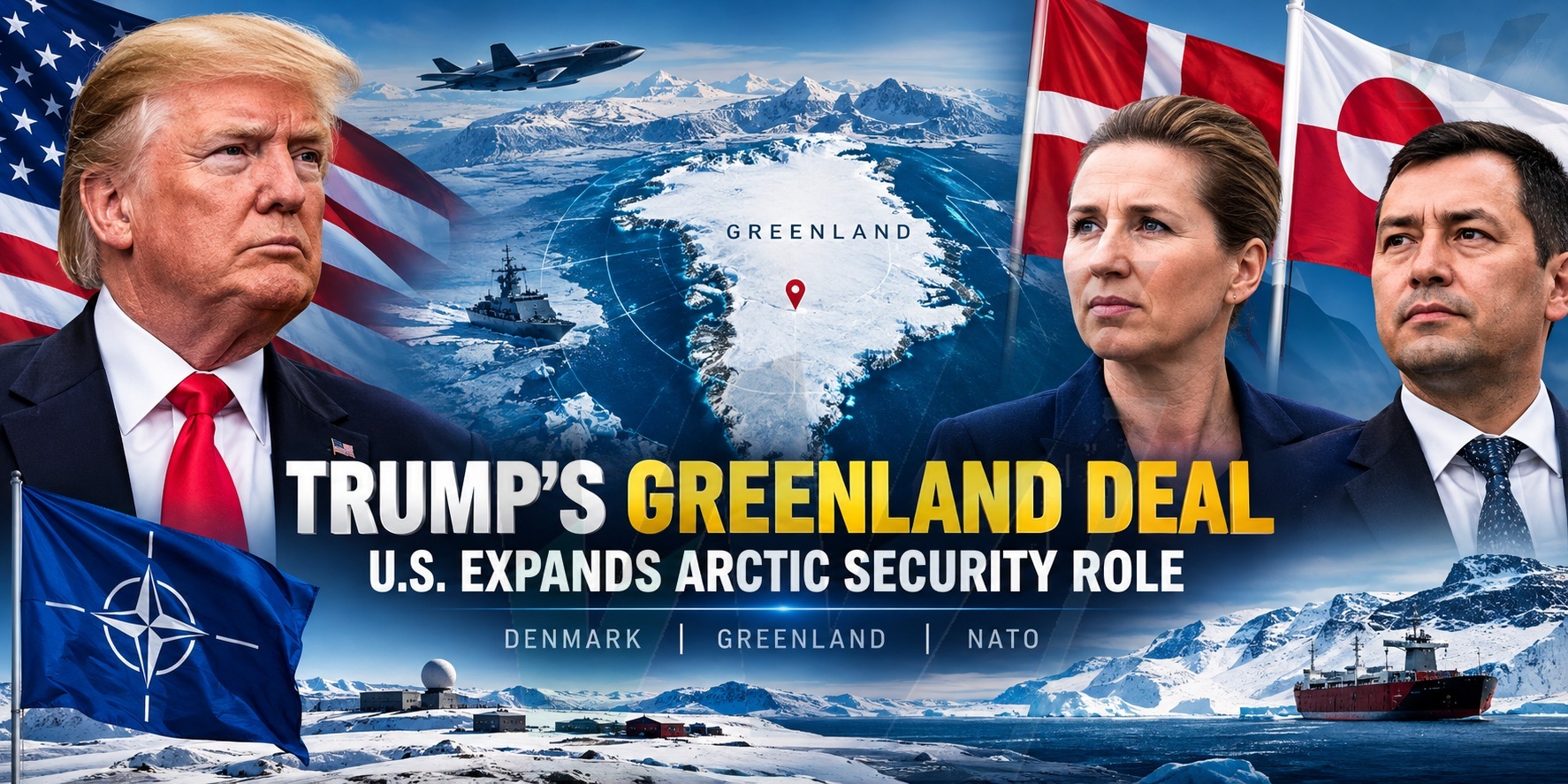
President Donald Trump says the United States has reached a sweeping security agreement with Denmark and Greenland that gives Washington “permanent control” over security and other U.S. needs on the strategically vital Arctic island. But Copenhagen and Nuuk are describing the emerging pact in markedly different terms: an agreement to strengthen Arctic security while preserving Danish sovereignty and Greenlanders’ right to self-determination.
The full text has not yet been released. That leaves the most consequential question unanswered: How much new authority does Washington gain?
The three governments are expected to sign the agreement during the United Nations General Assembly in New York next week, after which it will require the necessary parliamentary procedures in Denmark and Greenland.
From annexation threats to a military foothold
Trump’s announcement marks a dramatic change in tone after months of confrontation over Greenland.
The president had repeatedly argued that American control of the island was necessary for U.S. national security and had previously refused to rule out using force to obtain it. Denmark and Greenland rejected the idea of selling or surrendering the territory, while the dispute alarmed other NATO governments.
The emerging agreement does not transfer Greenland to the United States.
Instead, the arrangement appears designed to give Washington something strategically significant without changing the island’s formal status: greater and potentially enduring U.S. military access and infrastructure, while Greenland remains within the Kingdom of Denmark.
Trump said the United States would immediately begin developing a much larger military presence at suitable locations in Greenland.
That would build upon an American military presence that already exists at Pituffik Space Base, the U.S. installation in northwestern Greenland that plays an important role in missile warning, space surveillance and Arctic defense.
The phrase that triggered the alarm
The central dispute is over Trump’s description of the deal as giving Washington “permanent control” of Greenland’s security.
Danish and Greenlandic officials have not publicly endorsed that formulation.
Denmark’s Prime Minister Mette Frederiksen said the agreement recognizes the sovereignty and territorial integrity of the Kingdom of Denmark as well as the Greenlandic people’s right to self-determination. Greenland’s Prime Minister Jens-Frederik Nielsen similarly said the agreement recognizes Greenland’s interests and place in international cooperation.
Reuters reported that critical elements remain unknown, including the size of the future U.S. military presence and whether Washington would receive any formal authority over Greenland’s foreign policy or natural resources.
That gap between Trump’s language and the Danish-Greenlandic description is likely to dominate the next stage of negotiations.
China and Russia are at the center of the strategy
Behind diplomatic language is harder strategic calculation.
Trump says the agreement would prevent U.S. adversaries from establishing military bases, deploying forces or making sensitive investments in Greenland without American approval. U.S. officials cited by American media have described provisions intended to keep non-NATO powers, particularly China and Russia, from establishing a military foothold on the island.
That matters because Greenland sits astride the North Atlantic and Arctic approaches to North America.
Its location makes the island important for:
- missile warning and space surveillance;
- North Atlantic air and maritime security;
- Arctic military operations;
- emerging shipping routes;
- access to critical minerals and rare-earth resources;
- monitoring activity by Russia and China.
The Arctic is rapidly becoming a more contested strategic environment, and NATO has been increasing attention to the region.
NATO’s military leadership met in Copenhagen on September 18–19, where alliance chiefs discussed strengthening deterrence, readiness, air and missile defense, cyber, space and protection of critical infrastructure.
A NATO spokesperson has also welcomed the Greenland agreement, saying it could strengthen security, stability and cooperation in the Arctic and North Atlantic.
A new deal, or a reinforced old framework?
One of the biggest questions is how revolutionary the agreement is.
The United States already possesses extensive military rights in Greenland under a 1951 defense agreement with Denmark. That framework enabled Washington to maintain military installations on the island during the Cold War and still underpins the American presence today.
CNN noted that the new arrangement bears similarities to the longstanding security framework, raising the question of how much additional authority is being created.
The New York Times likewise reported that U.S. officials described the military relationship as cooperation with Danish and Greenlandic counterparts rather than Washington simply assuming command over Greenland’s defense.
That distinction is crucial.
The headline says, “permanent control.” The emerging diplomatic framework looks more like permanent access, expanded military capability and tighter exclusion of strategic rivals.
Europe watches, and recalibrates
The Greenland confrontation has already reshaped European thinking about Arctic security.
The European Union moved closer to Greenland earlier this month, promising a stronger partnership and €200 million ($232 million) in support over two years for areas including climate policy, internet connectivity, hydropower, fisheries and education.
European governments have also increased their attention to Arctic defense after Trump’s threats.
The emerging U.S.-Denmark-Greenland agreement could therefore reduce one immediate source of tension inside NATO, but analysts cited by the Atlantic Council caution that European concerns about the durability of the transatlantic relationship are unlikely to disappear simply because the Greenland dispute is being contained.
Greenland’s future remains the wild card
The agreement also appears designed to survive any future change in Greenland’s constitutional status.
Greenland is self-governing but remains part of the Kingdom of Denmark, and independence remains an important political question on the island.
According to reporting by the New York Times and Wall Street Journal, the emerging arrangement is intended to preserve American military access even if Greenland eventually becomes independent.
That could make the pact more than a short-term diplomatic settlement.
It could become a long-term architecture for U.S. Arctic power, regardless of who ultimately governs Greenland.
The next test comes in New York
For now, the agreement exists politically but is not yet fully operational.
Denmark and Greenland have emphasized that parliamentary procedures remain necessary. The formal signing expected during the UN General Assembly should reveal whether Trump’s description of “permanent control” matches the legal text.
Until then, the deal remains a carefully balanced compromise:
Washington gets a stronger and potentially permanent strategic position in Greenland.
Denmark retains sovereignty.
Greenland retains its claim to self-determination.
NATO gains a mechanism for strengthening Arctic defense.
And Russia and China face tighter barriers to establishing a strategic foothold.
The confrontation that once raised the prospect of a rupture between Washington and Copenhagen has therefore entered a new phase, not through an American takeover of Greenland, but through an attempt to turn the island into an even more deeply integrated pillar of Western Arctic security.