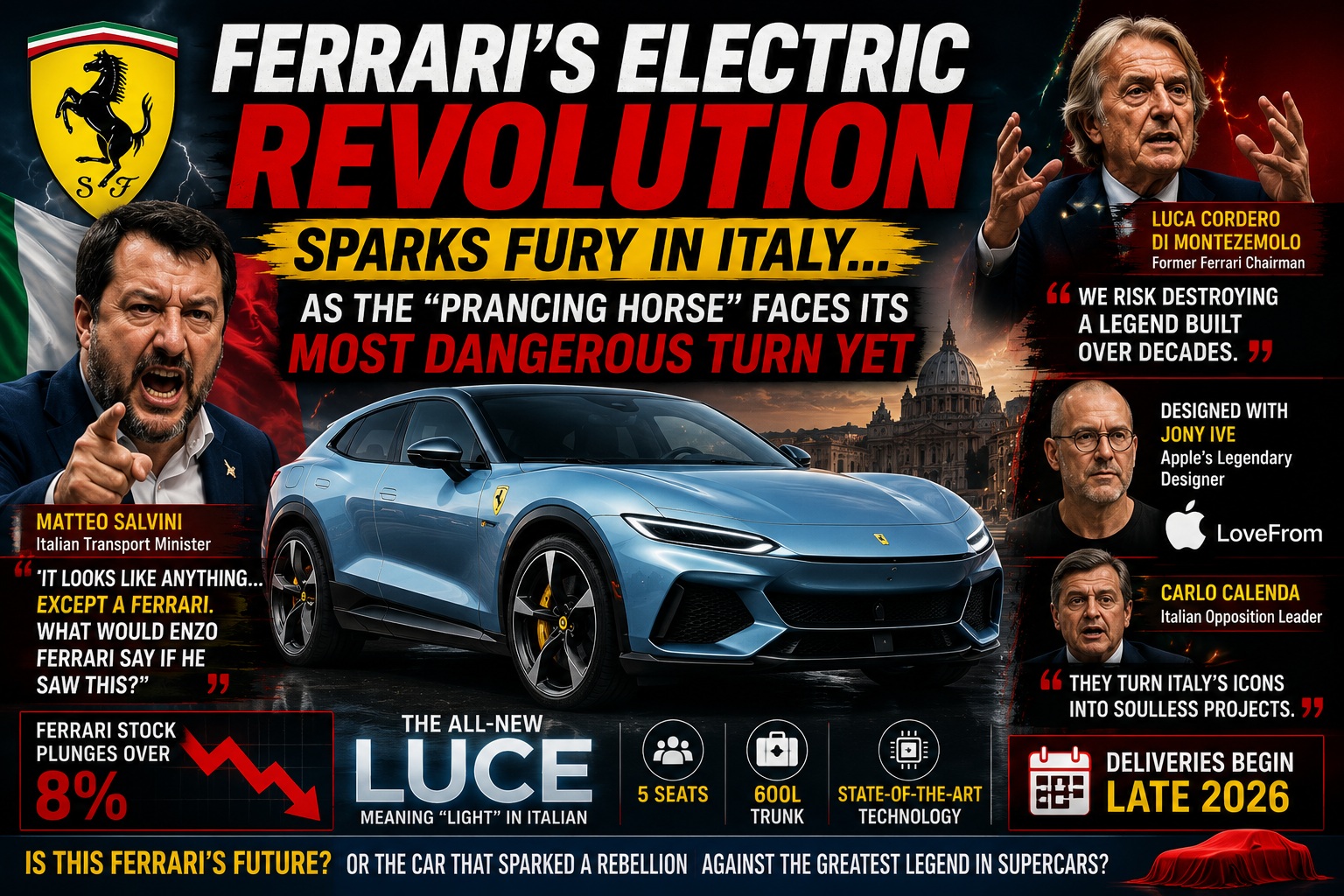
It was never supposed to be just another car launch.
But the moment Ferrari unveiled its first fully electric model, “Luce,” the reaction inside Italy exploded like a political and cultural earthquake. Within hours, social media transformed into a digital battlefield, as furious fans, politicians, and automotive legends unleashed a storm of criticism against the vehicle that was meant to represent the future of Ferrari’s iconic “Prancing Horse.”
Instead of celebrating the birth of a new era, many Italians saw something far more disturbing:
A betrayal of Ferrari’s soul.
The first major strike came from Italian Transport Minister Matteo Salvini, who tore into the car with brutal sarcasm. In a fiery social media post, Salvini mocked the vehicle’s staggering €550,000 price tag before delivering the line that instantly ignited headlines across Italy:
“It looks like anything… except a Ferrari. What would Enzo Ferrari say if he saw this?”
And that was only the beginning.
As outrage intensified, powerful voices from Ferrari’s own history entered the fight. Former Ferrari chairman Luca Cordero di Montezemolo openly warned that the company was “risking the destruction of a legend built over decades.” He even suggested that the car barely deserved to carry Ferrari’s legendary prancing horse emblem — a symbol long associated with roaring engines, raw speed, and mechanical passion.
Then came his cutting joke that sent shockwaves through the auto world:
“At least… the Chinese won’t copy this one.”
The remark poured fuel onto an already raging fire, especially among loyal Ferrari enthusiasts who accused the company of abandoning its racing DNA in pursuit of a cold, silent electric future.
But perhaps the biggest shock wasn’t under the hood.
It was the design itself.
With its unusual light-blue color, smooth futuristic styling, and minimalist luxury feel, many critics said the new Ferrari looked more like an Apple product than a brutal Italian supercar. The comparison was no accident. Legendary designer Jony Ive — the creative mind behind Apple’s most iconic devices — helped shape the car through his design firm LoveFrom.
Ferrari hoped the five-seat electric model would attract wealthy families seeking comfort, cutting-edge technology, and everyday usability. Instead, investors delivered an immediate warning signal.
Within hours of the unveiling, Ferrari’s stock plunged more than 8%, exposing growing fears that the company’s bold electric gambling could backfire spectacularly.
And the political storm only grew darker.
Italian opposition figure Carlo Calenda seized the moment to attack the powerful Agnelli-Elkann family, accusing them of stripping Italy’s industrial icons of their spirit and turning national legends into soulless corporate experiments.
Yet despite the fury, Ferrari appears determined to push forward.
“Luce” — meaning “light” in Italian — marks the company’s first fully electric vehicle at a time when rivals like Porsche and Lamborghini are already slowing their electric ambitions due to weakening global demand.
Still, Ferrari seems ready to race headfirst into the future — no matter the risks.
Now, as deliveries are set to begin in late 2026, one question continues to haunt Italy and the global world of speed:
Has Ferrari truly created the supercar of tomorrow?
Or has “Luce” become the machine that sparked a rebellion against the greatest legend in automotive history?