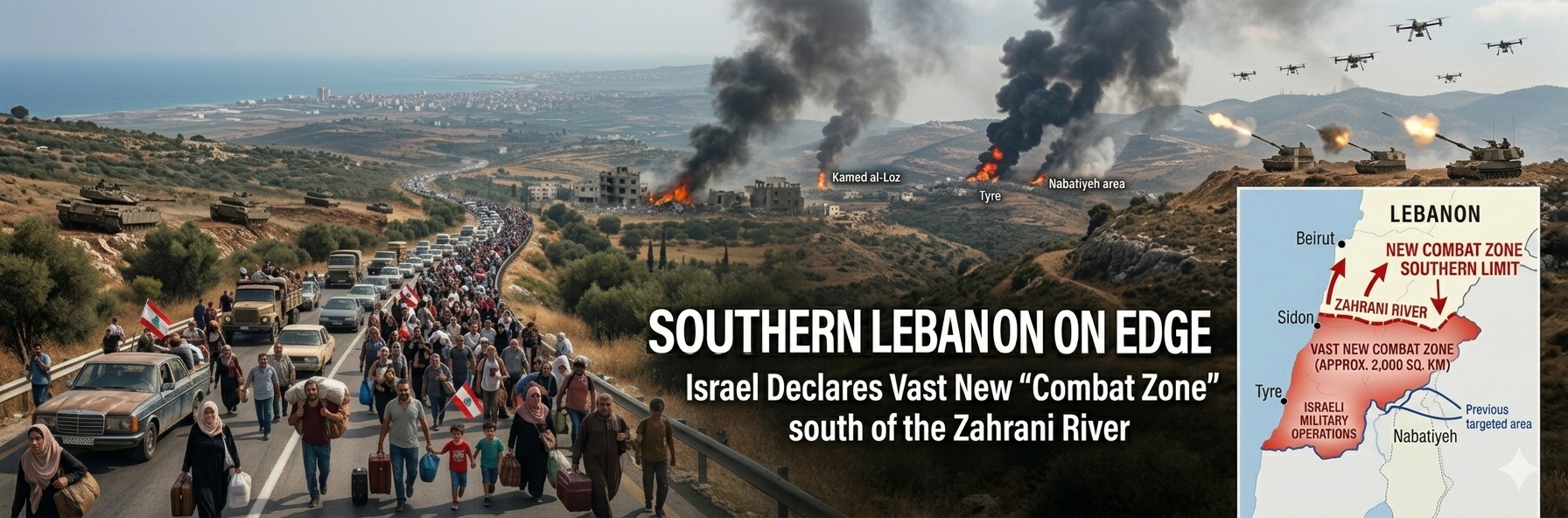
Panic swept across southern Lebanon on Wednesday after Israel dramatically widened its military campaign, declaring a massive stretch of territory a new “combat zone” and ordering civilians to flee north in one of the most serious escalations since the April ceasefire.
The warning came suddenly.
In a statement posted online, the Israeli military announced that every area south of the Zahrani River was now considered an active battlefield, cautioning residents to evacuate immediately or risk being caught in what officials described as operations that would be carried out “with great force” against Hezbollah positions.
The declaration sent shockwaves through towns and villages already scared by months of war.
Cars packed with frightened families clogged roads leading north toward Sidon as explosions echoed across the south. Witnesses described scenes of chaos unfolding during Eid al-Adha celebrations, with many abandoning homes mid-gathering after hearing the evacuation order spread through phones and mosque loudspeakers.
The Zahrani River lies roughly 40 kilometers north of Israel’s border, meaning the newly designated combat area stretches across nearly 2,000 square kilometers of Lebanese territory — a huge expansion of the zone previously targeted by Israeli operations.
Tuesday night had already hinted that something bigger was coming.
More than 120 Israeli strikes pounded southern and eastern Lebanon in a relentless wave of attacks despite the ceasefire announced in April. Fireballs lit the night sky as warplanes and drones targeted what Israel said were Hezbollah sites, weapons depots, and operational positions.
Israeli Prime Minister Benjamin Netanyahu signaled that the campaign was far from over, insisting Israel must take stronger action to secure northern Israeli communities threatened by Hezbollah.
Until now, evacuation warnings had mainly focused on areas south of the Litany River. But Wednesday’s announcement marked the first time Israel ordered civilians out of the entire region south of the Zahrani — a move many observers view as a dangerous new phase in the conflict.
Lebanese security officials reported thousands of additional civilians fleeing north as fears mounted that ground operations could push deeper into Lebanese territory. Israeli forces have already expanded operations beyond the so-called “Yellow Line,” though military officials have refused to reveal how far troops have advanced.
Despite the growing violence, Beirut remains untouched by direct strikes — at least for now.
Residents in the Lebanese capital continue to hear the constant buzz of Israeli surveillance drones overhead, while fighter jets occasionally roar low across the city skyline, serving as a chilling reminder that the war is never far away.
According to senior Israeli officials, that restraint is deliberate.
Israel reportedly believes it has broad freedom to strike Hezbollah in southern Lebanon but sees Beirut as politically explosive territory. Officials fear heavy attacks on the capital could jeopardize sensitive U.S.-led diplomatic efforts involving Iran and regional negotiations tied to President Donald Trump’s administration.
Behind the scenes, diplomacy and war now appear locked in a dangerous race against time.
Since fighting reignited in March after Hezbollah launched attacks in support of Iran, more than 1.2 million Lebanese have reportedly been displaced. Lebanese health authorities say over 3,200 people have been killed in Israeli strikes across the country, while the World Health Organization estimates hundreds have died even after the ceasefire technically took effect.
Meanwhile, Israel says Hezbollah drone attacks and ambushes have continued to kill its soldiers along the border.
With evacuation zones expanding, airstrikes intensifying, and diplomacy hanging by a thread, southern Lebanon is once again bracing for the possibility that the conflict could spiral into an even larger regional war.
Source: FRANCE 24 with Reuters