As the Strait of Hormuz becomes Washington and Tehran’s newest bargaining chip, the real question is no longer who can inflict more pain, but who can turn pressure into a negotiated outcome.
WASHINGTON — The battlefield may have fallen quieter, but the confrontation between Washington and Tehran has entered a more dangerous phase.
The missiles are no longer the only weapons.
Sanctions are weapons. Oil is a weapon. The Strait of Hormuz is a weapon. Economic pain is a weapon. Even the timing of negotiations has become a weapon.
And behind all of it sits one unresolved question:
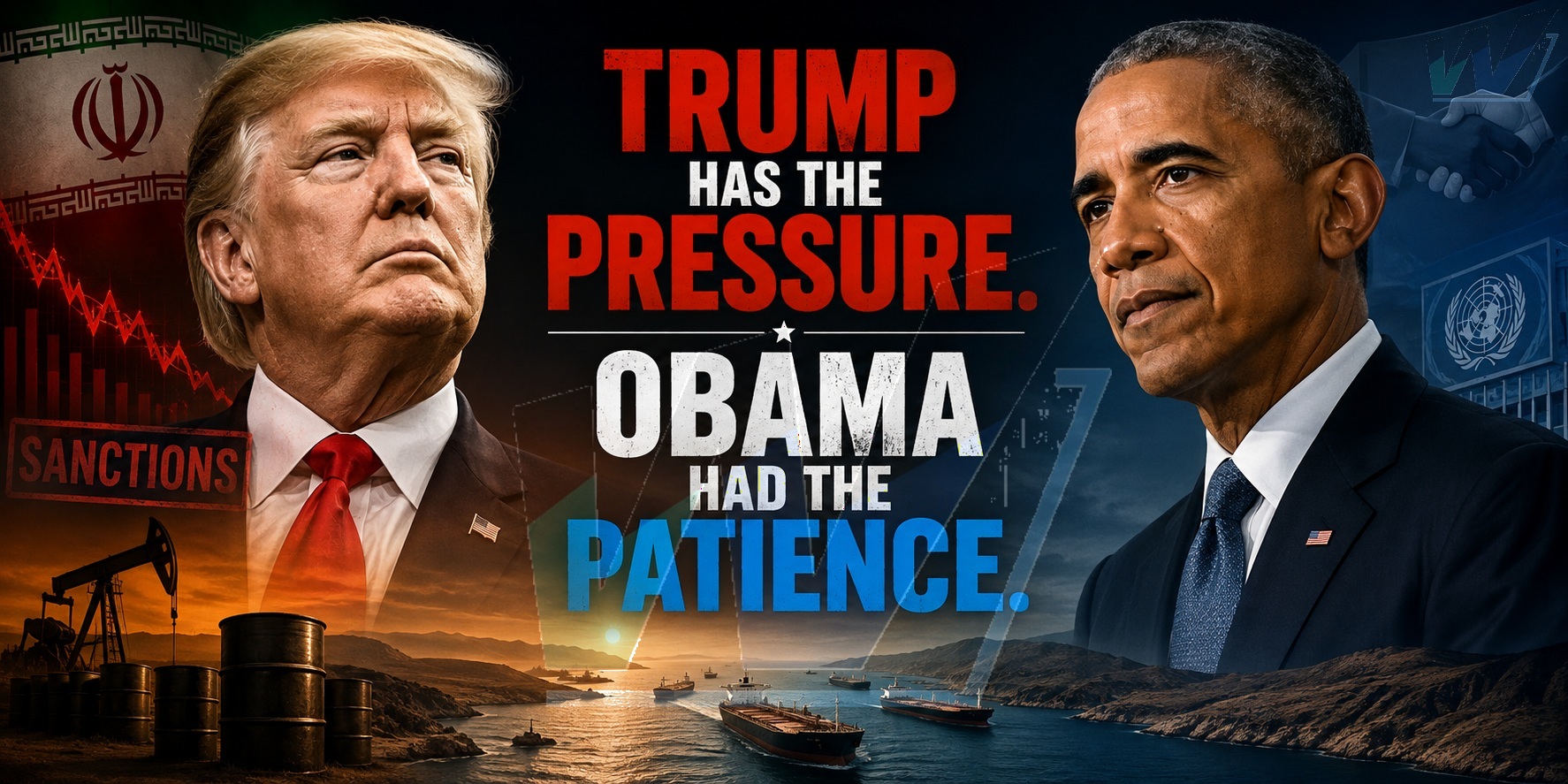
Can President Donald Trump force Iran to make the concessions he wants—or will maximum pressure once again produce maximum resistance?
There is an uncomfortable lesson for Trump in the record of Barack Obama.
It is not that Trump should revive Obama’s 2015 nuclear agreement.
It is almost the opposite.
Trump can argue, with considerable political justification, that the 2015 Joint Comprehensive Plan of Action was too narrow, contained time-limited restrictions and failed to address Iran’s missiles, regional proxies and broader security behavior.
But Obama demonstrated something strategically important:
Pressure works best when it creates an opening for diplomacy, and when the pressure is given time to work.
That lesson may matter more now than the text of the old nuclear deal itself.
The Obama Formula: Pressure First, Negotiation Second
History is often simplified.
Obama did not simply walk into Tehran and offer Iran a diplomatic bargain.
His administration spent years helping construct an increasingly powerful sanctions architecture against the Islamic Republic, working with Congress, the United Nations and U.S. allies.
By 2010, Washington had significantly expanded sanctions aimed at Iran’s oil exports and financial system. The objective was straightforward: reduce Tehran’s economic room for maneuver and make continued confrontation increasingly expensive. Congressional Research Service records describe those measures as an effort to deny Iran financial resources and compel changes in policy.
The pressure was not instantaneous.
It accumulated.
And that distinction matters.
CNAS data show that Iran was the most heavily targeted country under U.S. sanctions during the Obama years, with 655 Iranian individuals and entities designated under U.S. authorities from January 2009 to January 2017. The broader U.S. sanctions system produced hundreds of designations each year, reaching 619 in 2010, 485 in 2011, 590 in 2012 and 525 in 2013.
Then came a political opening.
Hassan Rouhani won Iran’s presidential election in June 2013.
By September, Obama and Rouhani had spoken by telephone, the first direct conversation between U.S. and Iranian presidents since 1979. Obama subsequently directed Secretary of State John Kerry to continue the diplomatic effort.
Two months later, the United States and its partners reached the Joint Plan of Action, the first-step nuclear agreement.
Obama’s own explanation was blunt: the sanctions had imposed substantial economic pressure, while the election of a new Iranian president created an opening for diplomacy.
That sequence is the real lesson.
Pressure created leverage. Politics created an opening. Diplomacy converted the leverage into concessions.
Trump Is Trying Something Different
Trump’s instinct is not fundamentally different from Obama’s on one crucial point.
He believes Iran must feel pressure before it will surrender meaningful concessions.
But the two presidents have differed sharply in the way they have applied that pressure.
Obama’s approach was gradual and institutional.
Trump has often been abrupt, public and intensely personalized.
The Trump administration’s first-term “maximum pressure” campaign dramatically increased sanctions activity. CNAS data show 880 U.S. sanctions designations in 2017, 1,457 in 2018 and 785 in 2019—well above the annual totals recorded during Obama’s presidency.
Yet sanctions alone did not produce the sweeping political transformation Washington wanted.
Iran endured.
And Tehran learned to adapt.
Oil continued to move through alternative channels. Sanctions evasion networks expanded. China remained an important buyer of Iranian crude. The Iranian state absorbed enormous economic damage without simply capitulating.
That history should be impossible to ignore in 2026.
The New Battlefield Is Hormuz
The most striking development in the current confrontation is that the nuclear dispute is no longer isolated.
It has merged with the global energy system.
The Strait of Hormuz has become the immediate pressure point.
In June, Washington and Tehran reached a framework that halted the fighting and launched a 60-day negotiation process dealing with the nuclear program, enriching uranium and sanctions. The arrangement also envisioned reopening the strategic waterway.
But the diplomacy did not deliver a final settlement.
Instead, the two sides became locked in another contest over leverage.
Iran wants sanctions relief, an end to the U.S. blockade and other concessions.
Washington wants guarantees on Iran’s nuclear capabilities and broader security concerns.
And Hormuz sits between them.
The stakes could hardly be higher.
On August 10, Reuters reported that uncertainty over the waterway was already pushing Gulf markets and oil prices, while negotiations involving Oman faced new Iranian demands, including compensation for damage caused during the conflict.
By August 11, Brent crude was holding above $87 a barrel as hopes for a settlement faded. Reuters reported that oil flows through Hormuz had fallen sharply, adding another layer of pressure to already fragile global energy markets.
The Strait is therefore no longer merely a military or geographic issue.
It is negotiating leverage measured in barrels, shipping premiums and inflation.
And Trump Is Changing Tactics
This is where the current moment becomes particularly interesting.
Trump has repeatedly threatened stronger military action against Iran, but recent signals suggest Washington is also returning to economic pressure.
Axios reported on August 9 that Trump said the United States was “low-keying it” with Iran, indicating a preference for allowing economic pressure to accumulate rather than immediately launching another major military offensive.
That sounds remarkably close to the principle behind Obama’s strategy, even if the politics and rhetoric are completely different.
The difference is that Trump appears to want results much faster.
And that may be the problem.
Economic sanctions rarely operate according to a presidential timetable.
They can take months or years to change calculations inside a government.
Governments under pressure can also become more defiant rather than more conciliatory, particularly when leaders believe that surrender would threaten the survival of the regime.
The Obama Lesson Is Not “Sign Another JCPOA”
This distinction is crucial.
Obama’s nuclear agreement imposed substantial restrictions on Iran’s nuclear program.
Under the JCPOA, Iran agreed to restrict its enrichment capacity, including maintaining no more than 5,060 IR-1 centrifuges at Natanz for 10 years and limiting uranium enrichment to 3.67% for 15 years. The agreement also established extensive monitoring and verification provisions.
But the agreement did not resolve every dispute between Washington and Tehran.
It did not settle Iran’s missile program.
It did not end Iran’s support for regional armed groups.
And many of its most controversial nuclear restrictions were time-limited.
Trump’s criticism of those shortcomings has therefore remained politically powerful.
The question is not whether Trump should simply recreate the 2015 agreement.
He shouldn’t.
The more useful question is:
Can Trump use Obama’s method while negotiating a very different agreement?
That means maintaining pressure while keeping a diplomatic door open.
Where Trump Could Actually Improve on Obama
If Trump wants a stronger agreement, the logical objective would be to combine the strengths of both approaches.
First: preserve economic leverage.
If sanctions are removed before Iran makes verifiable concessions, Washington risks surrendering its strongest bargaining tool.
Second: stop treating every negotiation as a deadline.
Iranian leaders have spent decades learning how to survive pressure. Public ultimatums may strengthen their incentive to wait.
Third: broaden the negotiating agenda.
A future agreement could potentially address nuclear enrichment, inspections, ballistic missiles, drones, regional proxies and mechanisms for resolving future violations.
Fourth: make sanctions relief conditional and reversible.
Instead of an all-or-nothing bargain, Washington could link economic relief to specific, independently verified Iranian actions.
Fifth: keep the diplomacy quiet.
This may be the most important lesson.
Obama’s negotiations were frequently conducted through painstaking diplomatic channels, including the P5+1 framework and behind-the-scenes contacts.
The current confrontation is often played out publicly, sometimes in real time, through presidential statements and social media.
That creates political pressure, but it can also make compromise harder.
A government that publicly promises never to compromise has less room to compromise.
Iran Has Its Own Clock
There is another reality Washington cannot ignore.
Iran does not measure time the same way the White House does.
Trump may think in terms of weeks.
Tehran may think in terms of years.
The Iranian leadership has repeatedly demonstrated a willingness to absorb economic pain if it believes waiting will improve its negotiating position.
That is why Trump’s current approach faces a paradox.
The harsher the pressure becomes, the greater the incentive for Iran to negotiate.
But the harsher the pressure becomes, the greater the incentive for Iran to make the negotiations about survival, sovereignty and national resistance rather than nuclear concessions.
The result can be a dangerous cycle:
Pressure → resistance → escalation → retaliation → more pressure.
At some point, Washington must decide whether the objective is punishment or a deal.
Those are not always the same thing.
Hormuz Could Become the Test
The next phase may therefore be decided not inside a nuclear facility but on the water.
Iran and Oman have been discussing mechanisms for maritime traffic through the Strait. Reuters reported that proposals have included questions surrounding shipping control and fees, while Washington has resisted arrangements that could give Tehran excessive leverage over international shipping.
AP likewise reported that a potential agreement was close but remained vulnerable because Washington and Tehran would have to retreat from competing positions.
Then the rhetoric hardened.
Iran demanded compensation and major U.S. concessions.
Trump responded by demanding compensation from Iran for Americans killed or wounded in conflicts and attacks attributed to Tehran or Iran-backed groups. Reuters reported the escalation on August 10.
Suddenly, the negotiation was no longer just about uranium.
It was about who pays whom.
Who controls Hormuz.
Who lifts sanctions.
Who withdraws military forces.
Who gets to claim victory.
And that is precisely where diplomacy becomes most difficult.
The Dangerous Mistake Would Declaring Victory Too Soon
Trump’s greatest advantage is also potentially his greatest weakness.
He has demonstrated a willingness to use overwhelming pressure.
But pressure is not the final objective.
Leverage is valuable only if it can be converted into an agreement.
Obama understood that distinction.
He did not obtain everything Washington wanted from Iran.
But he managed to transform sanctions into negotiations, negotiations into restrictions, and restrictions into an internationally monitored agreement.
Trump wants something broader and potentially more durable.
That is a legitimate ambition.
But a bigger deal requires more, not less, strategic patience.
The current situation offers a striking irony.
Trump spent years condemning Obama’s Iran agreement.
Yet the pathway to a stronger agreement may require Trump to rediscover the very mechanism that made Obama’s diplomacy possible:
sustained pressure, followed by serious negotiations, followed by carefully calibrated concessions.
Not endless war.
Not endless sanctions.
Not endless headlines.
A bargaining process.
The Final Question: Can Trump Wait?
The answer may determine what happens next.
If Trump maintains economic pressure while quietly reopening serious diplomatic channels, he could eventually recreate the leverage that helped bring Iran to the negotiating table in 2013—while demanding a substantially broader agreement than the one Obama reached in 2015.
If, however, Washington repeatedly escalates, imposes deadlines, threatens military action and then demands immediate surrender, Tehran may conclude that surviving the pressure is safer than compromising.
That would leave the Middle East trapped between two options neither side truly wants:
another war, or another frozen nuclear crisis.
The Strait of Hormuz has already demonstrated the price of that stalemate.
Oil rises.
Shipping slows.
Insurance costs climb.
Markets react.
And the pressure spreads far beyond Iran and the United States.
The lesson from Obama is therefore neither liberal nor conservative.
It is strategic.
Sanctions can create leverage.
Military force can create leverage.
But neither can create a durable agreement by itself.
For that, someone eventually must sit across the table.
And if Trump wants the strongest Iran deal in American history, the hardest move may not be another strike.
It may be knowing when to stop striking, and let the pressure do the negotiating.