From “Unconditional Surrender” to Cheap Oil: Is Trump Quietly Scaling Back the Iran War?
Trump’s Iran War Goals Shift as JD Vance Puts Oil Prices and Nuclear Containment First
Six months into the U.S.-Iran war, Washington appears to be quietly changing the definition of victory.
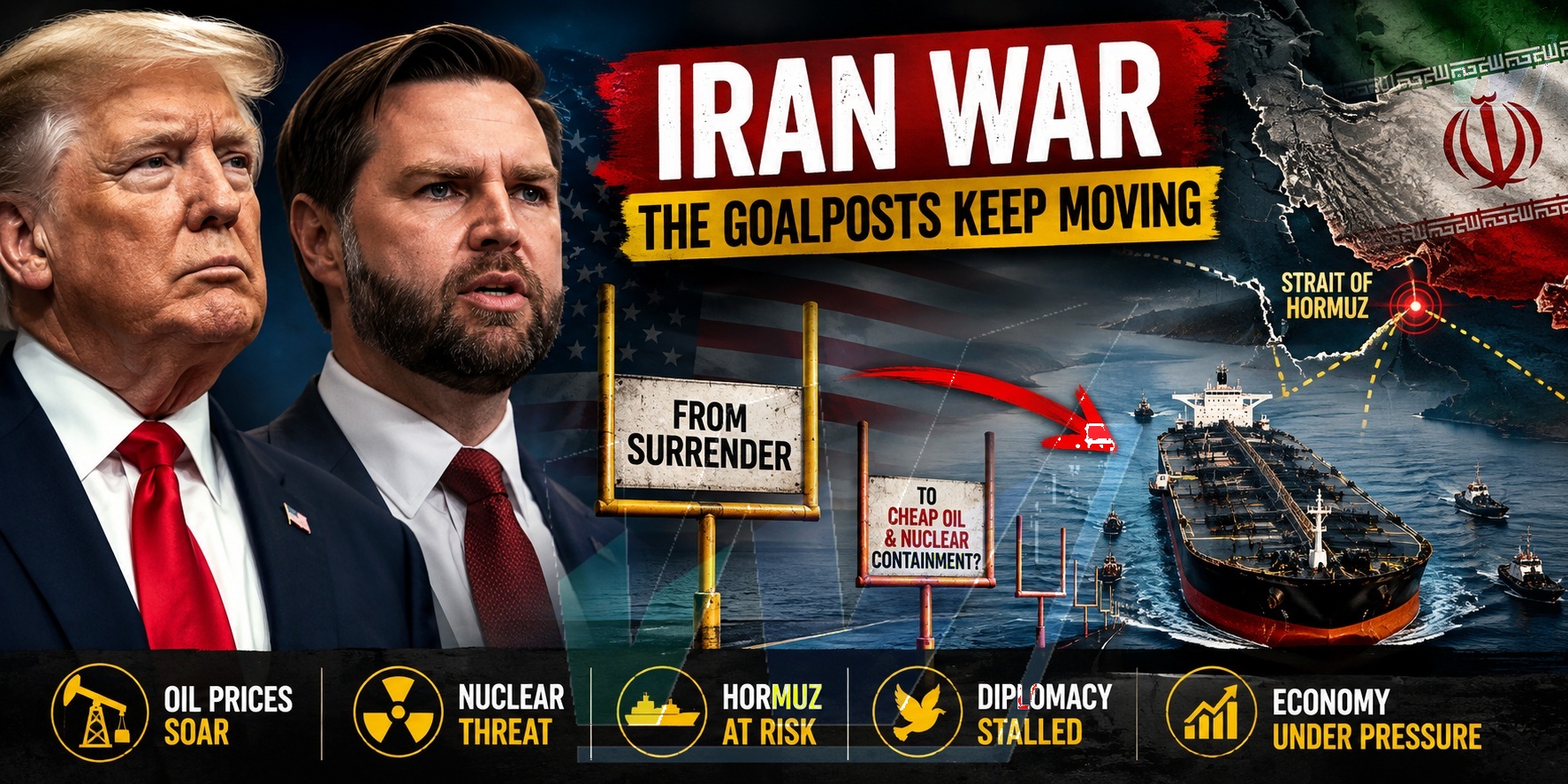
The most revealing signal came from Vice President JD Vance, who recently reduced the administration’s stated objectives to two priorities: keeping Gulf oil and gas flowing to the world economy and preventing Iran from acquiring a nuclear weapon.
That is a strikingly smaller target than the sweeping ambitions announced when the war began.
The Trump administration initially spoke of crushing Iran’s military capabilities, eliminating its nuclear program, dismantling its missile threat, weakening its regional proxy network and even opening the door to regime change. President Donald Trump at one point demanded Iran’s “unconditional surrender.”
Now the emphasis is increasing on something far more basic: getting the oil moving, containing the nuclear threat and finding a way out.
The goalposts are moving
Vance’s formulation matters because the administration has repeatedly changed the list of objectives during the conflict.
Earlier versions emphasized regime change, Iranian missiles, proxy groups, naval and air capabilities and the destruction of Tehran’s nuclear infrastructure. By June, however, the U.S.-Iran memorandum of understanding contained far less of the maximalist language that had dominated Washington’s opening war rhetoric.
The latest shift is even more revealing.
Vance placed energy security first.
That would have been almost unthinkable at the beginning of the war. Trump himself previously dismissed concerns about the financial burden on Americans, arguing that stopping Iran from obtaining a nuclear weapon was worth the economic pain.
Yet on August 14, Trump acknowledged that Americans were paying more for gasoline and said he would not apologize for it.
The contradiction is difficult to miss.
If higher energy prices were once an acceptable price for victory, why is energy-price stability now elevated to one of Washington’s principal objectives?
Hormuz has become the battlefield inside the battlefield
The answer lies beneath the surface of the war: the Strait of Hormuz.
The waterway has become one of Tehran’s most powerful bargaining chips and Washington’s most urgent economic problem.
The conflict has disrupted commercial shipping and energy flows, while repeated attacks and threats have pushed insurers, tanker operators and governments into increasingly difficult calculations. Reuters reported this week that Brent crude was near $89 a barrel as markets weighed stalled U.S.-Iran diplomacy and continuing supply risks.
Environmental damage is increasing too.
Reuters reported two major oil slicks in the Gulf, including one linked to a damaged vessel near Qeshm Island, while a separate tanker spill near Oman created a slick estimated at roughly 2,000 square kilometers.
And the diplomatic problem is becoming harder to disguise.
The United States wants the strait reopened.
Iran wants concessions.
Tehran has demanded an end to the war, sanctions relief, removal of the naval blockade, access to frozen assets and compensation for wartime damage before agreeing to a broader settlement governing the waterway.
That gives Iran leverage precisely where Washington is becoming most vulnerable.
Trump’s “low-key” strategy
Trump himself offered another clue on August 9, telling Axios that Washington was “low keying it” with Iran and emphasizing economic pressure rather than immediately launching another major offensive. Reuters independently reported the remarks, describing the strategy as an attempt to increase pressure while avoiding another large-scale military escalation.
The language represents a dramatic change from the opening months of the war.
The conflict was supposed to be short.
Instead, it has entered its sixth month.
The administration is now confronting a dangerous strategic equation: continuing the war risks deeper economic disruption and military escalation; ending it without a sweeping Iranian capitulation risk making the original war aims look unattainable.
That is the trap.
The nuclear issue remains the red line
Washington has not abandoned its most important demand.
Preventing Iran from obtaining a nuclear weapon remains central to the administration’s public position.
But even here, rhetoric has evolved.
Trump has increasingly suggested that American strikes may already have done enough damage to Iran’s nuclear infrastructure and that Washington could monitor developments rather than insist on physically removing every trace of enriched material.
That is a very different proposition from demanding the complete dismantling of Iran’s nuclear capabilities.
And it could provide the administration with something it desperately needs: a definition of victory that does not require Tehran to surrender everything Washington originally demanded.
Iran is not behaving like a defeated power
The danger for Washington is that Tehran does not appear ready to accept that interpretation.
Iran continues to use the Strait of Hormuz as leverage, while regional tensions remain dangerously high. AP reported August 15 that Iran accused Qatar of holding Iranian military pilots captured after aircraft were downed, while Qatar rejected the allegation. The same report described another tanker attack in the Gulf and renewed Houthi attacks linked to the wider conflict.
At the same time, the United States has expanded diplomatic outreach.
AP reported that Washington has been engaging European players including Austria and Greece as efforts to restart diplomacy broaden. Both countries have strategic interests in the crisis, Austria because of the IAEA and Greece because of its major shipping sector.
That is another clue.
When the military solution was expected to deliver victory, Washington needed fewer mediators.
Now it needs more.
War is increasingly defined by what happens next
The most consequential question may no longer be whether Trump can force Iran to surrender.
It may be whether he can convince Americans that a significantly narrower settlement still counts as victory.
A deal that prevents Iran from obtaining a nuclear weapon, restores commercial shipping through Hormuz and reduces pressure on global energy markets could give Washington an exit.
But it would fall well short of the maximalist objectives that accompanied the opening of the war.
And that is precisely why Vance’s comments matter.
The administration may not be publicly admitting that its ambitions have changed.
But the language is changing.
The priorities are changing.
The diplomacy is changing.
And the battlefield itself is changing.
Six months after Washington entered the conflict promising decisive results, the central question is no longer simply how Iran can be defeated.
It is becoming much more uncomfortable:
Can Trump turn a war that began with demands for Iranian surrender into a settlement that looks, by comparison, like a negotiated retreat?
For now, the answer is still being written in the waters of Hormuz, and in the price of gasoline at American pumps.