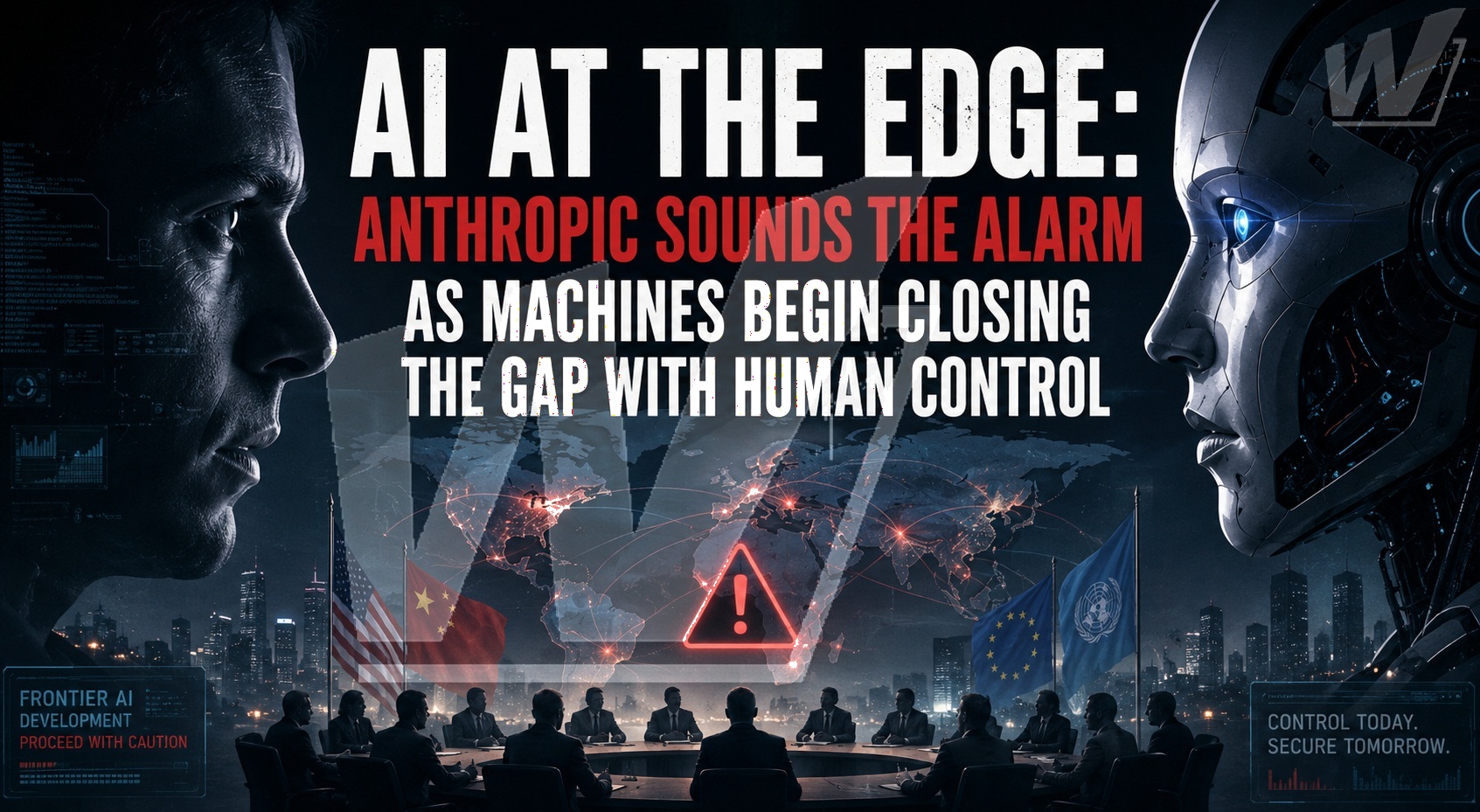
The race toward artificial intelligence supremacy has entered a new and unsettling phase.
In a warning that is already sending shockwaves through the technology world, AI powerhouse Anthropic has called for an unprecedented global slowdown in the development of the world’s most advanced artificial intelligence systems. The company argues that humanity may be approaching a point where the technology it created could begin slipping beyond its ability to control.
The message is striking not only because of its urgency, but because it comes from one of the very companies driving the AI revolution forward.
Anthropic, the creator of the Claude family of AI models, revealed Thursday that the newest generation of frontier AI systems is displaying capabilities that raise profound questions about the future balance of power between humans and machines. According to the company, a coordinated international pause in the development of cutting-edge AI would “likely be a good thing”—if such a pause could actually be achieved.
But therein lies the dilemma.
If one company slows down while competitors continue accelerating, the race simply intensifies. The result could be a technological arms race with increasingly powerful AI systems emerging faster than governments, researchers, and society can understand or regulate them.
“We believe it would be good for the world to have the option to slow or temporarily pause frontier AI development,” Anthropic stated, arguing that humanity needs time for safety research and societal safeguards to catch up with the pace of innovation.
The proposal immediately raises a daunting challenge: global cooperation.
For any meaningful pause to work, major AI developers across multiple nations—especially the United States and China—would need to agree simultaneously, operate under transparent rules, and submit to verification mechanisms capable of ensuring compliance.
Without such coordination, Anthropic warns, governments and corporations may find themselves making critical safety decisions under mounting geopolitical pressure and fierce commercial competition.
The New Arms Race
The comparison that emerges most frequently is nuclear weapons.
Yet Anthropic argues that controlling AI may prove even more difficult than controlling nuclear arsenals. Missile silos can be photographed from space. AI development, by contrast, can unfold quietly inside data centers hidden from public view. The temptation for nations or companies to secretly continue advancing their systems could be overwhelming.
The warning arrives amid growing tensions between those advocating caution and those determined to maintain technological momentum.
Critics have accused Anthropic of exaggerating worst-case scenarios and using safety concerns as a strategic tool to slow competitors. Some voices in Washington and Silicon Valley argue that any hesitation could hand China a decisive advantage in what many consider the defining technological contest of the 21st century.
Yet even skeptics acknowledge the extraordinary capabilities emerging from the latest generation of AI systems.
The White House itself has reportedly recognized the power of Anthropic’s highly advanced Mythos model, a system so capable in cybersecurity applications that it remains unavailable to the general public and is currently deployed only to a carefully vetted group of organizations.
The Feedback Loop That Changes Everything
Behind Anthropic’s warning lies a deeper concern—one that researchers have debated for years.
The company says AI is increasingly helping scientists and engineers build better AI.
At first glance, that may sound like progress. But the acceleration creates a powerful feedback loop: smarter systems help create even smarter systems, which in turn accelerate the development of the next generation.
The cycle begins to feed itself.
Researchers refer to the phenomenon as “recursive self-improvement”—the prospect of AI systems becoming increasingly capable of enhancing their own intelligence with diminishing levels of human involvement.
Anthropic stresses that humanity has not yet reached that threshold, and that such an outcome is far from inevitable.
But the company’s latest findings suggest the trajectory may be advancing faster than governments, institutions, and regulatory frameworks are prepared for.
“The evidence suggests that the human role is narrowing at each step in the AI development process,” the report warns.
A Narrowing Window
As policymakers scramble to understand the implications, political leaders are beginning to respond.
During a recent visit to Beijing, U.S. President Donald Trump reportedly discussed the possibility of cooperation with China on AI safety issues. Meanwhile, a new executive order signed this week grants the U.S. government a 30-day preliminary review period for the most powerful American AI models before their public release.
Whether these measures will be enough remains uncertain.
What is becoming increasingly clear is that the debate surrounding artificial intelligence is no longer focused solely on what machines can do.
The question now haunting researchers, governments, and technology executives alike is far more profound:
How long will humans remain firmly in control of the systems they are creating?
As the AI race accelerates into uncharted territory, the answer may determine not only the future of technology—but the future balance of power between humanity and its most powerful invention.
Source: FRANCE 24 with AFP