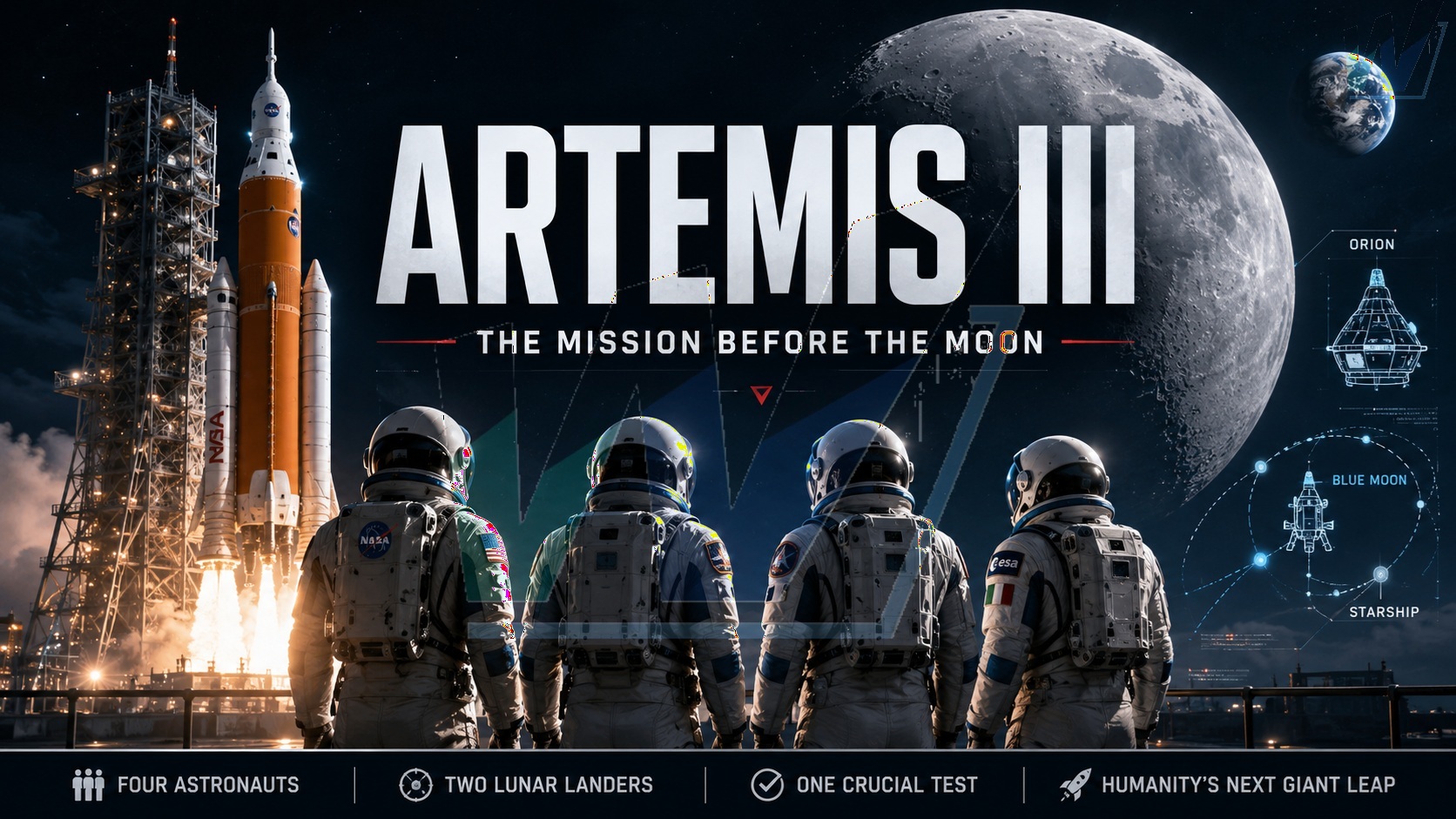
Four Astronauts, Two Lunar Landers, and One Crucial Test That Could Decide Humanity’s Next Giant Leap
The giant screens inside Mission Control glowed against the darkness.
Rows of engineers stared at streams of telemetry. Flight directors tracked timelines measured not in hours or days, but in years of preparation and billions of dollars of investment. Somewhere beyond the walls of NASA’s control centers, factories hummed, rockets took shape, and spacecraft engineers wrestled with problems that could determine the future of human exploration.
The next chapter of humanity’s return to the Moon has begun.
And everything may depend on Artemis III.
For decades, the Moon has remained tantalizingly close yet frustratingly distant. Since the final footsteps of Apollo astronauts faded into history in 1972, no human has ventured back to the lunar surface. Generations have grown up knowing the Moon only as a symbol of what humanity once achieved—not what it is actively pursuing.
Now NASA believes that reality is about to change.
This week, the agency unveiled the four astronauts who will carry the hopes of a new era into orbit aboard Artemis III, a mission unlike any that has come before it. While it will not place humans on the lunar surface, it may prove even more important. The mission is designed to answer a single question:
Can the technologies, spacecraft, and partnerships needed for a return to the Moon actually work together in space?
The answer could determine whether humanity takes its next giant leap—or faces another generation of waiting.
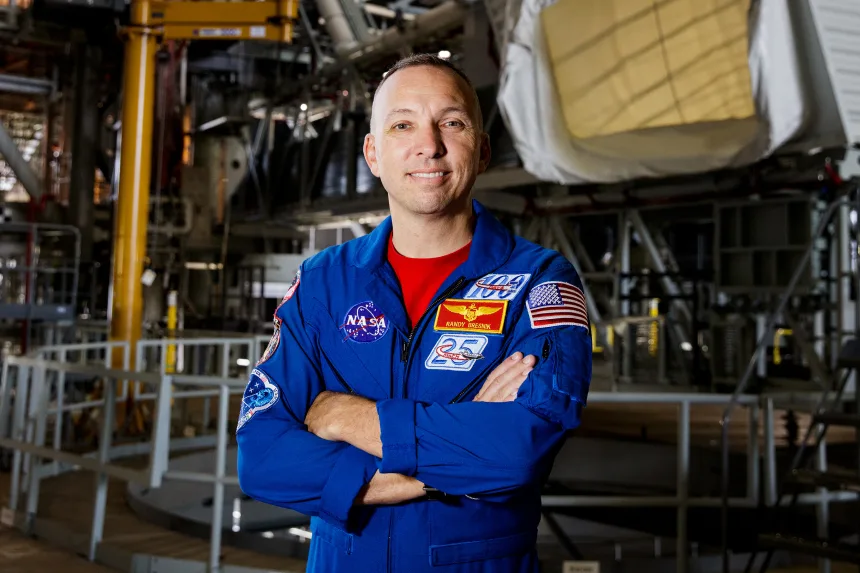
NASA astronaut Randy Bresnik poses for a portrait inside the Vehicle Assembly Building at Kennedy Space Center in Florida in 2019. (Joel Kowsky/NASA)
The Mission Between Dream and Reality
When NASA first announced the Artemis program, the goal seemed straightforward: return astronauts to the Moon.
But space exploration has a way of exposing the gap between ambition and execution.
As engineers dug deeper into the challenges of lunar operations, agency leaders faced a difficult truth. Jumping directly from a lunar flyby mission to a full lunar landing carried enormous risks. The technologies involved—from docking systems and life-support hardware to lunar landers themselves—had never been tested together.
NASA Administrator Jared Isaacman made a controversial decision.
Rather than rushing toward a historic landing, NASA would first conduct a critical proving mission.
That mission became Artemis III.
Instead of descending to the lunar surface, the crew will remain in low-Earth orbit, conducting a series of highly complex operations designed to simulate future moon-landing missions. It is a cautious approach, but one born from the lessons of history.
The Apollo program did not leap directly to Apollo 11.
Mercury came first.
Then Gemini.
Then multiple Apollo missions.
Each flight reduced uncertainty. Each mission eliminated risk.
Now Artemis III is expected to perform the same role for the twenty-first century.
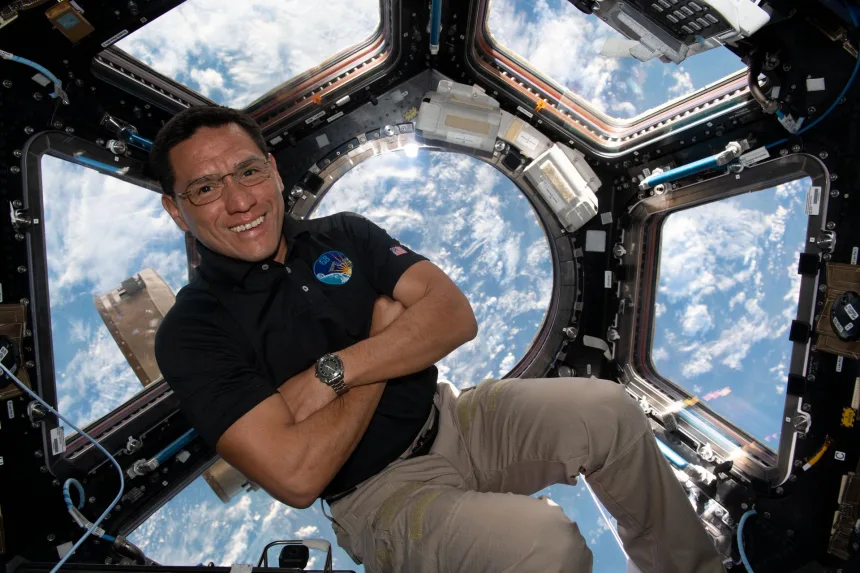
NASA astronaut and Expedition 68 Flight Engineer Frank Rubio is pictured on October 1, 2022, inside the cupola, the International Space Station’s “window to the world.” (Frank Rubio/NASA)
A Crew Forged for the Challenge
The four astronauts selected for Artemis III represent decades of experience, military discipline, engineering excellence, and scientific achievement.
At the helm will be Randy Bresnik, a veteran astronaut, former Marine Corps officer, and accomplished test pilot.
Bresnik understands pressure.
He has flown aboard both the Space Shuttle and Russian Soyuz spacecraft. He has spent months in orbit and helped shape the Artemis program from within NASA itself. Colleagues describe him as calm under pressure—a quality that may prove invaluable during one of the most technically demanding missions ever attempted.
Joining him is Frank Rubio, whose name is already etched into NASA history.
In 2022, Rubio launched aboard a Russian Soyuz spacecraft expecting a six-month mission. A spacecraft malfunction unexpectedly stranded him in orbit for more than a year. The result was the longest single-duration spaceflight ever completed by an American astronaut.
Living in space for 370 days tested not only Rubio’s technical skills but also his endurance, adaptability, and mental resilience.
Those qualities will now be brought to Artemis III.
For Andre Douglas, the mission represents something entirely different.
It will be his first journey into space.
Yet Douglas is hardly a rookie.
As the backup astronaut for Artemis II, he completed extensive training for a lunar mission, preparing for scenarios he never expected to fly. Now those years of preparation have transformed into a front-row seat for one of the most important missions of the decade.
Completing the crew is Italian astronaut Luca Parmitano, one of Europe’s most respected space veterans.
Parmitano has already faced one of the most dangerous emergencies in modern spaceflight history when his helmet began filling with water during a spacewalk. Remaining remarkably calm, he managed to return safely to the airlock.
The incident became legendary within astronaut circles.
In an environment where panic can be fatal, Parmitano demonstrated the kind of composure that cannot be taught.
Together, the four astronauts form a crew built not merely to fly a mission—but to confront uncertainty.
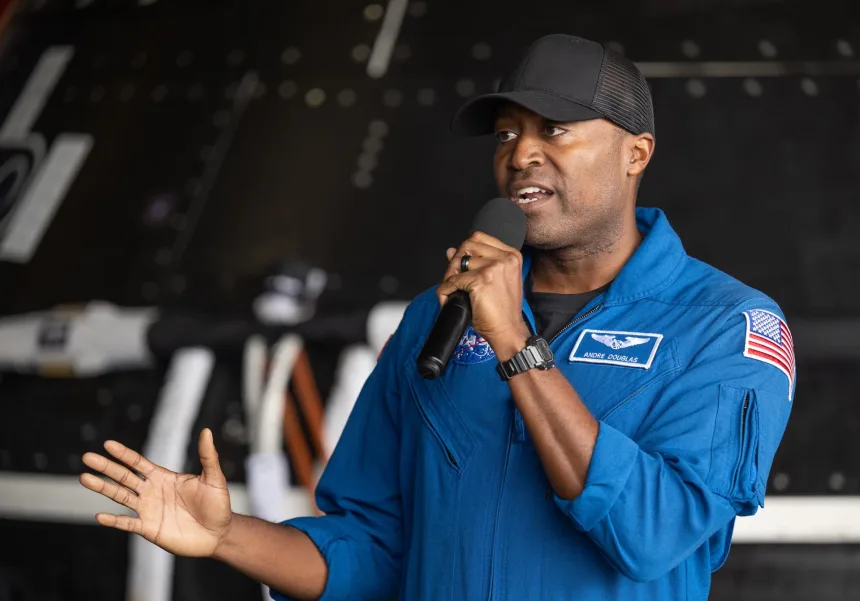
NASA astronaut Andre Douglas gives remarks during an Artemis II media event in California on March 31, 2025. (Bill Ingalls/NASA)
The Race Between Titans
Behind Artemis III lies another story.
A story of competition.
A story of technological rivalry.
A story involving two of the most ambitious aerospace companies on Earth.
SpaceX and Blue Origin.
Both companies have spent years developing lunar landers capable of transporting astronauts between lunar orbit and the Moon’s surface. Both have secured multibillion-dollar contracts. Both have promised revolutionary capabilities.
And both have encountered setbacks.
SpaceX’s Starship remains the most powerful rocket system ever developed, but its path has been marked by explosive test flights, engineering challenges, and relentless redesigns.
Blue Origin’s Blue Moon lander offers a competing vision for lunar transportation, yet recent technical difficulties involving the company’s New Glenn rocket have raised questions about schedule readiness.
NASA now finds itself navigating a delicate balance.
Competition drives innovation.
But delays threaten timelines.
Artemis III may become the first mission where both systems are evaluated in a real operational environment.
If successful, it could transform the future of lunar exploration.
If problems emerge, years of planning could be thrown into uncertainty.
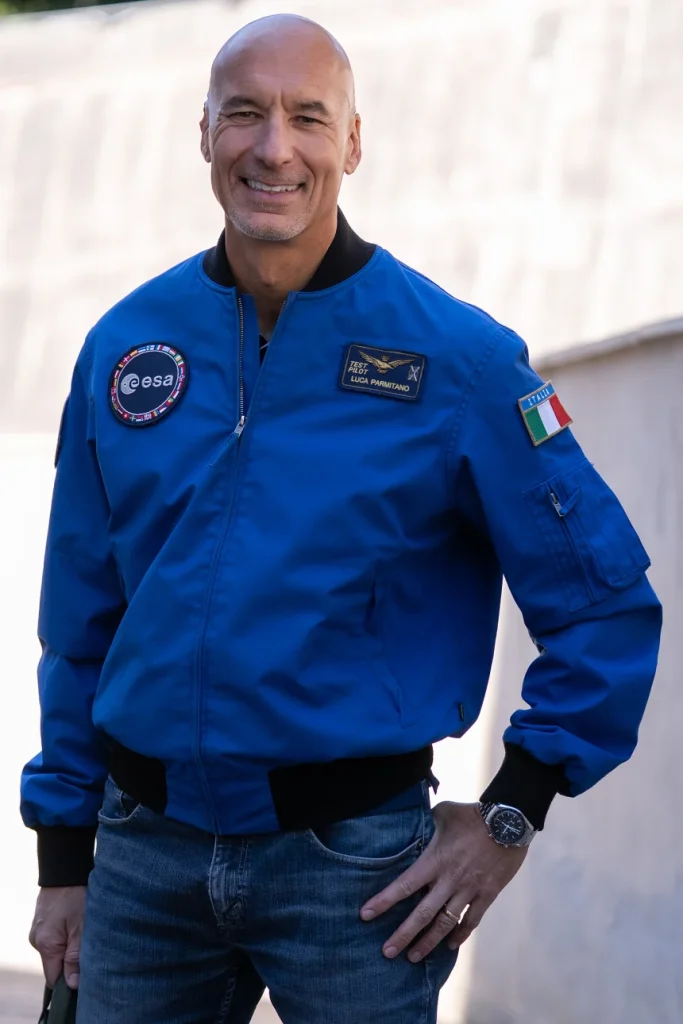
Luca Parmitano, Italian military officer and astronaut, attends Comicon 2026. (Andrea Gulí/SOPA Images/LightRocket/Getty Images)
The Most Critical Maneuver
At the heart of Artemis III lies a deceptively simple objective.
Docking.
The concept sounds routine.
In reality, it may become one of the most difficult challenges ever attempted during a NASA mission.
After launching aboard the Orion spacecraft, the Artemis III crew will enter low-Earth orbit.
Then the waiting begins.
Separate lunar landers will launch independently, climbing into orbit to meet Orion.
At that moment, years of engineering will face their ultimate test.
The spacecraft must locate one another while traveling at extraordinary speeds. Navigation systems must function flawlessly. Guidance computers must perform perfectly. Tiny errors could become catastrophic.
If everything proceeds according to plan, Orion will dock with the first lander.
Astronauts will transfer equipment, evaluate systems, and conduct extensive testing of hardware intended for future lunar operations.
Later, Orion may undock and repeat the process with a second lunar lander.
The sequence has never been performed in exactly this way before.
Each connection, each separation, and each maneuver represents another opportunity for success—or failure.
Mission planners know that future moon landings will depend on these procedures.
That is why Artemis III matters so profoundly.
It is not simply a mission.
It is a rehearsal for humanity’s return to another world.
The Shadow of Apollo
Every discussion of lunar exploration eventually returns to Apollo.
The images remain iconic.
Astronauts bounding across gray landscapes.
American flags standing motionless in a vacuum.
A blue Earth hanging silently above the horizon.
Yet Apollo was also a product of its time—a race fueled by Cold War competition and national prestige.
The Artemis era is different.
Today’s lunar ambitions extend beyond planting flags.
NASA, international partners, and private industry envision a sustained human presence around and eventually on the Moon. Lunar habitats, scientific laboratories, resource extraction technologies, and deep-space infrastructure are all part of a long-term vision.
The Moon is no longer viewed as a destination.
It is becoming a stepping stone.
A proving ground for Mars.
A testbed for technologies that may someday carry humans across millions of miles of interplanetary space.
And before any of that can happen, Artemis III must succeed.
Standing at the Threshold
The road ahead remains uncertain.
Schedules may shift.
Technical challenges will emerge.
Hardware will be tested to its limits.
Space exploration has never offered guarantees.
But for the first time in generations, humanity stands within reach of a new lunar age.
The astronauts selected for Artemis III understand the weight of that responsibility.
They are not merely preparing for a mission.
They are preparing to become the bridge between what humanity once achieved and what it hopes to accomplish next.
Somewhere in laboratories, factories, launch pads, and control rooms across the world, the countdown has already begun.
The Moon is waiting.
And when Artemis III rises into the sky, carrying four explorers and the ambitions of an entire generation, it will do far more than launch a spacecraft.
It will test whether humanity is truly ready to return to the frontier that has called to us for more than half a century.
The outcome may determine not only the future of the Artemis program, but the future of human exploration itself.
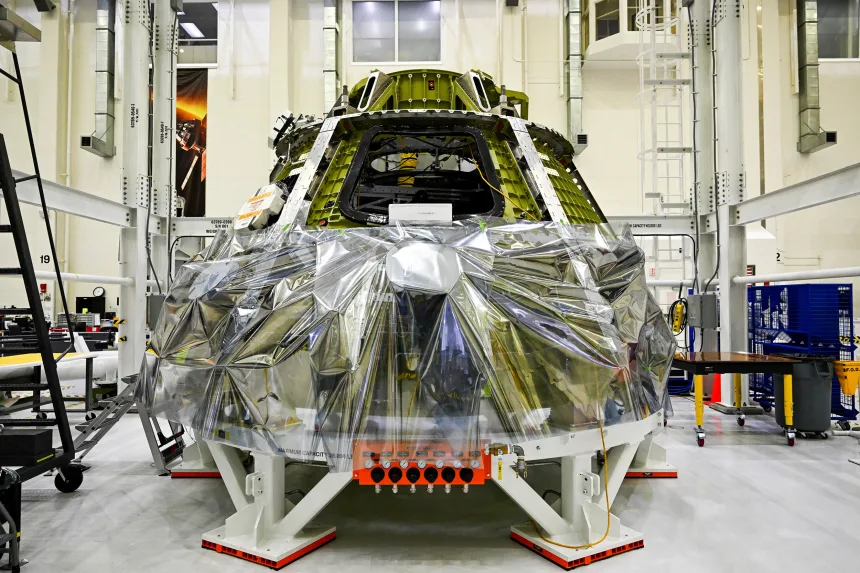
The Artemis III crew module is seen inside the Neil Armstrong Operations and Checkout Building at the Kennedy Space Center in Florida. (Chandan Khanna/AFP/Getty Images)