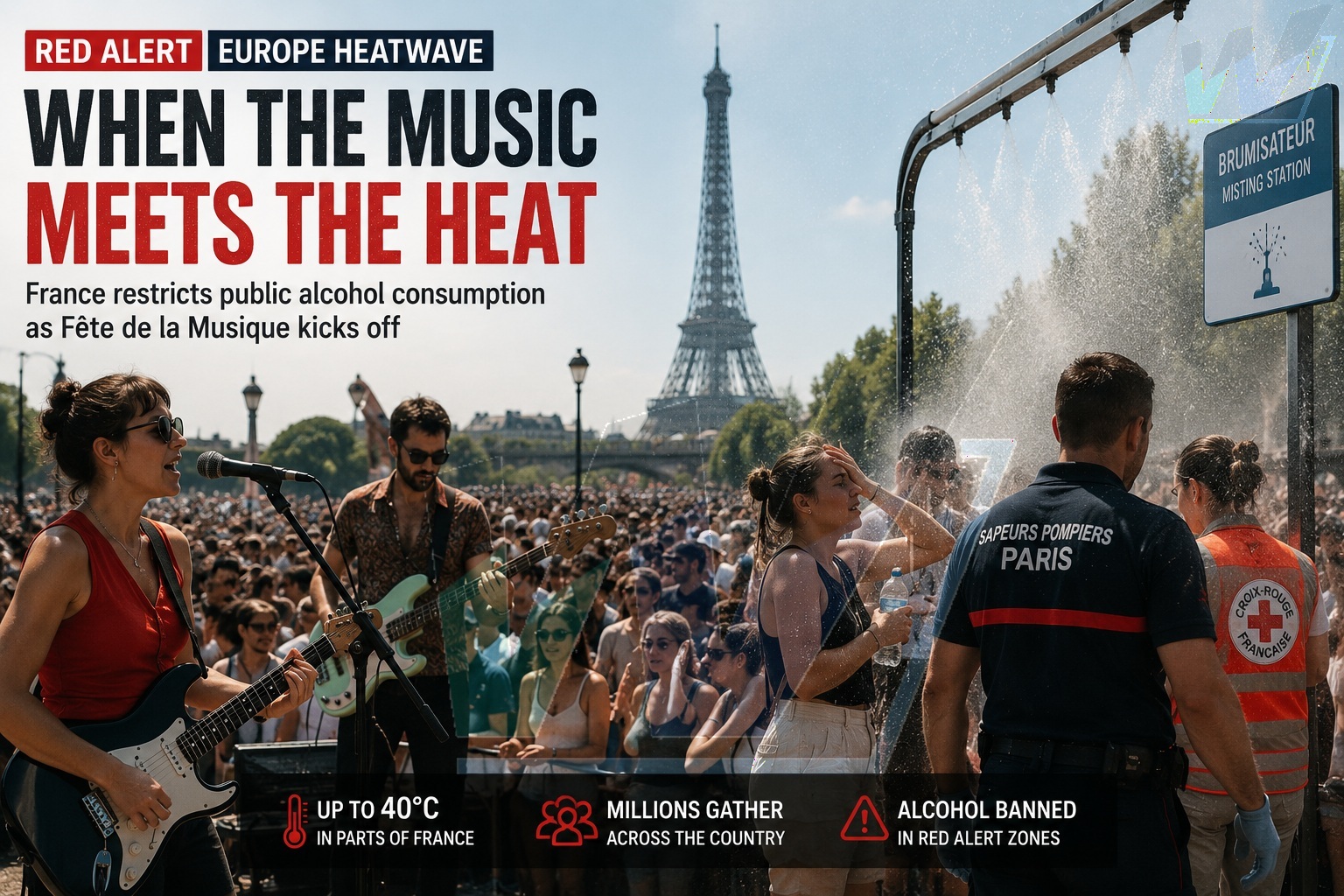
France’s Legendary Street Festival Faces an Unforgiving Enemy: Extreme Heat
PARIS — In France, June 21 is usually sacred.
It is the night when streets become stages, strangers become dancers, and music spills from cafés, alleyways, plazas, and balconies. From Paris to Provence, from Marseille to the smallest rural village, Fête de la Musique transforms the nation into one giant open-air concert.
But this year, something else arrived before the first guitar chord.
The heat.
And not ordinary summer heat.
A brutal, relentless, continent-wide heatwave has swept across Europe, pushing temperatures toward 40°C (104°F) in parts of France and beyond, forcing authorities into emergency mode and turning one of the world’s most beloved public celebrations into a high-stakes test of survival.
For the first time in years, celebration and crisis are colliding in dramatic fashion.
French authorities imposed extraordinary restrictions Sunday, including bans on public alcohol consumption in red-alert zones, among them Paris and several densely populated regions. The decision was blunt and urgent: keep emergency rooms from being overwhelmed.
Officials fear a dangerous cocktail — extreme heat, massive crowds, alcohol, dehydration, and exhausted emergency services.
Because under a blazing sun, one drink can become one collapse.
One collapse can become many.
And one festive night can turn catastrophic.
A Nation Under Red Alert
France’s meteorological agency placed roughly one-third of the country under red heat alert, the highest warning level reserved for severe public danger.
Meteorologists describe this hot spell with unusually alarming language: widespread, long-lasting, and intense.
The warning is not theoretical.
Hospitals have increased readiness. Firefighters are on standby. Military units have been mobilized for wildfire response. Water resources are under heightened surveillance, including supplies used to cool France’s nuclear reactors.
In Paris, authorities raced to deploy emergency countermeasures.
Misting stations appeared near major landmarks, including Eiffel Tower. Water refill points expanded across crowded districts. Medical teams prepared for surges in heat exhaustion, heatstroke, and dehydration.
The message from officials was unmistakable:
Drink water. Stay cool. Avoid alcohol.
Stay alive.
The Ghost of 2003
France has seen this nightmare before.
Every heatwave in the country carries the haunting memory of the 2003 European heat disaster, a tragedy that killed approximately 15,000 people in France alone, many of them elderly citizens isolated in homes and nursing facilities. 2003 European heat wave.
That catastrophe permanently changed how France responds to extreme weather.
Now, with climate scientists warning that such events are becoming more frequent and more severe, authorities are determined not to repeat history.
The most vulnerable remain the same: older adults, outdoor workers, homeless populations, and those living in poorly ventilated urban apartments.
In many French homes, air conditioning remains uncommon.
Concrete buildings trap heat.
Streets radiate it back.
Night offers little relief.
Europe Is Burning
France is not alone.
Across Europe, the heat is escalating.
In Italy, multiple cities entered “red flag” status, with temperatures climbing into the upper 30s Celsius. Farmers near Milan installed fans and sprinklers to cool livestock as agricultural stress intensified.
In Rome, tourists crowded around fountains, splashing water on their faces and arms for relief.
Further south, parts of Spain braced for temperatures surpassing 42–45°C, while wildfire risk surged across Mediterranean landscapes.
The World Health Organization Europe office has already warned that more than 200,000 people across Europe have died from heat-related causes in the last four years, with many deaths considered preventable.
That statistic hangs heavily over this summer.
The Night Music Refused to Stop
Yet despite the danger, France did not cancel its cultural heartbeat.
That may be the most remarkable part of this story.
Fête de la Musique, created in 1982 by the French Ministry of Culture, is not a traditional festival held behind gates or fences. It is everywhere. Streets. Squares. Bars. Sidewalks. Villages. Rooftops. Every citizen can participate. Every neighborhood can become a stage. Millions attend each year.
That decentralized beauty is also what makes control nearly impossible.
How do you police an entire country celebrating at once?
How do you stop millions from drinking in public?
How do you protect crowds dancing on scorching asphalt under a suffocating sky?
Officials know enforcement will be difficult.
Still, they are trying.
Because this year, the greatest danger may not be disorder.
It may be heat itself.
A Summer Warning
What is unfolding in France is bigger than one festival.
It is a warning.
Europe’s summers are changing.
Heatwaves once described as “exceptional” are becoming recurring events. Climate experts increasingly warn that what shocks today may become routine tomorrow.
This is no longer just about weather.
It is about infrastructure.
Urban design.
Public health.
Energy systems.
And whether nations can adapt fast enough.
As night falls over Paris, guitars will still sing.
Drums will still thunder.
Crowds will still gather.
But beneath every melody lies a new reality.
This summer, Europe is dancing on hotter ground.
And the music, no matter how loud, cannot drown out the warning.