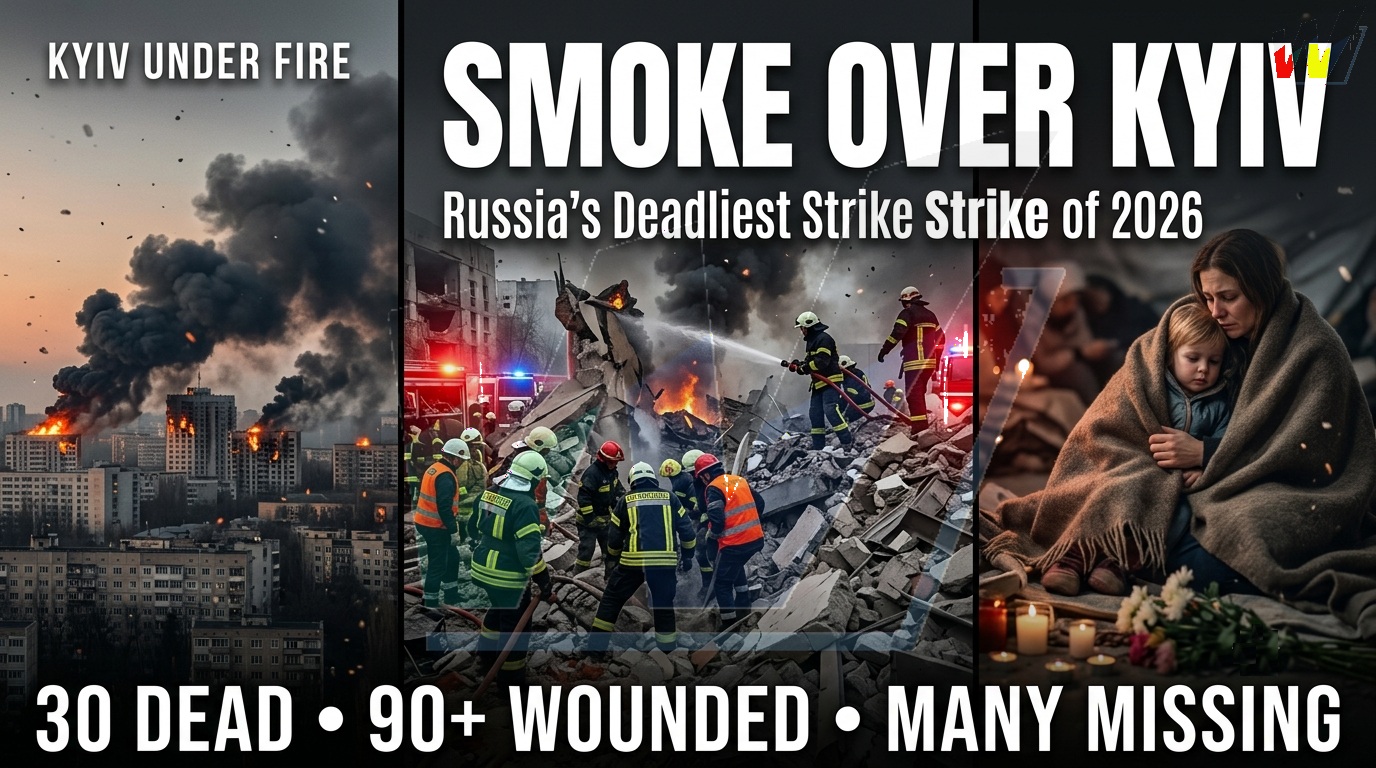
Rescuers Race Against Time as Russia’s Deadliest Strike of the Year Leaves Kyiv Buried in Rubble and Choking on Toxic Air
KYIV, Ukraine — Dawn did not bring relief to Kyiv. It revealed devastation.
As the first light broke through a grey, smoke-choked sky on Friday, rescue sirens still echoed across Ukraine’s capital. Excavators clawed through mountains of concrete. Firefighters sprayed steaming ruins. Families stood frozen behind police tape, staring at what had once been their homes.
Some were still waiting for phones to ring.
Others already knew they never would.
One day after Russia launched one of the largest combined missile-and-drone assaults of the war, Kyiv remains a city in mourning, and in shock. At least 30 people are confirmed dead, more than 90 wounded, and several remain missing beneath collapsed apartment blocks after what officials describe as the deadliest strike on the capital in 2026.
The attack began in darkness.
Air raid sirens screamed through the night as waves of drones flooded Ukrainian airspace, followed by ballistic and cruise missiles. Residents rushed into metro stations, basements, and underground shelters as explosions ripped through the city center. Windows shattered across multiple districts. Entire floors of residential buildings collapsed within seconds.
Witnesses described a night that felt endless.
“It sounded like the sky was breaking apart,” one resident told local media.
By sunrise, more than 130 buildings had been damaged — apartment complexes, medical facilities, warehouses, and civilian infrastructure reduced to twisted steel and dust. Entire neighborhoods bore the scars of direct impacts and falling debris.
In one residential block, rescuers worked around the clock searching for survivors trapped beneath crushed concrete slabs. Emergency crews reported hearing intermittent sounds from deep inside the rubble, fueling desperate hopes that someone might still be alive.
Among the missing are the parents of a hospitalized 10-year-old boy, whose fate remains unknown. A 15-year-old girl also remains unaccounted for. President Volodymyr Zelenskyy said rescue operations continued at three major impact zones, with at least ten people still missing.
Across the city, grief turned physically.
Flowers appeared beside collapsed buildings. Candles flickered on broken sidewalks. Flags flew at half-mast.
For many survivors, the attack did not simply damage property, it erased lives.
Zoia, a 65-year-old pensioner, stood outside her shattered apartment clutching a small bag of belongings.
“We prayed to God we would survive,” she said.
Nearby, 27-year-old Tetiana Pryvalova surveyed what remained of her home.
“The walls are broken. The windows are gone,” she said. “The apartment is no longer livable.”
But even after the missiles stopped, the city faced a second threat.
The air itself became dangerous.
Massive fires triggered by the bombardment sent thick plumes of smoke across Kyiv. With little wind dispersing the pollution and temperatures climbing, toxic particles accumulated over the capital, causing air-quality readings to spike to hazardous levels.
Authorities urged residents to remain indoors, shut windows, avoid outdoor activity, and use air filtration if available.
Kyiv was no longer only a battlefield.
It had become a gas chamber of ash and smoke.
The strike comes at a pivotal moment in the war.
Ukraine has recently intensified long-range drone attacks deep inside Russia, targeting refineries, fuel depots, and military-linked infrastructure. Those attacks have strained Russian logistics and contributed to fuel shortages inside Russia, increasing pressure on Moscow’s energy sector.
Russia claims the Kyiv assault was retaliation.
Moscow’s defense ministry said the barrage targeted military-industrial and energy infrastructure linked to Ukrainian operations. Ukraine rejects that justification, arguing the overwhelming damage to civilian neighborhoods tells a different story. Both sides deny deliberately targeting civilians, but the destruction in Kyiv has reignited international condemnation.
President Vladimir Putin has shown no sign of easing pressure.
In his nightly address, Zelensky delivered one of his sharpest rebukes in months.
“Russia has no argument left for its war other than ballistic missiles.”
The statement captured growing Ukrainian fears that Moscow’s battlefield frustrations are increasingly translating into mass aerial terror aimed at civilian morale.
Military analysts warn the latest barrage reflects a dangerous evolution in Russian tactics: larger strike packages, layered drone swarms, and missile sequencing designed specifically to overwhelm air defenses. The pattern suggests Moscow retains the capacity to launch devastating attacks multiple times per month despite sanctions and battlefield losses.
Meanwhile, the war’s front lines continue shifting.
Russia announced the capture of Oleksandrivka in the Dnipropetrovsk Oblast region, while Ukrainian forces continue resisting along the sprawling 1,200-kilometer front.
Yet for Kyiv, strategic maps mean little today.
Today is about bodies.
Today is about names.
Today is about silence where voices once lived.
As night approaches once again, thousands of Kyiv residents brace for another sleepless vigil beneath sirens and smoke. In shelters across the city, parents clutch children. Phones remain fully charged. Emergency bags sit beside doors.
No one trusts silence.
Because in Kyiv now, silence no longer means peace.
It means waiting for the next explosion.