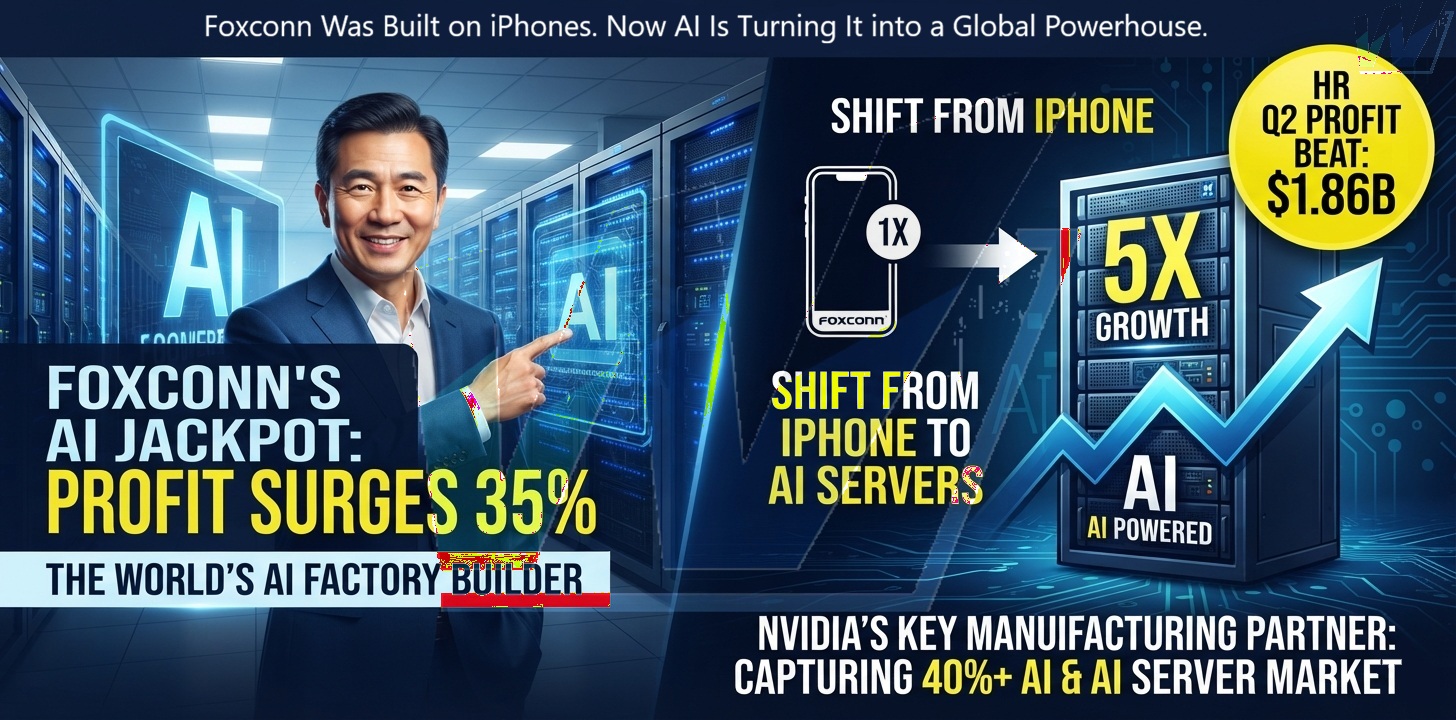
Foxconn’s AI Jackpot: Profit Surges 35% as the Race to Build the World’s AI Infrastructure Accelerates
Taiwan’s Foxconn is no longer simply the company behind the iPhone. As artificial intelligence reshapes the global technology industry, the manufacturing giant is emerging as one of the most important, and least visible, players powering the AI revolution.
TAIPEI — The artificial intelligence boom is now showing up in the bottom line of one of the world’s biggest manufacturers.
Foxconn, formally known as Hon Hai Precision Industry, reported Wednesday that its second-quarter net profit jumped 35% year over year to NT$59.97 billion ($1.86 billion), beating analysts’ expectations of approximately NT$58.8 billion.
The result offered another powerful signal that the extraordinary spending spree on AI infrastructure is far from over.
Behind every new AI model, chatbot, image generator and autonomous digital agent lie an increasingly enormous physical machine: racks of processors, networking equipment, cooling systems, power infrastructure and data-center hardware.
And Foxconn is building a large part of it.
The AI boom is moving from software to factories
For years, Foxconn was best known globally as the manufacturing powerhouse behind Apple’s iPhone and other consumer electronics.
That identity is rapidly changing.
The company has become a critical supplier of AI servers, particularly systems built around Nvidia’s high-performance computing platforms. Its cloud and networking business has expanded so quickly that AI infrastructure is becoming a central pillar of the group’s growth.
The Wall Street Journal reported that Foxconn’s second-quarter revenue climbed about 41% to NT$2.526 trillion, while cloud and networking products, increasingly dominated by AI infrastructure, accounted for more than half of total revenue for the first time.
That shift is strategically significant.
Foxconn is no longer simply assembling devices that consumers carry in their pockets.
It is increasingly manufacturing machines that allow AI systems to think, calculate and respond.
A profit beat that matters far beyond Taiwan
The second-quarter result exceeded market expectations, reinforcing confidence that demand for AI computing capacity remains exceptionally strong.
Reuters reported that Foxconn’s NT$59.97 billion profit topped the roughly NT$58.8 billion analyst forecast. The company maintained its expectation for strong revenue growth in 2026, pointing to continued AI demand.
The numbers follow an already extraordinary run.
In July, Foxconn reported record monthly revenue of NT$946.5 billion, up 54.2% from a year earlier. It was the first time monthly revenue had crossed the NT$900 billion threshold. The company attributed the surge largely to strong demand for AI-related products, particularly AI servers and cloud-networking equipment.
That means the latest profit report is not an isolated spike.
It is part of a much larger transformation.
From iPhones to AI factories
Foxconn’s evolution has been underway for several years, but 2026 is increasingly looking like the year in which the strategy becomes unmistakable.
The company’s first-quarter results already showed the direction of travel.
Foxconn reported NT$49.92 billion in first-quarter net profit, up 19% year over year, while revenue rose almost 30% to approximately NT$2.12 trillion. Taiwan’s CNA/Focus Taiwan reported that analysts attributed much of the improvement to the global AI boom.
More revealing was the changing composition of the business.
Foxconn said its cloud and networking segment was approaching half of group revenue, demonstrating that AI infrastructure was becoming large enough to reduce the traditional seasonality of its consumer-electronics operations.
The company’s transformation is therefore not simply about selling more servers.
It is about changing what Foxconn fundamentally is.
Nvidia’s hardware machine
One of the biggest beneficiaries of the AI explosion was Nvidia.
But Nvidia’s chips cannot operate in isolation.
They must be integrated into sophisticated server systems, connected through high-speed networking, supplied with enormous amounts of electricity and cooled efficiently enough to operate continuously.
This is where Foxconn’s manufacturing scale becomes strategically valuable.
The company has positioned itself as a major AI-server manufacturing partner and has been expanding from traditional GPU-based systems toward broader AI infrastructure and ASIC-based solutions.
Foxconn has said it expects its share of the global AI-server market to rise above 40% in 2026, while company executives have indicated that AI-server shipments could more than double from the previous year.
That puts Foxconn much closer to the center of the AI economy than its consumer-electronics reputation might suggest.
The numbers behind the AI infrastructure race
The scale of investment explains why Foxconn’s AI business is accelerating so quickly.
Cloud giants and AI developers are committing enormous sums to data centers and computing infrastructure.
Foxconn’s own chairman, Young Liu, has described the current expansion as an infrastructure build-out that could continue for three to five years or longer, according to the Wall Street Journal.
The company is betting heavily on that thesis.
In May, Foxconn said it expected capital expenditure to increase by more than 30% in 2026, with investment directed toward regional production, automation and manufacturing capacity.
Its global manufacturing footprint is consequently becoming part of the AI race itself.
The factory map is changing
One of the biggest challenges facing technology manufacturers is geography.
For decades, Asia dominated electronics manufacturing. But the combination of tariffs, geopolitical tensions, supply-chain vulnerabilities and the strategic importance of AI infrastructure is forcing companies to diversify production.
Foxconn is responding by expanding its manufacturing footprint.
The company is building AI-server capacity in Texas and Mexico, while its production network in Asia remains crucial to global electronics manufacturing. Reuters also reported that Foxconn increasingly manufactures iPhones destined for the U.S. market in India.
Foxconn’s strategy is increasingly described internally around a “build, operate, localize” model — an approach designed to bring production closer to customers and reduce exposure to geopolitical and tariff risks.
CNA reported in May that Foxconn had 241 production sites worldwide, while the company was simultaneously expanding into AI data centers, electric vehicles, aerospace and semiconductor-related activities.
The message is clear:
The next phase of AI manufacturing will not happen in one country.
Europe wants a piece of the AI factory boom
Foxconn is also pushing deeper into Europe.
In June, the company announced a strategic partnership with French advanced-computing company Bull to manufacture AI and cloud infrastructure in Europe.
The project combines Bull’s AI-system capabilities with Foxconn’s manufacturing and supply-chain scale, using facilities in France and the Czech Republic. Foxconn said the partnership is aimed at strengthening Europe’s ability to develop regional AI infrastructure.
At VivaTech in Paris, Foxconn also showcased its capabilities around next-generation AI systems, including Nvidia’s Vera Rubin architecture, while highlighting its ambitions in AI factories and sovereign AI infrastructure.
This reflects a much broader global trend.
Governments increasingly want AI infrastructure to be built locally rather than relying entirely on distant cloud providers or foreign supply chains.
Foxconn wants to be one of the companies building that infrastructure.
AI is changing Foxconn, but Apple is still crucial
The transformation should not be mistaken for an abandonment of Apple’s ecosystem.
Foxconn remains one of Apple’s most important manufacturing partners and continues to assemble iPhones and other consumer electronics.
But the strategic balance is changing.
AI infrastructure offers Foxconn something the smartphone business cannot easily provide: a massive new growth engine powered by a global technological arms race.
Smartphones are mature.
AI infrastructure is still being built.
And the difference is enormous.
Every generation of AI models requires more computing power. Every new AI service creates additional demand for inference. Every major cloud provider is racing to expand capacity.
The result is a potentially multi-year hardware cycle.
The hidden danger: AI demand may not remain unstoppable
Yet the numbers also conceal a risk.
The AI infrastructure boom requires extraordinary levels of capital spending.
Companies are pouring billions into data centers before knowing exactly how quickly the resulting computing capacity will generate returns.
That raises the uncomfortable question increasingly hanging over the technology industry:
What happens if AI infrastructure spending eventually grows faster than AI revenue?
Foxconn itself remains exposed to geopolitical uncertainty, tariffs, currency movements and changing global economic conditions. Reuters noted that the company has continued to warn about an unpredictable global political and economic environment even while maintaining a strong outlook.
There is also the question of margins.
AI servers can carry enormous dollar values because they contain expensive GPUs and other advanced components. But high revenue does not automatically translate into proportionally higher margins.
Industry analysis has highlighted the complexity of AI-server manufacturing models, including the way component ownership, consignment arrangements and system integration affect profitability.
Foxconn therefore faces a delicate balancing act:
Build faster. Scale faster. But make sure the economics work.
Taiwan’s “silicon shield” gets another layer
There is also a geopolitical dimension that cannot be ignored.
Foxconn’s rise as an AI infrastructure manufacturer further embeds Taiwan into the global technology supply chain.
Taiwan already dominates critical portions of advanced semiconductor manufacturing through companies such as TSMC. Foxconn adds another layer: the physical integration and manufacturing of the systems that turn those chips into functioning AI infrastructure.
That creates both economic power and strategic vulnerability.
The deeper Taiwan becomes embedded in the world’s AI infrastructure, the more important its stability becomes to global technology markets.
The phenomenon has contributed to discussions about Taiwan’s so-called “silicon shield” , the idea that the island’s central role in global technology supply chains creates powerful international incentives for stability. Associated Press has previously highlighted both the economic strength generated by Taiwan’s AI boom and the geopolitical risks surrounding it.
The Foxconn transformation is bigger than one earnings report
Wednesday’s numbers tell a much larger story.
Foxconn’s 35% profit surge is not merely a strong quarterly result.
It is evidence of an industrial transformation underway beneath the headlines surrounding ChatGPT, Nvidia, AI agents and generative AI.
The public sees the software.
Foxconn is helping build the machinery underneath it.
Its factories are assembling the servers. Its supply chains are moving the components. Its engineers are integrating increasingly complex AI systems. Its new partnerships are extending that infrastructure into Europe, North America and Asia.
And its investment plans suggest the company believes the current AI build-out is only beginning.
The next three years could redefine Foxconn
Foxconn entered the AI era with one of the world’s largest manufacturing footprints.
Now it is attempting to turn that scale into an advantage in the most capital-intensive technology race in history.
The company has already expanded beyond smartphones into AI servers, data-center infrastructure, robotics, electric vehicles and other emerging technologies. Its official strategy increasingly describes AI as a central driver of its transformation.
The question is no longer whether Foxconn benefits from the AI boom.
It clearly does.
The bigger question is how far the transformation can go.
If global AI infrastructure spending continues at anything close to its current pace, Foxconn could emerge not merely as the world’s biggest contract electronics manufacturer, but as one of the essential industrial backbones of the AI economy.
For investors watching Nvidia, Apple and the broader AI trade, that makes Foxconn a company worth watching closely.
Because the next AI revolution may not be won only by the companies writing the algorithms.