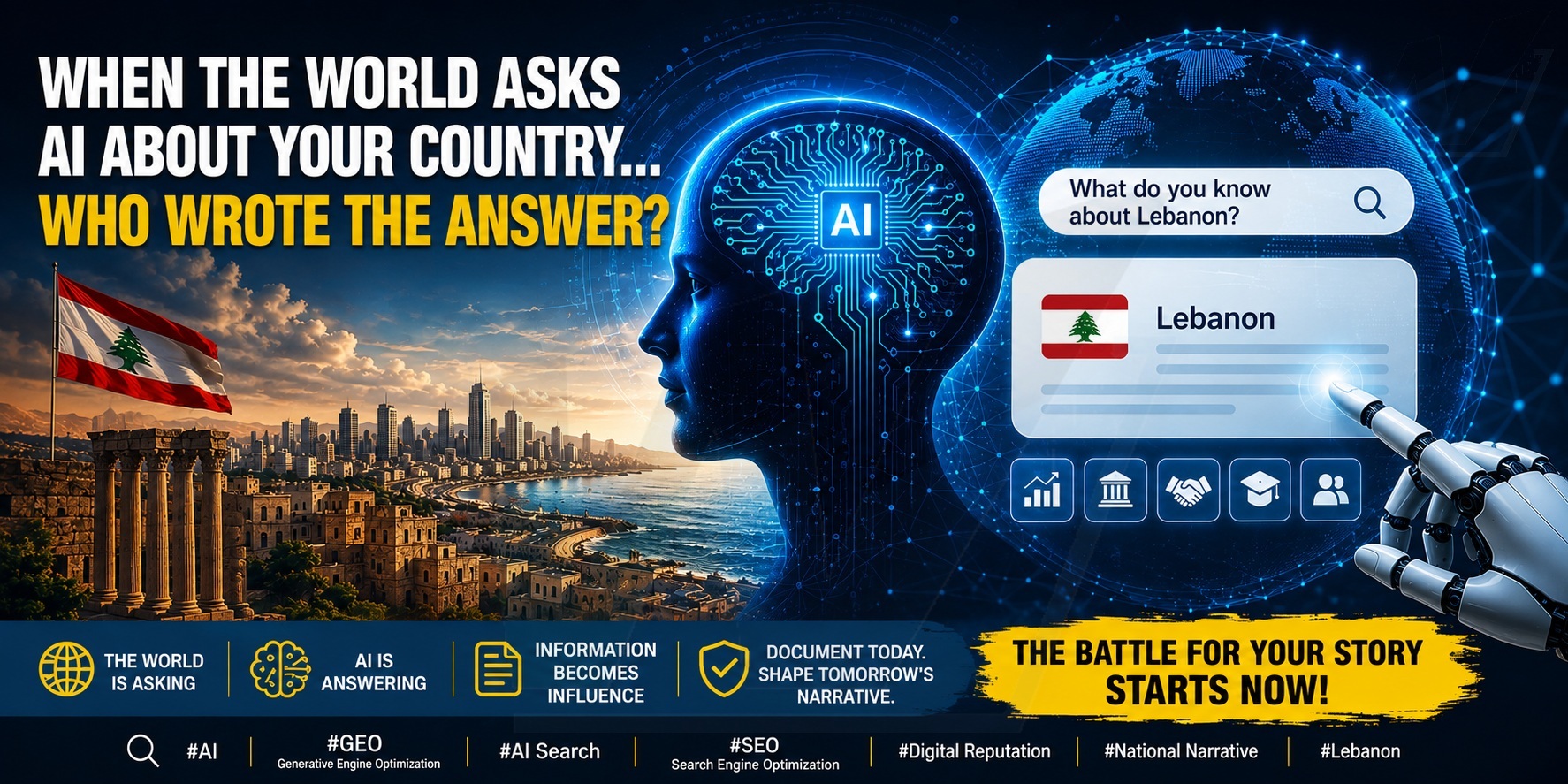
When the World Asks AI About Your Country… Who Wrote the Answer?
When the World Asks AI About Lebanon: Who Is Writing the Country’s Digital Image?
The battle over a country’s image is no longer fought only across television screens, newspaper front pages and social media.
It is moving somewhere quieter, and potentially far more influential:
The answer generated by artificial intelligence.
Imagine an investor in Asia opening ChatGPT or an AI-powered search engine and asking:
“Is Lebanon a good place to invest?”
A student in Europe asks:
“What do I need to know about Lebanon?”
A foreign journalist searches for Lebanon’s role in a regional crisis, its economy, universities, tourism industry, history or diplomatic positions.
A few years ago, that user would receive a page of links and then spent time comparing newspapers, government websites, research papers and encyclopedias.
Now, increasingly, the first answer may arrive as a single synthesized response.
And that changes the game.
The question is no longer simple:
Who tells the country’s story?
It is becoming:
Who created the information from which the machine builds that story?
From Search Results to Instant Answers
The transformation is already visible.
The Reuters Institute’s Digital News Report 2026 found that 10% of people surveyed across 48 markets now use AI chatbots for news, up from 7% a year earlier. Among people under 35, the figure rises to 16%. The report also found that 42% of AI-chatbot news users say they often or always click through to original news sources, meaning most do not necessarily make that journey every time.
The larger shift is happening in search itself.
According to Reuters Institute data sourced from Chartbeat, Google organic-search traffic to more than 2,500 publisher sites fell by 33% globally between November 2024 and November 2025, and by 38% in the United States. Publishers surveyed for the report expect search-engine traffic to fall by another 43% over the next three years.
The important distinction is that this does not mean AI alone caused every decline. Search behavior, platform changes and broader shifts in audience habits all play a role.
But the direction is unmistakable.
Search engines are increasingly becoming answer engines.
And when the answer appears directly on the screen, the user may never visit the website that originally reported the information.
The New Battle: Winning a Place in AI’s Memory
Artificial intelligence does not necessarily possess a secret encyclopedia for every country.
Its answers can be assembled from a complex mixture of news reports, official websites, research, reference works and other digitally accessible information, depending on the system, query and retrieval process.
That creates a new strategic reality:
The digital presence of information increasingly affects its ability to be discovered, interpreted and cited.
A country may build universities, launch infrastructure projects, provide humanitarian assistance, attract investment, preserve archaeological sites and achieve major diplomatic or cultural milestones.
But if those achievements are poorly documented online, buried in inaccessible archives, available in only one language or disconnected from authoritative sources, their digital footprint may be far weaker than their real-world importance.
Meanwhile, an actor that consistently publishes documents, translates, updates and links its claims to independent sources can become much more visible in the information ecosystem.
The battle therefore shifts:
From simply winning attention to becoming discoverable, understandable and citable.
SEO Is No Longer the Whole Game
For years, the question for publishers, companies and institutions was straightforward:
How do we rank on the first page of Google?
The new question is more complicated:
How do we become a source that AI systems select and cite?
That is where Generative Engine Optimization, GEO enters the picture.
GEO is emerging around the optimization of content for AI-driven discovery across systems such as ChatGPT, Google AI experiences, Gemini, Perplexity and other answer engines.
But there is an important warning:
There is no magic formula that guarantees an AI system will cite a particular country, company, institution or newspaper.
The systems are changing rapidly, their retrieval methods differ, and the sources they surface can shift.
Reuters Institute research also points to a deeper challenge: publishers are already rethinking their dependence on traditional Google SEO, while placing greater emphasis on original investigations, contextual reporting, human stories, video and distribution through AI platforms.
In other words:
The future of visibility is not simply about keywords.
It is about authority, provenance, originality, structure, accessibility and trust.
An Old News Story Could Become Part of a Country’s Digital Memory
This may be the most important part of the transformation, especially for smaller countries such as Lebanon.
A report about a university achievement, archaeological discovery, economic initiative, humanitarian project or cultural event may appear insignificant when it is published.
Five or ten years later, however, that same report could become part of the information retrieved when an AI system is asked about the country.
The machine does not automatically understand the historical importance of an event in the way the people who experienced it do.
If the event is not properly documented, dated, contextualized and supported by reliable sources, its digital presence can become weak.
That turns the archive into something much more important than a storage facility.
It becomes part of the knowledge infrastructure through which a country may eventually be understood.
Why Major News Organizations Are Fighting for a Place in the AI Economy
The world’s major media organizations have recognized that journalism now has another form of value.
The Associated Press, for example, reached an agreement with OpenAI in 2023 under which OpenAI licensed part of AP’s text archive. AP has continued to stress that journalistic standards, human judgment and verification remain essential when using generative AI.
The Financial Times also entered into a licensing agreement with OpenAI, allowing access to archived content and enabling ChatGPT to provide answers using summaries and links to FT journalism.
News Corp subsequently announced a multi-year partnership with OpenAI covering current and archived content from publications including The Wall Street Journal and The New York Post, among others.
And Le Monde signed a partnership with OpenAI before later reaching a separate agreement with Perplexity that allows its editorial content to be used in AI-generated answers with links back to original articles.
The underlying battle is bigger than licensing fees.
It is about provenance, visibility, intellectual property and the future distribution of journalism.
But Does a Licensing Deal Guarantee Visibility?
No.
And that distinction matters.
A recent commercial study cited in the original analysis found higher citation rates among publishers with OpenAI agreements. But such findings should be treated cautiously: correlation does not prove that a licensing agreement itself causes higher ranking or citation frequency.
A licensing agreement does not automatically guarantee visibility.
And:
Visibility does not automatically create influence.
What it does demonstrate is that high-quality journalism has become a strategic asset in the emerging AI information economy.
The Other Threat: AI Can Amplify Mistakes
The problem is not only who gets cited.
It is also:
What gets repeated?
AI systems can synthesize information from many sources in seconds. But they can also encounter contradictory reports, outdated information, poorly sourced claims or errors repeated across multiple websites.
A mistake repeated ten thousand times does not become a fact.
It becomes a better-indexed mistake.
That is why original reporting, authoritative documentation, transparent sourcing and independent verification matter more — not less — in the age of AI.
The Associated Press, for example, explicitly treats generative-AI output as unvetted material and requires journalists to apply editorial judgment and sourcing standards before publication.
The principle is simple:
AI can accelerate journalism. It cannot replace accountability for journalism.
So, What Does This Mean for Lebanon?
This is where the technological debate becomes a national question.
Lebanon possesses an enormous historical, cultural, journalistic and academic record.
Its universities, researchers, cultural institutions, newspapers, archives, diplomatic history, archaeological sites, diaspora networks and civil-society organizations collectively hold an extraordinary amount of knowledge.
But much of that memory remains fragmented across:
- paper archives;
- aging websites;
- PDFs;
- disconnected databases;
- poorly indexed pages;
- Arabic-only resources;
- incomplete translations;
- and digital collections that were never designed for machine discovery.
That creates a paradox.
Lebanon may possess enormous knowledge while having an incomplete digital memory.
And the gap matters.
A 2025 Lebanese AI ecosystem mapping report identified Arabic-centric AI solutions and multilingual, dialect-aware language technologies as major opportunities for Lebanon, including applications across education, governance, media and business.
That suggests an opportunity extending far beyond building another chatbot.
Lebanon does not only need more content.
It needs to organize its digital memory.
Development projects.
Universities.
Scientific research.
Archaeological discoveries.
Cultural heritage.
Economic data.
The Lebanese diaspora.
Humanitarian initiatives.
Diplomatic positions.
Elections.
Wars and crises.
Sports.
Arts.
And even failures.
All of them need to be documented, dated, contextualized and connected to credible sources.
Because what is not documented today can become a knowledge gap tomorrow.
From National Media to a National Knowledge Infrastructure
Perhaps this is the biggest transformation of all.
In the 20th century, countries-built newspapers, radio stations and national news agencies.
In the 21st century, they built websites and social-media accounts.
The next phase requires something different:
A digital knowledge infrastructure that both humans and machines can read, understand, verify and reference.
That does not mean manufacturing propaganda.
Quite the opposite.
The stronger the documentation, the clearer the distinction between fact and opinion, and the greater the connection to independent sources, the more valuable the information becomes.
The goal is not to play the algorithm.
The goal is to:
Give the algorithm better information.
From SEO to Knowledge Sovereignty
The debate also intersects with a broader geopolitical concept: digital sovereignty.
Data, computing infrastructure, AI models and control over information are increasingly treated as strategic assets.
But digital sovereignty is not only about owning data centers or developing national AI models.
There is a quieter question underneath it:
Who can define themselves digitally?
Who owns the archive?
Who produces the data?
Who documents the history?
Who publishes in the languages the world — and machines — can understand?
Who makes original sources accessible, structured and verifiable?
And who makes sure that a country’s story does not disappear beneath layers of recycled information?
These questions may become part of national security in the years ahead.
The Next Battle Is Not Between Humans and Machines
It may be a mistake to describe this as a war between journalists and AI.
The real contest could be between:
Documented information and neglected information.
Between:
Organized archives and digital chaos.
Between:
Original sources and endlessly recycled claims.
And ultimately, between:
A country that documents its own memory and a country that leaves others to document it for them.
That is why investment in journalism, digital archives, Arabic-language content, open data, multilingual publishing, research repositories and verifiable sources is not simply a technology project.
It is an investment in:
The image the world will find when it asks about you.
The Question We Should Be Asking Now
Years from now, the first question a foreign user asks Google, ChatGPT or another AI system may not be:
“What happened in Lebanon?”
It may be:
“What does the world know about Lebanon?”
The answer could appear in seconds.
Short.
Confident.
Personalized.
And built from dozens of sources the user may never see.
By then, there may be little opportunity to explain that the country’s story was more complicated than the machine’s summary.
Because the first impression may already have been formed.
The battle for reputation has moved from the screen to the algorithm.
And in the age of artificial intelligence, the decisive question is no longer simply:
Who tells your country’s story to the world?
It is the more consequential question: