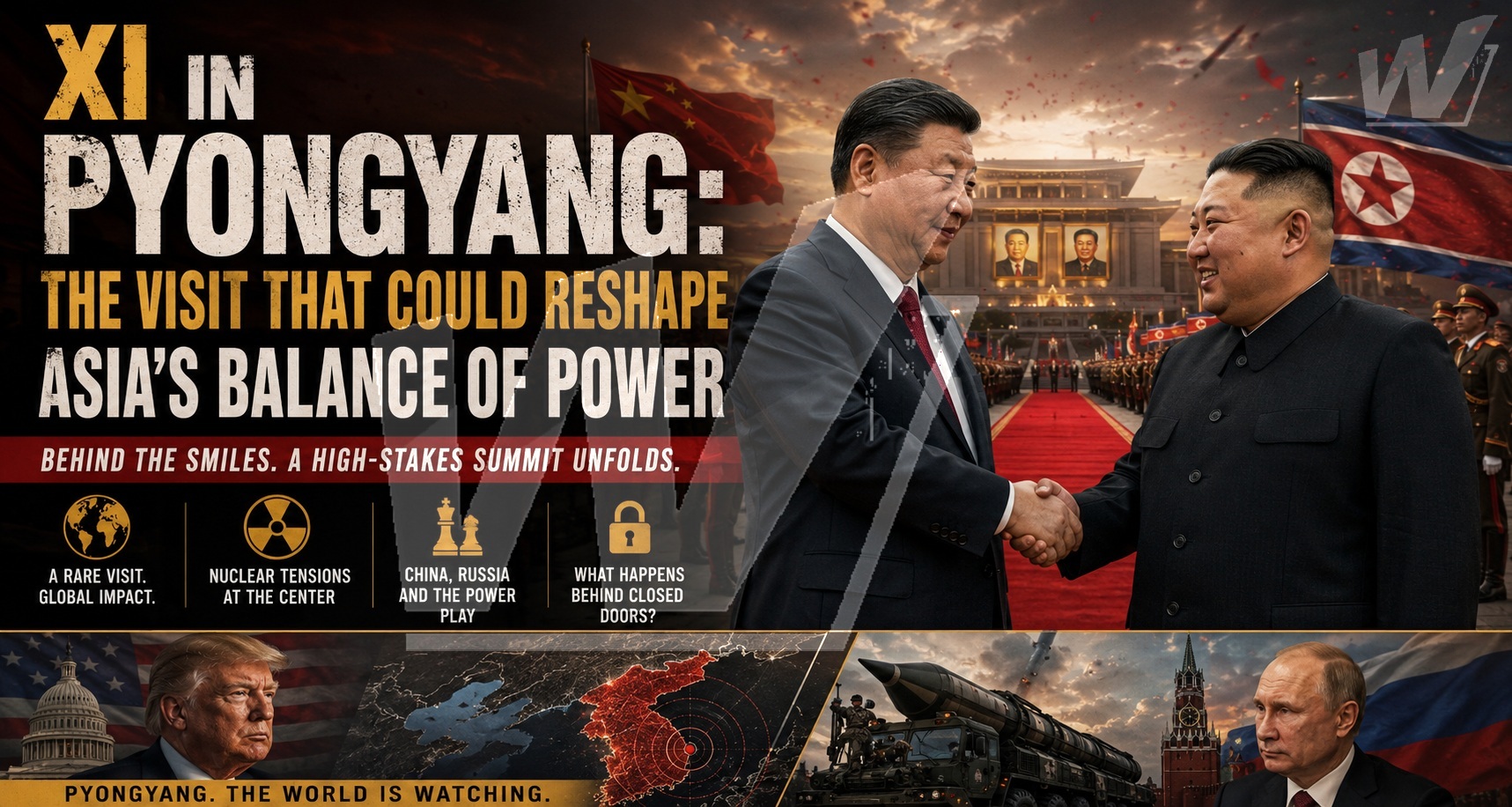
Behind the Smiles, a High-Stakes Summit Unfolds
As red carpets unfurled across Pyongyang and military honor guards stood motionless beneath the summer sky, the world watched a scene that has become increasingly rare in modern diplomacy.
Chinese President Xi Jinping stepped onto North Korean soil on Monday for his first visit to the isolated state in seven years, greeted personally by Kim Jong Un and First Lady Ri Sol Ju in a carefully choreographed display of friendship and strategic unity.
To the casual observer, it appeared to be a ceremonial reunion between two neighboring allies.
To diplomats, intelligence analysts, and world leaders, it looked like something far more consequential.
Behind the handshakes, flowers, and smiling photographs lies a meeting that could redefine the balance of power across Northeast Asia at a moment when tensions between major powers are reaching levels not seen in decades.
And perhaps most intriguingly, neither Beijing nor Pyongyang has revealed exactly what is being discussed behind closed doors.
That silence is fueling speculation around the globe.
Why Now?
Xi’s arrival comes at a remarkably sensitive moment in international affairs.
Only weeks ago, the Chinese leader hosted both Russian President Vladimir Putin and U.S. President Donald Trump in Beijing in separate high-profile meetings.
Now, Xi has turned his attention to North Korea.
The timing is impossible to ignore.
China finds itself navigating growing strategic competition with Washington while simultaneously deepening its partnership with Moscow. North Korea, meanwhile, has become increasingly dependent on Russia since the outbreak of the Ukraine war, supplying troops, artillery shells, and weapons in exchange for economic and military assistance.
For years, analysts questioned whether Beijing’s influence over Pyongyang was fading.
This visit may be Xi’s answer.
By appearing alongside Kim Jong Un in Pyongyang, the Chinese leader is sending a message not only to North Korea but also to Washington, Moscow, Seoul, and Tokyo:
China remains the indispensable power on the Korean Peninsula.
The Silent Contest Between Beijing and Moscow
One of the most significant developments in recent years has been North Korea’s rapid expansion of ties with Russia.
Since Kim’s meetings with Putin, cooperation between the two countries has intensified dramatically.
Weapons shipments, military technology exchanges, and political coordination have transformed what was once a secondary relationship into one of Pyongyang’s most important strategic partnerships.
That evolution has inevitably raised questions in Beijing.
For decades, China has been North Korea’s primary economic lifeline, largest trading partner, and most important diplomatic protector.
The prospect of Russia becoming Pyongyang’s dominant partner is not a scenario Chinese strategists welcome.
Xi’s visit appears designed, at least in part, to remind Kim that China’s support remains irreplaceable.
Experts expect discussions to include expanded economic cooperation, increased Chinese tourism, food assistance, fertilizer shipments, and potentially new joint economic projects aimed at revitalizing North Korea’s struggling economy.
Such measures would reinforce Beijing’s influence while reducing Pyongyang’s dependence on Moscow.
The Nuclear Question Looms Over Every Conversation
Yet the most pressing issue remains North Korea’s expanding nuclear arsenal.
Just days before Xi’s arrival, Kim Jong Un unveiled a new facility linked to nuclear weapons production and pledged to accelerate the growth of the country’s strategic forces.
South Korean intelligence assessments suggest North Korea may now be producing enough fissile material annually for between ten and twenty nuclear weapons.
Meanwhile, Pyongyang continues to advance its intercontinental ballistic missile capabilities and has recently accelerated efforts to build a nuclear-armed navy.
Kim’s position has become increasingly clear.
North Korea no longer seeks negotiations aimed at denuclearization.
Instead, it seeks recognition as a permanent nuclear weapons state.
This creates a delicate challenge for China.
Officially, Beijing has long supported the denuclearization of the Korean Peninsula.
In practice, however, Chinese officials have increasingly avoided public discussions of the issue, focusing instead on stability and regional security.
Many analysts believe Kim hopes Xi will quietly accept a reality that much of the world still refuses to acknowledge:
North Korea’s nuclear program is not going away.
Trump’s Shadow Over Pyongyang
The summit also carries important implications for U.S.-China relations.
President Donald Trump has repeatedly expressed interest in reviving diplomacy with Kim Jong Un.
Their historic meetings between 2018 and 2019 produced dramatic images but ultimately failed to deliver a lasting agreement.
Since then, North Korea has expanded rather than reduced its nuclear capabilities.
If Xi can demonstrate significant influence over Kim, he gains valuable leverage in future negotiations with Washington.
For Beijing, North Korea remains one of the few strategic issues where China possesses influence that the United States cannot easily replicate.
Every conversation Xi has with Kim may therefore echo far beyond Pyongyang, potentially shaping future discussions in Washington, Beijing, and even at the United Nations Security Council.
The Message Hidden in Xi’s Words
Before arriving in North Korea, Xi published an article in the country’s state media emphasizing “strategic cooperation” and opposition to what he described as “hegemonism and coercive politics.”
The language was widely interpreted as a reference to the United States and its allies.
Though diplomatic in tone, the message reflected a broader trend visible across global politics.
China, Russia, North Korea, and several other nations increasingly portray themselves as advocates of a multipolar world order challenging decades of Western dominance.
Pyongyang eagerly embraces that narrative.
For Kim Jong Un, closer alignment with China offers not only economic benefits but also political legitimacy at a time when international sanctions continue to isolate his government.
What We Still Don’t Know
Perhaps the most fascinating aspect of Xi’s visit is how little information has emerged from the summit itself.
State media in both countries have released images of welcoming ceremonies, smiling leaders, and carefully scripted statements.
But details remain scarce.
No official agenda has been published.
No major agreements have yet been announced.
No substantive readouts from the private discussions have been released.
That absence of information is unusual even by the standards of Chinese and North Korean diplomacy.
It suggests that the most important conversations may be taking place far from cameras and microphones.
Questions remain unanswered:
Will China provide substantial new economic assistance?
Will Kim offer assurances regarding his relationship with Russia?
Will Beijing soften its position on North Korea’s nuclear ambitions?
And most importantly, are Xi and Kim preparing a coordinated strategy for a rapidly changing geopolitical landscape?
A Meeting the World Cannot Ignore
As night falls over Pyongyang and negotiations continue behind closed doors, one reality is becoming increasingly clear.
This is not merely a ceremonial state visit.
It is a summit taking place at the intersection of nearly every major geopolitical fault line of our era: the U.S.-China rivalry, the war in Ukraine, North Korea’s nuclear ambitions, Russia’s growing influence, and the struggle for leadership in Asia.
The images broadcast today may show friendship and celebration.
The real story, however, is unfolding beyond public view.
And when the doors finally open and the details emerge, the consequences could extend far beyond the Korean Peninsula.
For now, the world waits.
Watching.
And wondering what Xi Jinping and Kim Jong Un are deciding behind those closed doors.