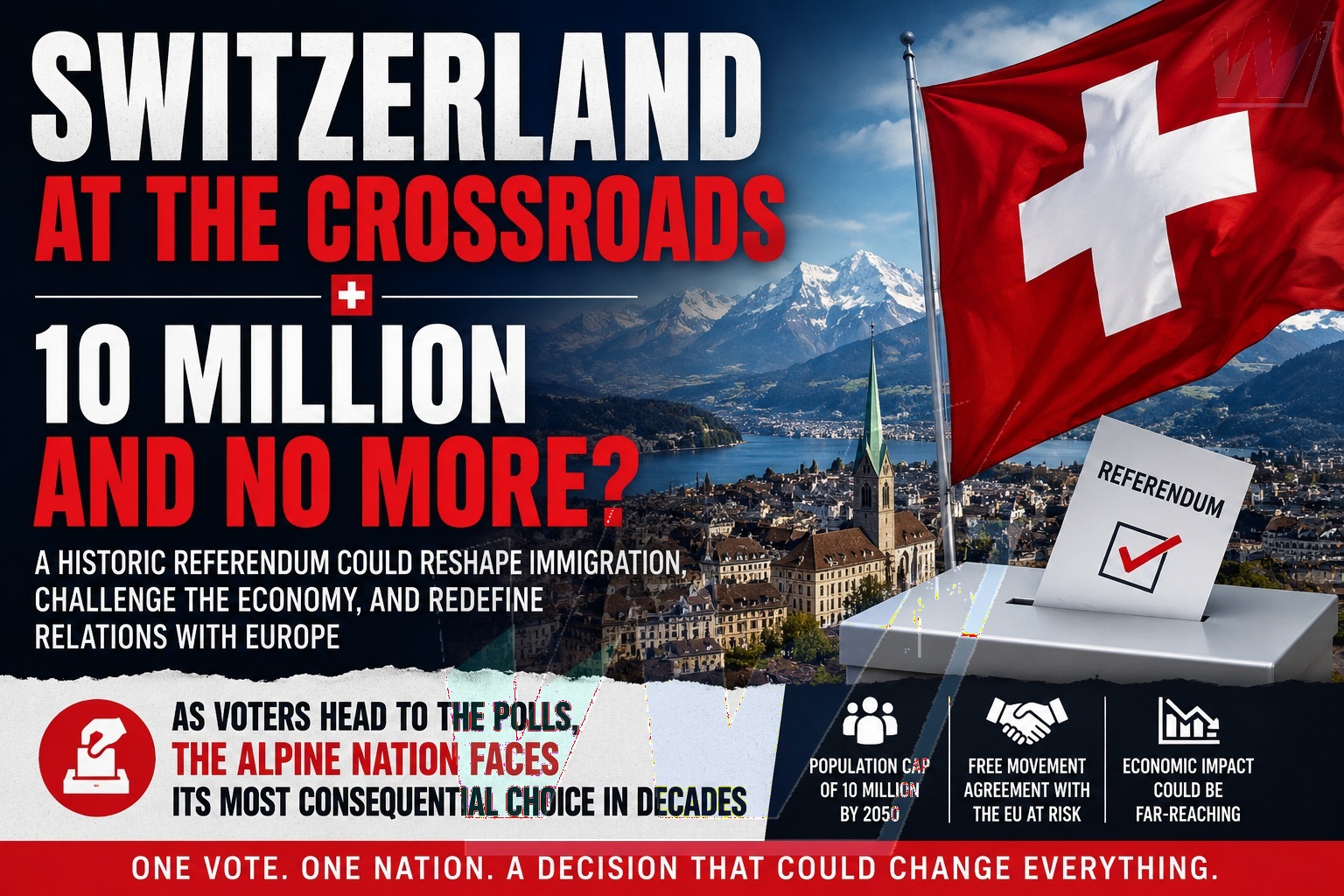
As Voters Decide on a 10-Million Population Cap, Europe Watches Closely
BERN — In a country renowned for stability, precision, and political consensus, an extraordinary question has reached the ballot box:
How many people is too many?
On Sunday, millions of Swiss voters headed to polling stations in one of the most consequential referendums in modern Swiss history—a vote that could reshape immigration policy, challenge economic assumptions, and potentially alter Switzerland’s relationship with the European Union for decades to come.
The proposal, known as the “Sustainability Initiative,” seeks to enshrine a population ceiling of 10 million people in the Swiss constitution by 2050. At first glance, the figure may appear symbolic. Yet behind that number lies a fierce national debate about identity, prosperity, sovereignty, and the future of one of Europe’s wealthiest nations.
As voting began, tension rippled through political circles, business headquarters, and European capitals alike.
The outcome could send shockwaves far beyond Switzerland’s alpine borders.
The Numbers Behind the Battle
Switzerland’s population currently stands at roughly 9.1 million people. Government projections suggest that, under current trends, the country could surpass the 10-million mark sometime in the early 2040s. Much of that growth has been fueled by immigration, particularly from European Union countries whose citizens enjoy freedom of movement under long-standing agreements with Bern.
Supporters of the initiative argue that the country is approaching a breaking point.
They point to rising housing costs, crowded trains, strained infrastructure, pressure on public services, and concerns about preserving Switzerland’s environment and quality of life. Across towns and cities, many voters say they feel the effects of rapid growth in their daily lives.
For them, the referendum is not merely about immigration.
It is about control.
“We cannot continue growing indefinitely,” has become a central message of campaigners who believe Switzerland must set limits before demographic expansion outpaces the nation’s capacity to absorb it.
A Vote Echoing Across Europe
The referendum arrives amid a broader political shift unfolding across Europe.
From the Netherlands to Italy, from Germany to France, immigration has emerged as one of the defining political issues of the decade. Concerns over housing shortages, living costs, security, and economic uncertainty have fueled support for parties advocating stricter border controls and reduced migration.
In Switzerland, the campaign has been led by the right-wing Swiss People’s Party (SVP), which has long argued that unchecked immigration threatens the country’s long-term sustainability. The party describes the initiative as a necessary safeguard against overcrowding and overdevelopment.
Critics, however, see something far more dangerous.
Many have compared the referendum to Britain’s Brexit vote—a decision that could unleash consequences extending well beyond its original objectives.
The Economic Stakes
Business leaders, economists, and government officials have mounted an unusually united campaign against the proposal.
Their warning is stark: Switzerland’s prosperity depends heavily on foreign labor.
From hospitals and nursing homes to pharmaceutical giants, financial institutions, construction firms, and technology companies, entire sectors rely on workers from neighboring European countries. An aging population and low birth rates have made that dependence increasingly critical.
Should the initiative pass, restrictions would begin once the population reaches 9.5 million. If the country ultimately crosses the 10-million threshold, authorities could be forced to terminate agreements guaranteeing the free movement of people with the European Union. Such a step could trigger broader disputes affecting trade and economic cooperation.
For a nation whose economy is deeply integrated with European markets, the implications could be profound.
Business groups warn that companies planning investments, expansions, and hiring strategies could face years of uncertainty. Some fear Switzerland’s reputation as a magnet for global talent could suffer a lasting blow.
Europe Holds Its Breath
The timing could hardly be more delicate.
Switzerland recently concluded agreements aimed at strengthening economic ties with the European Union after years of complex negotiations. A population cap that undermines freedom of movement could place those achievements at risk and reopen political battles many believed had been settled.
European officials have largely avoided direct intervention, but diplomats across the continent are watching the vote closely.
The referendum is increasingly viewed as a test case for how far anti-immigration sentiment can translate into concrete constitutional change in one of Europe’s most prosperous democracies.
A Divided Nation
Recent polls suggest the race is exceptionally close.
Public opinion has shifted repeatedly throughout the campaign. Early surveys indicated the initiative had a realistic chance of passing. More recent polling suggested momentum had moved toward rejection, though analysts caution that Swiss referendums have a long history of producing surprises.
The memory of a 2014 vote to curb immigration still looms large. At that time, voters narrowly approved restrictions despite expectations that the proposal would fail. Although the measure was later softened during implementation, it demonstrated the power of immigration concerns in Swiss politics.
That precedent has left both supporters and opponents wary of predictions.
The Verdict Awaits
As ballot boxes close and officials begin counting votes, Switzerland stands before a defining moment.
The referendum is about more than a numerical limit.
It is a confrontation between competing visions of the country’s future: one seeking tighter control overgrowth and immigration, the other warning that openness remains essential to prosperity and international influence.
By the end of the day, voters may decide not only how many people Switzerland should accommodate—but also what kind of nation it wants to become.
Across Europe, governments, investors, and policymakers are waiting for the answer.
And in the quiet mountain republic at the heart of the continent, history may be about to take a decisive turn.