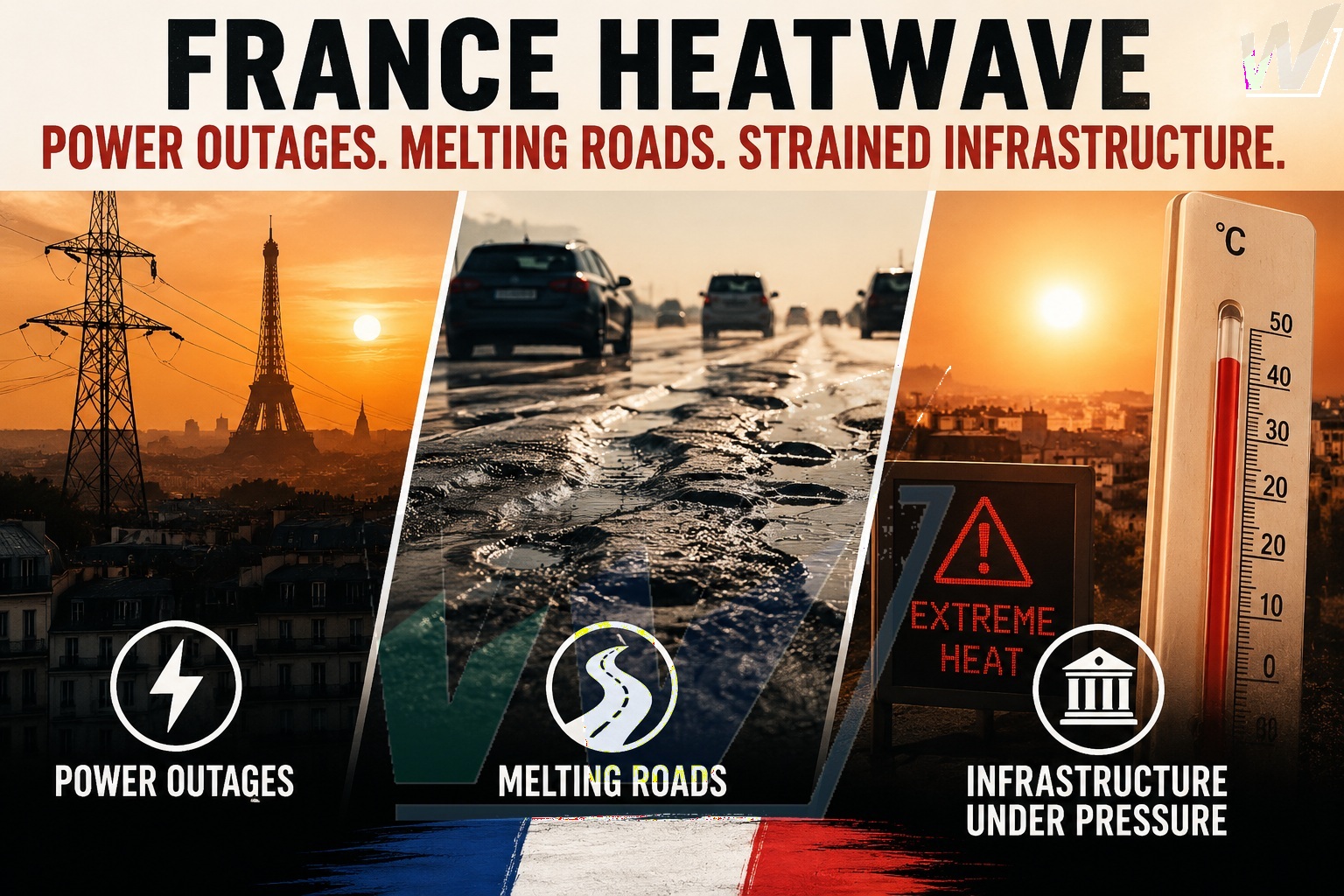
France’s Infrastructure Pushes to the Edge as Heatwave Turns Cities into Pressure Cookers
PARIS — The asphalt shimmered first. Then it softened.
By midday, highways across parts of France began to behave less like infrastructure and more like something temporary bending under a sun that refused to relent. In neighborhoods already gasping under record temperatures, the country’s systems started to fail one by one: electricity, transport, and public safety.
What is unfolding is not just a heatwave. It is a stress test on a modern nation built for a cooler climate.
Across Western Europe, an “Omega block” weather pattern has locked in extreme heat, driving temperatures above 40°C in multiple French regions and pushing the national grid to its breaking point. Hospitals have been overwhelmed, schools closed, and emergency services have been pushed into crisis mode.
But the most visible cracks are in the infrastructure itself.
A Grid Under Siege
In northern and western France, power systems have been buckling under record demand as millions switch on fans and air conditioning simultaneously. Transformers overheated. Substations failed. Entire districts were plunged into sudden darkness.
In one of the most severe episodes, transformer failures in Brittany alone left tens of thousands, reports estimate around 70,000 residents, without electricity.
Elsewhere, outages spread in waves, affecting homes, traffic systems, and essential services. According to multiple reports, more than 100,000 people across France were left temporarily without power as the grid struggled to balance soaring demand with heat-reduced capacity.
The cause is not just consumption. It is collapsing under physics.
Nuclear reactors, a backbone of France’s energy system, were forced to reduce output as river waters used for cooling reached dangerous temperatures. Environmental safeguards required shutdowns or throttling at several sites, tightening supply at the exact moment demand peaked.
Electricity that once flowed steadily across borders also weakened, turning France from exporter to constrained supplier in a matter of days.
Roads That Begin to Give Way
On the ground, the effects are brutally visible.
Highways shimmered and warped under extreme heat. Rail systems experienced disruptions as metal expanded beyond safe tolerances, contributing to delays and emergency shutdowns in several areas.
In some regions, drivers reported asphalt softening under tires. Emergency crews warned of localized road deformation, especially on older surfaces not designed for sustained extreme heat. While not a total structural collapse, the phenomenon has become an increasingly familiar symptom of Europe’s warming summers.
What was once considered rare, roads reacting visibly to temperature, is now part of a recurring pattern of infrastructure strain.
A Country Operating on Emergency Mode
Paris, meanwhile, has taken unusual public health measures, restricting alcohol sales during peak heat hours to reduce strain on emergency services already flooded with heat-related incidents. Hospitals report rising admissions for dehydration, cardiac stress, and heat exhaustion.
Transport networks have slowed. Schools have closed or shortened hours. Public institutions, from museums to municipal offices, are operating under emergency heat protocols.
Even daily life has been reorganized around survival.
The Quiet Warning Behind the Crisis
Meteorologists say this is not an isolated event, but part of a widening pattern of extreme heat waves across Europe driven by persistent atmospheric blocking systems and long-term warming trends.
For engineers and policymakers, the message is becoming harder to ignore infrastructure built for the climate of the past is now operating in a climate that no longer exists.
And as night falls over France, the country’s systems continue to hum, flicker, and strain—holding, for now, against a heat that shows no sign of releasing its grip.